I Thought I Was Doing My Children A Favor. Instead, Someone Was Using Me To Drive Them Apart.
I Thought I Was Doing My Children A Favor. Instead, Someone Was Using Me To Drive Them Apart.
The Year of Quiet Peace
My husband and I were married for forty-three years, and when he passed, I thought the hardest part would be learning how to be alone. I was wrong — the hardest part was the paperwork. The decisions. The phone calls to attorneys and banks while your hands are still shaking from grief. But we had talked about all of it, he and I, long before it became necessary. We had a plan. Sell the house, divide everything equally among our three children — Tyler, Melissa, and Brian — and make sure no one could ever say I played favorites. That mattered to me more than I can explain. I had watched other families tear themselves apart over estates, and I was not going to let that happen to mine. So I followed the plan exactly. Every dollar accounted for, every transfer documented, every child receiving the same amount. Robert Chen, our family attorney, handled the paperwork, and I sat at that table and signed my name until my wrist ached. By the time it was finished, nearly a year had passed since the funeral. I had moved into a smaller place, planted a little garden, started sleeping through the night again. My children called regularly. Holidays felt tender but manageable. I told myself we had come through it with our dignity intact, all four of us. Sitting in my kitchen on an ordinary Tuesday evening, the late sun coming through the window, I felt something I hadn't expected to feel so soon — a quiet, settled sense that I had done right by all three of them.
 Image by RM AI
Tyler's Impossible Question
Tyler called on a Wednesday evening, which wasn't unusual. He checked in regularly, always had. I was in the middle of making tea when my phone buzzed on the counter, and I picked it up expecting the usual — how are you feeling, Mom, did you eat today. Instead, after a few minutes of careful small talk, he went quiet for a moment and then asked me something I didn't understand at first. He asked why I had given Melissa an extra two hundred thousand dollars. I actually laughed. Not a big laugh — more like the sound you make when someone says something so far outside reality that your brain doesn't know what else to do with it. I told him that was impossible, that every child had received exactly the same amount, that I had the records to prove it. Tyler didn't laugh back. That's what I remember most clearly — the silence on his end of the line where a laugh should have been. His voice stayed careful, measured, the way it gets when he's worried about something but doesn't want to alarm me. He said he had documentation. He said he had found something while going through his own estate records and that he needed me to look at it. I told him again that there had to be a mistake, that I had never authorized any such thing. He asked if he could come over in the morning. I said yes, of course, still half-convinced we'd clear it up in five minutes. Then he said, quietly, "Mom, I think someone gave Melissa two hundred thousand dollars in your name."
 Image by RM AI
The Folder
Tyler arrived at eight-thirty the next morning with a manila folder tucked under his arm and a look on his face I hadn't seen since his father's funeral. He didn't hug me at the door the way he usually does — he just came in, set the folder on the kitchen table, and sat down. I poured us both coffee and sat across from him, and he spread the papers out one by one like he was laying out evidence he wished he didn't have. The documents looked official. That was the first thing that struck me. They weren't blurry printouts or something that looked cobbled together — they had the weight and formatting of real estate paperwork, the kind Robert's office produces. There was a transfer record dated several weeks after the estate settlement had closed, listing Melissa's name and an amount of two hundred thousand dollars. There were account numbers I didn't recognize. There were dates that placed the transaction squarely after everything had already been finalized. Tyler watched me read without saying much. He told me he'd found the papers while organizing his own files, that he hadn't wanted to believe what he was looking at, that he'd spent two days trying to find an innocent explanation before he called me. He seemed more worried than angry, and somehow that made it worse. I kept telling him I had never authorized this, that I had no memory of any second transfer, that something had to be wrong with the documents themselves. He nodded slowly, like he wanted to believe me. I picked up the folder and held it, turning it over in my hands, and the weight of it felt heavier than paper had any right to feel.
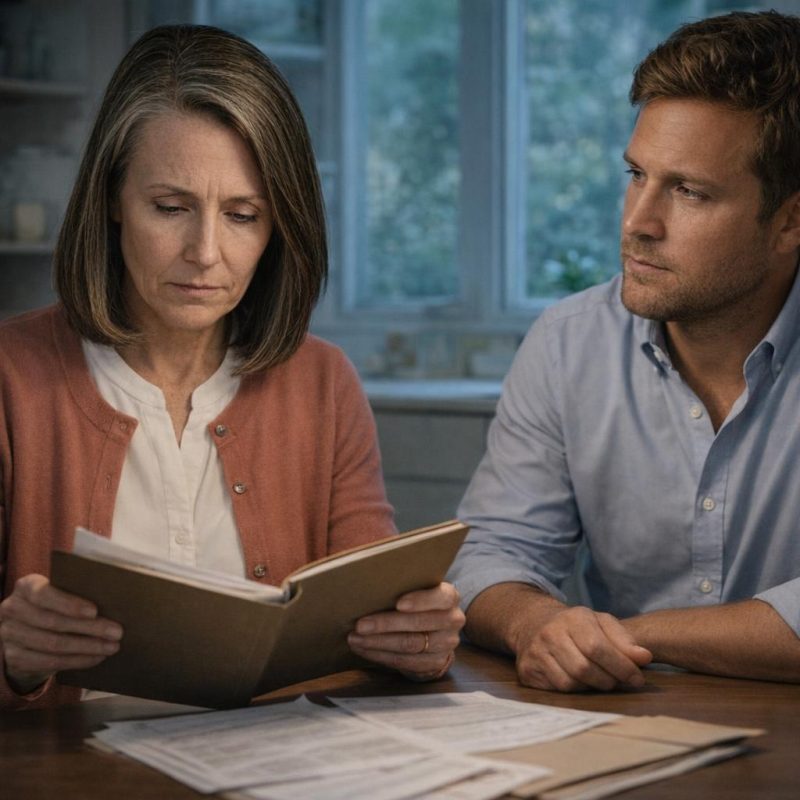 Image by RM AI
The Signature That Looked Like Mine
After Tyler left, I sat at the kitchen table for a long time with those documents spread out in front of me. I told myself I was going to find the error — a wrong date, a transposed account number, something that would make the whole thing collapse into a simple clerical mistake. I went through every page slowly, the way I used to proofread my husband's business letters before he sent them. The formatting was exact. The account numbers were formatted the way Robert's office formats them. The notarization stamps looked official, with a seal and a commission number and everything placed exactly where it should be. Each page was signed. The same signature, over and over, on every authorization line. I leaned in closer each time, adjusting my glasses, telling myself I would find the flaw. The handwriting was careful and consistent. The loops, the slant, the way the letters connected — it was all familiar in a way that made my stomach tighten. I called Robert's office before noon and asked his assistant to fit me in that afternoon. I told her it was urgent. She put me through to Robert directly, and I explained as calmly as I could that I had documents in front of me that I needed him to look at immediately. He said he'd clear time at two o'clock. I gathered everything back into the folder and set it on the counter, and then I turned to the last page one more time — and there was my signature at the bottom, looking back at me like it had always belonged there.
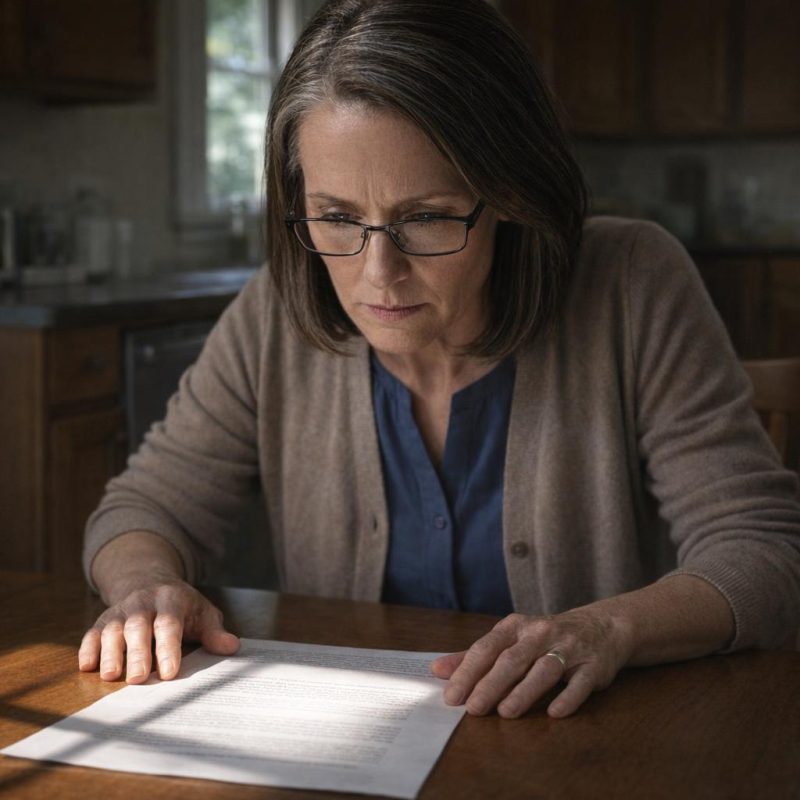 Image by RM AI
The Tensions I Hadn't Named
I had a few hours before my appointment with Robert, and I couldn't sit still. I kept moving through the apartment — kitchen to living room, living room to kitchen — and somewhere in that restless loop, my mind started pulling up memories I hadn't examined closely before. Thanksgiving had felt off. Brian had been quieter than usual, answering questions in short sentences, leaving before dessert with an excuse about an early morning. I had chalked it up to grief — we were all still finding our footing without his father at the table. Then there was Melissa's birthday dinner in the spring. Brian had left early from that too, and when I hugged him goodbye he'd been stiff in a way I couldn't quite name. Melissa had smiled through the whole evening, but her smile had that careful quality, the kind that takes effort to hold. Tyler had asked me a question at that dinner — something about whether I'd kept copies of all the estate paperwork — and I'd thought it was just his practical nature showing. Now I turned that question over differently. The conversations I'd had with each of them over the past several months had felt slightly heavier than they should, like everyone was carrying something they hadn't told me about. I had attributed all of it to grief, to the ordinary weight of loss settling differently in each of them. Standing in my kitchen now, I wasn't so sure. The pattern of Brian's absences, the careful smiles, the questions about paperwork — it all sat with me in a way I couldn't quite set down.
 Image by RM AI
Melissa's Frightened Voice
I called Melissa that afternoon, before I left for Robert's office. I wasn't sure what I was going to say — I just knew I needed to hear her voice before I walked into that meeting. She picked up on the second ring, cheerful and a little rushed, and I asked if she had a few minutes. She said of course. I told her as plainly as I could that Tyler had brought me documents showing a second transfer in her name, two hundred thousand dollars, dated after the estate had closed. There was a pause. Then she said, "What?" Not defensively — just genuinely confused, the way you sound when someone tells you something that doesn't fit any version of reality you're living in. I explained it again, more slowly. Her voice changed as I talked. The cheerfulness dropped away and something else came in underneath it — a tightness, a kind of controlled alarm. She said she had never received any extra money, that every dollar she had used for her house purchase had come from her own savings and a mortgage she'd qualified for on her own. She asked me what Tyler thought she had done. She asked if someone was trying to cause trouble between us. Then she asked, very quietly, if someone might be trying to hurt the family. I told her I didn't know yet, but that I was going to find out. After I hung up, I sat with the sound of her voice still in my ear — not the words, but the fear underneath them, real and unguarded in a way that settled into me like a stone.
 Image by RM AI
Gerald's Concern
I was back home from Robert's office and still turning everything over in my mind when Gerald called. He and my husband had been friends for more than thirty years — the kind of friendship built on shared business history and Sunday afternoon phone calls that went on too long. Gerald had been kind to me since the funeral, checking in every few weeks, never overstaying his welcome. His voice on the phone that evening was warm and unhurried, the way it always was. He said Tyler had mentioned there was some confusion around the estate, and he wanted me to know he was thinking of me. He said family misunderstandings had a way of feeling larger than they were, that grief had a long tail and sometimes it showed up sideways in the people you loved. I told him it was more complicated than a misunderstanding, without going into detail. He didn't press. He reminded me that he had helped my husband navigate business matters for years and that if I ever needed someone to sit down with financial documents and talk through what I was looking at, he was available. He said it gently, the way you offer help to someone who might be too proud to ask for it. I thanked him and meant it. After everything that day — the documents, Robert's careful face, Melissa's frightened voice — it was a relief to hear from someone who simply seemed to care. He told me to call anytime, day or night, that he meant it, and that I didn't have to go through any of this alone.
 Image by RM AI
The Attorney's Confusion
Robert's office had that particular quiet that law offices always have — thick carpet, closed doors, the sense that difficult conversations happen there regularly and the walls have learned not to react. He had the documents spread across his desk when I arrived, and he was already wearing his reading glasses, which meant he'd been at it for a while. I sat across from him and watched him work through the pages without speaking. He checked the formatting against something on his computer. He held the notarization stamps up to the light. He opened a drawer and pulled out a file from the original estate settlement and laid it alongside the new documents, comparing them side by side. He was quiet for a long time. Then he told me the formatting matched his firm's templates exactly — the margins, the font, the section headers, all of it. He said the signature looked convincing. He said the notary listed was a real person, someone his office had worked with on previous matters. He checked his own files twice, methodically, and confirmed there was no record of his firm preparing or processing this document. He said he couldn't explain it. He took his glasses off and set them on the desk and looked at me steadily, and I could see that his professional composure was doing real work in that moment. Then he picked up the document again, turned to the notarization page, and said the stamp and commission number appeared completely legitimate.
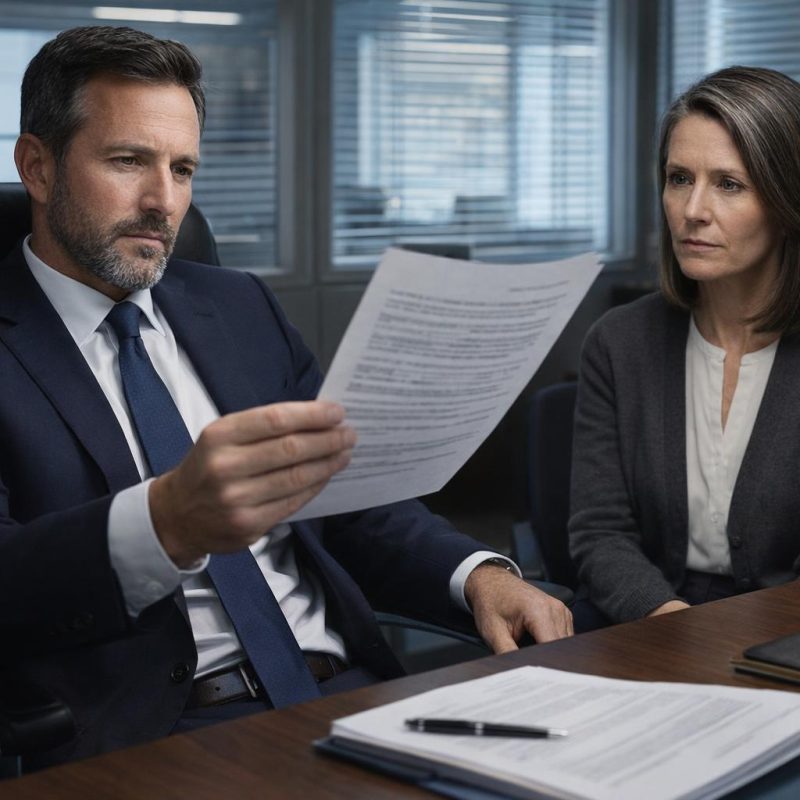 Image by RM AI
The Impossible Date
I got home from Robert's office and sat at the kitchen table for a long time before I could make myself move. The notarization date was printed right there on the document — three weeks after the estate settlement closed. I pulled out my wall calendar and found the week. Something shifted in my chest when I saw what I'd written in the little square. I'd been at my sister Carol's place in Phoenix that week. I remembered it clearly — we'd gone through old photos, eaten at her favorite diner twice, argued about whether to keep Mom's china. I started going through the accordion folder I keep in the hall closet, the one with travel records and receipts I never quite get around to throwing away. My hands were moving faster than my thoughts. I found the folder from that trip near the back, behind some old utility bills. I pulled everything out and spread it on the table. Hotel confirmation. Restaurant receipts with Phoenix addresses. And then, underneath all of it, the airline receipt — departure date printed in plain black ink, the same date listed on the notarization page.
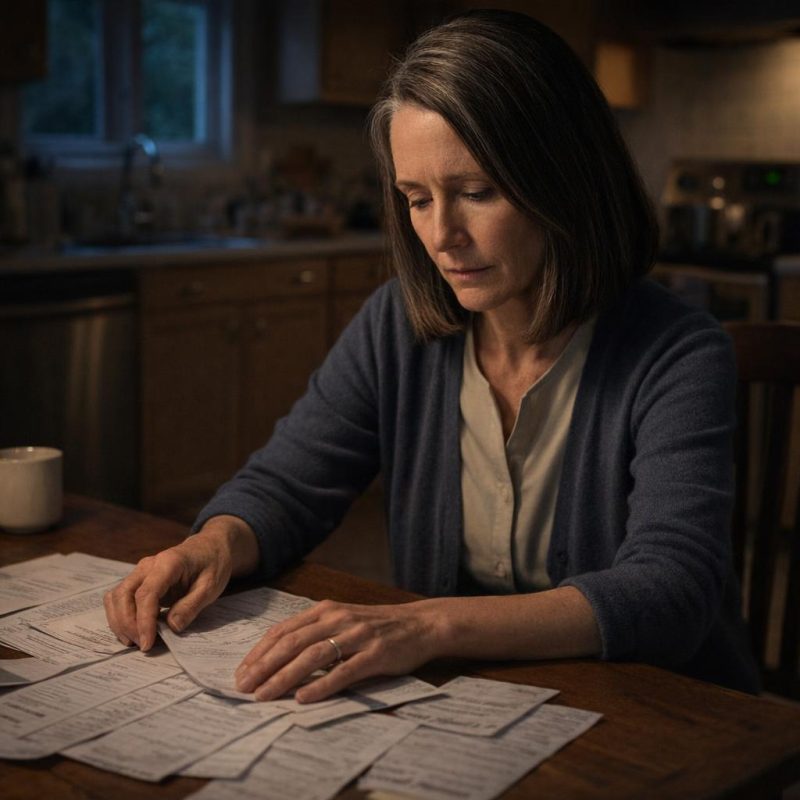 Image by RM AI
The Notary's Memory
Robert arranged a call with Patricia Woods the following afternoon. I sat at my kitchen table with a notepad in front of me, though I barely wrote anything down. Patricia was professional and unhurried. She pulled up her appointment records while we were on the phone — I could hear her clicking through something — and she confirmed the appointment without any hesitation. She said a woman had come in with the documents already prepared, that she'd reviewed them carefully before notarizing, the way she always did. She walked me through her standard process: she asked for photo identification, she compared the signature on the ID to the signature on the documents, she recorded the appointment in her log. Everything had been in order. I asked her to describe the woman, and she paused only briefly before answering. She said the woman had seemed a little nervous, but that wasn't unusual for people signing legal documents. She said there had been nothing that gave her pause. I told her, as calmly as I could manage, that I had been in another state that day. There was a long silence on the line. Patricia said she understood what I was telling her, but that she stood by her records. She wasn't defensive about it — just certain. That certainty, delivered in a quiet and even voice, settled over me like something heavy I couldn't put down.
 Image by RM AI
Building the Alibi
I called my sister Carol the morning after the call with Patricia. I explained as much as I could without going in circles, and Carol didn't hesitate for a second. She said she'd write out a statement, sign it, have it notarized if Robert needed that — whatever would help. I spent the rest of that day going through everything from the trip. I found the photos on my phone, timestamped and geotagged, showing Carol's backyard, her kitchen, the diner we'd gone to twice. I found the restaurant receipts in the accordion folder, both of them with Phoenix addresses and dates printed at the top. I pulled up my credit card statement online and printed the relevant pages — gas station, grocery run, the little bookshop Carol dragged me into. Every transaction placed me squarely in Arizona on the day that document was supposedly signed in front of Patricia Woods. I put it all in a new folder, organized by date, and set it on the table in front of me. Carol's statement. The flight receipt. The photos. The credit card pages. The restaurant receipts. Robert had said the next step would be looking into whether the notary's building had security cameras, and I understood why. The folder on the table proved where I had been. What it couldn't tell me was who had been somewhere else in my place.
 Image by RM AI
Meeting the Notary
Robert and I met Patricia at her office on a Thursday morning. She had her appointment log open on the desk before we even sat down, and she walked us through the entry with the same calm precision I'd heard on the phone. She described her standard process again, and then Robert asked her, gently, if she could describe the woman who had come in. Patricia looked at her notes, then looked up. She said the woman appeared to be in her late sixties. She said she'd been dressed neatly, conservatively. She said she'd seemed composed enough, though a little tense around the eyes. Robert asked about her hair. Patricia said it was gray — silver-gray, she said, the kind that goes all the way through, not streaked. Robert asked if she wore glasses. Patricia nodded and said yes, wire-rimmed ones, the kind that sit low on the nose. I sat very still in my chair. I wasn't sure what I'd been expecting to hear, but something about the specificity of it — the silver-gray hair, the wire-rimmed glasses sitting low on the nose — made the room feel smaller than it had a moment before.
 Image by RM AI
Brian's Accusation
I'd hoped a family dinner might give me a chance to explain what Robert and I had found — the alibi evidence, the call with Patricia, all of it. Brian arrived already wound tight, jaw set, barely making eye contact with Melissa when she came in. We got through the first part of the meal on small talk, but it didn't hold. Melissa mentioned she'd been looking at furniture for the new house, and Brian put his fork down. He asked, in a voice that was careful and flat, how she'd managed the down payment on a house like that on her salary. Melissa said she'd been saving for years and had a good mortgage rate, and her voice stayed steady even though I could see her hands tighten in her lap. Brian said he wasn't trying to start anything, and then he said the thing about the documents — that there were papers with Mom's signature on them that nobody could explain. Melissa said she didn't know anything about any documents. Tyler said Brian, come on, and Brian said he was just asking questions. I tried to explain the impersonation evidence, the airline receipt, Patricia's description, all of it, but the words came out too fast and nobody was really listening. Brian said he didn't know what to believe anymore. Melissa pushed back her chair and said she needed some air. Tyler looked at me across the table, and then the back door closed behind Melissa, and the room went quiet in a way that felt like something breaking rather than something resting.
 Image by RM AI
Tyler's Doubt
Tyler called me four days after the dinner. He apologized first, which was like him — he always apologized for things that weren't his fault. He said he'd been thinking about everything and he couldn't make the pieces fit. He said he trusted me, he wanted me to know that, but that the documents were real and the notary was real and he didn't understand how any of it was possible. I told him I didn't fully understand it either, not yet, but that the evidence of where I'd been that day was solid. He was quiet for a moment. He said Brian had stopped returning his calls, which I hadn't known. He said he was worried about Melissa, that she'd sounded brittle when he'd spoken to her. He asked me, carefully, whether I thought someone might be trying to cause problems for the whole family, not just for me. I said I thought that was possible. I said Robert was working on it. Tyler said he wanted to believe that everything would get sorted out, that he really did. But the way he said it — slowly, like each word cost him something — told me the wanting and the believing weren't quite the same thing for him anymore. The exhaustion in his voice when he said he just didn't know what was real sat with me long after we hung up.
 Image by RM AI
The Surveillance Request
I met with Robert midweek to talk through next steps. He'd already been in touch with Patricia about the building where her office was located, and he told me the building had a security camera system covering the main entrance and the elevator lobby. He explained that obtaining the footage would require a formal written request, and that he'd need to move quickly because most systems only retained footage for thirty to sixty days. The notarization had happened about five weeks earlier, which meant we were close to the edge of whatever retention window the building used. He drafted the request that afternoon while I sat across from him, and he walked me through what he was including — the date, the approximate time of the appointment from Patricia's log, the legal basis for the request. He submitted it to the building management company before I left his office. I went home and tried not to check my email every twenty minutes, which I mostly failed at. Three days later, Robert called. Building management had reviewed the request and confirmed that footage from that date was still in their system. They would provide it within the week. I sat down when he told me that.
 Image by RM AI
The Waiting
The week that followed was the longest I could remember in years. I'd told myself I wouldn't call Brian or Melissa — not until I had something concrete to show them, something that couldn't be argued with — and I kept to that, though it cost me. I reviewed the alibi folder more times than made sense. I went through the credit card statements again. I tried to imagine, carefully and without letting my thoughts run too far ahead, what the footage might show. Some nights I slept badly and lay in the dark turning things over. I kept the calendar on the kitchen wall, the one I use for appointments and reminders, and each morning I crossed off the previous day with a red marker. Robert had said the footage would arrive by Friday. I'd circled the date when we spoke, pressing the marker down harder than I needed to. Every morning I crossed off another day and looked at that red circle, and waited.
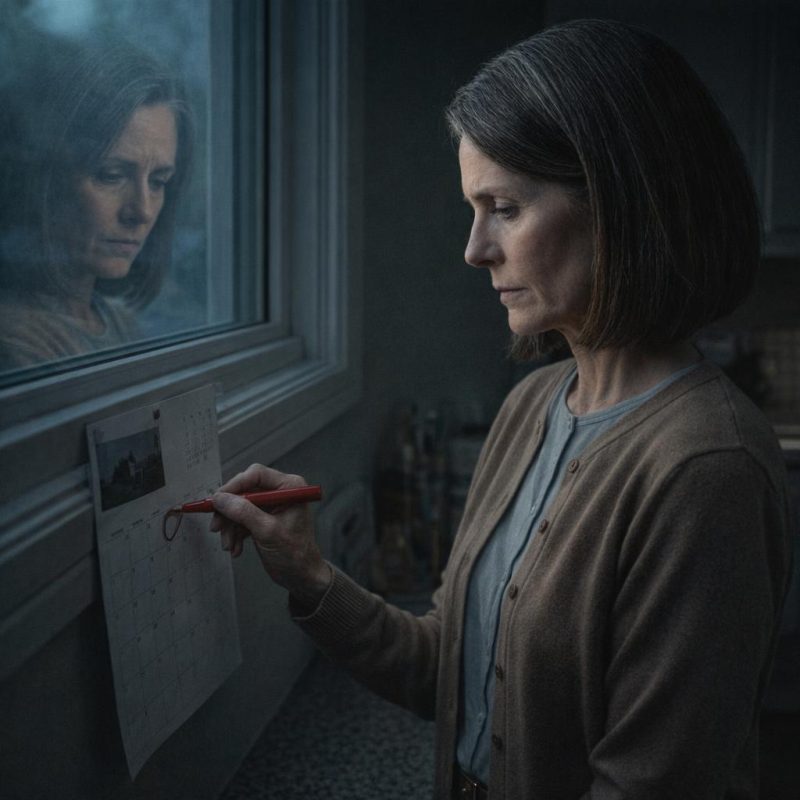 Image by RM AI
The Woman in the Video
Robert called on Thursday morning, a day earlier than I'd expected, and said the footage had come through. I was in my coat before I'd even hung up the phone. His office is about twenty minutes from my apartment, but I made it in fifteen. He had it pulled up on his computer when I walked in — a grainy but watchable clip from the building's exterior camera, timestamped the morning of the notary appointment. We watched it together without saying much at first. A woman came through the front entrance at 9:47 a.m. She moved at a measured pace, unhurried, like someone who knew exactly where she was going. Gray hair, cut short and neat. Wire-rimmed glasses. A dark cardigan over slacks, a purse held in the crook of her left arm. I felt something cold move through me. I told Robert, quietly, that I had not been there that morning. He nodded and said he believed me. We watched it again. The woman crossed the lobby and turned down the hallway toward the notary's suite. The camera angle was awkward, the resolution just soft enough that you couldn't make out her face clearly. But the hair, the glasses, the way she carried herself — it was like watching a photograph of me that I had never posed for. Robert leaned forward and clicked to the next segment, where the woman paused at the hallway's end and turned toward the camera.
 Image by RM AI
Studying the Impersonator
Robert played it back in slow motion, and we went through it frame by frame. I pulled my chair closer to the screen and made myself look carefully, the way you look at something you don't want to see but know you have to. The woman's gait was steady and deliberate — not rushed, not hesitant. She kept her chin angled slightly downward, just enough to stay out of the clearest camera sightlines, but not so much that it looked unnatural. Her glasses were the same thin wire frames I'd worn for years. The purse was a dark burgundy shoulder bag, structured, the kind I'd carried myself until the strap broke two winters ago. Robert pointed out that she approached from the side of the lobby with the fewest cameras, and that when she paused near the notary's door, she turned her face away from the overhead angle before pushing it open. He wrote all of it down in his yellow legal pad — the clothing, the hair, the route through the building, the camera awareness. I told him the hair color was close, maybe not exact, but close enough that you wouldn't question it at a glance. He agreed. He said whoever had done this had paid attention to details that most people wouldn't think to notice. I sat with that for a moment. The glasses, the purse, the posture, the careful route through the building — none of it had been accidental.
 Image by RM AI
Sharing the Truth
I called all three of them that evening and asked them to come to my apartment the following afternoon. I didn't explain much on the phone — just said I had something they needed to see. Tyler arrived first, then Brian, then Melissa, who came in looking like she hadn't slept well in days. I had Robert's copy of the footage loaded on my laptop, and I sat them all down at the kitchen table and played it without a preamble. Nobody spoke while it ran. When it finished, Melissa put both hands flat on the table and let out a long, slow breath. Brian leaned back in his chair and rubbed his face. Tyler watched the screen even after the clip had ended, like he was still processing what he'd seen. I told them the timestamp matched the appointment time exactly, and that I had not been in that building that morning. Brian looked at me and said he was sorry — not a long speech, just those three words, but he meant them, and I could hear it. Melissa said she'd been trying to tell him for months. There was an edge in her voice, but she didn't push it further, and I was grateful for that. Tyler asked who the woman was. I told him I didn't know yet. He asked why someone would go to that kind of trouble. None of us had an answer. The relief in the room was real, but it sat alongside something else — a confusion that hadn't lifted, and questions none of us knew how to finish asking.
 Image by RM AI
The Bigger Question
We stayed at the kitchen table for another hour, drinking coffee that went cold while we talked. Brian was the one who brought up the part that didn't make sense — he said, if someone forged documents to make it look like Melissa had received two hundred thousand dollars, where did the money actually go? Because Melissa hadn't gotten it. She said so plainly, and she'd already told us her bank records would show nothing. Tyler asked what the point was, then. If the forgery wasn't about stealing from Melissa, and Melissa never saw a dollar of it, then what was it for? I said I didn't know. Brian wondered aloud whether someone had wanted to damage Melissa's reputation specifically — make her look like she'd taken more than her share. Melissa said that had certainly worked for a while, and there was a silence after that. I told them Robert was already working on tracing the account number listed in the forged transfer document, that we'd know more once he had those records. We agreed to stay in close contact and not let the silence between us stretch the way it had before. Tyler walked me to the kitchen to refill the coffee, and while we stood there he said it quietly, almost to himself — who benefits from tearing this family apart?
 Image by RM AI
The Account That Never Existed
Melissa came to Robert's office two days later with a manila folder thick enough that it made a solid sound when she set it on his desk. She'd printed everything — every bank statement from the six months surrounding the estate settlement, front and back, organized by date. Robert put on his reading glasses and went through them page by page while Melissa and I sat across from him. It took about forty minutes. He checked the deposits column on every sheet, cross-referencing the dates against the timeline in the forged document. There was nothing. No transfer of two hundred thousand dollars, no large deposit of any kind that wasn't already accounted for by her regular income or the documented savings she'd used toward her house. Robert asked about the down payment, and Melissa walked him through it — the savings account she'd built over eight years, the mortgage paperwork, the closing documents. He reviewed those too. When he finished, he set his glasses down and said the records looked complete and consistent. Melissa asked what account the forged document had actually referenced. Robert said he was working on that — he had the account number and had already contacted the bank. He said he'd have more information within the week. I looked at my daughter across that desk, at the folder she'd brought without being asked, at the careful way she'd organized every page, and I felt the last of any doubt I might have been carrying simply fall away. The column where a two-hundred-thousand-dollar deposit should have appeared was blank, page after page after page.
 Image by RM AI
Tracing the Ghost Account
Robert called me four days later, mid-morning, and asked if I could come in. His voice was even, the way it gets when he has something specific to tell you and wants to do it in person. I was there within the hour. He had a printed summary on his desk and walked me through it carefully. The account number listed in the forged transfer document was real — it had existed. The bank confirmed it had been opened approximately two weeks before the date on the forged document. Robert said no funds matching the described transfer had ever actually moved into it. I asked how long the account had been active. He looked at his notes and said it had been closed three days after the transfer date listed in the forgery. I sat with that for a moment. Someone had opened an account, put it in a document designed to look like proof of a transaction, and then closed the account again almost immediately. Robert said the bank required a formal legal request before they could release any information about who had opened or controlled it, and that he'd already begun preparing the paperwork. I asked him why someone would go to that trouble — open an account, use it in a forged document, then close it so quickly. He said it suggested the document was meant to be found, not acted on. I turned that over in my mind without landing anywhere. On Robert's printed summary, the account closure date sat three days after the forged transfer.
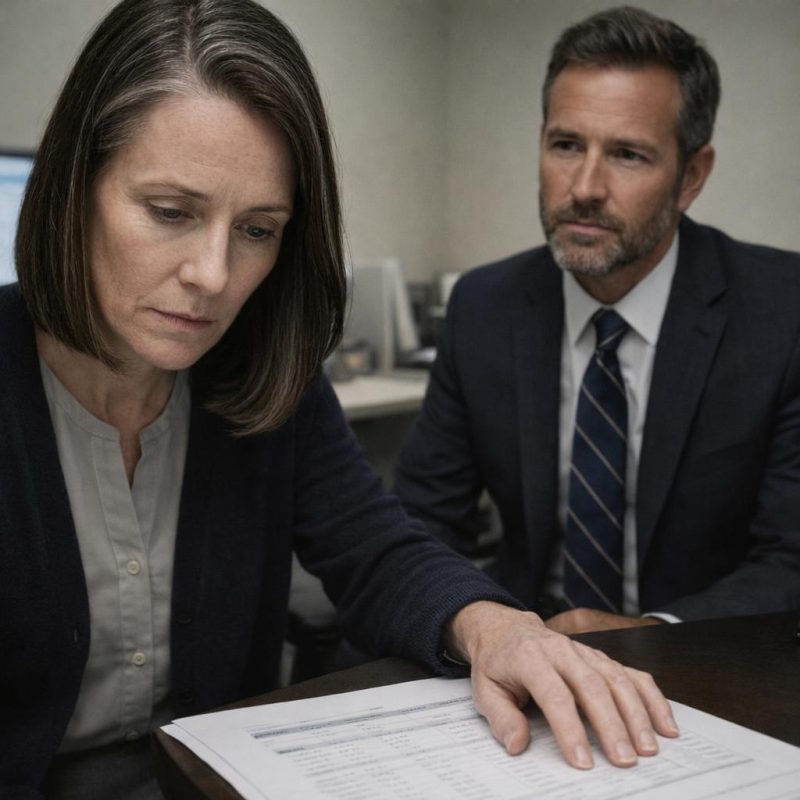 Image by RM AI
Waiting for Answers
The days that followed moved slowly. Robert had filed the legal requests, but these things take time — he'd told me that upfront, and I tried to hold onto it when the waiting felt heavy. I kept my children updated with short calls every few days, enough to let them know the process was still moving even when there was nothing new to report. I found myself going back to the timeline I'd written out on a yellow legal pad — the estate settlement date, the date the forged document was supposedly signed, the date the account opened, the date it closed. I'd look at those four dates and try to think of anyone who might have had reason to do this. I went through the people who had known about the settlement — the family, Robert, a few longtime friends. I made a list and looked at it and couldn't find a shape in it that made sense. I thought about whether this could have been random, some kind of opportunistic fraud targeting estates. But the details were too specific, too close — the physical resemblance, the right notary office, the right timeframe. Whoever had done this had known things that weren't public. I didn't have a name. I didn't have a motive I could follow to its end. I just had the list, and the timeline, and the quiet of my apartment in the evenings, and the weight of questions that still had no answers.
 Image by RM AI
Gerald's Offer
Gerald stopped by on a Wednesday afternoon, unannounced, the way he'd done occasionally over the years since my husband passed. He had a small paper bag from the bakery two blocks over — the kind my husband used to bring home on weekends — and he set it on the counter without making a thing of it. We sat at the kitchen table with coffee and he asked how I was holding up. I told him the investigation was still moving, that we were waiting on some bank records, that the children were doing better now that they'd seen the footage together. He listened without interrupting, which was something I'd always appreciated about him. When I finished, he leaned forward slightly and said he wanted me to know that if the legal fees started to add up, he had resources and he wasn't going to let me manage that alone. He said my husband would have done the same for him without a second thought, and that the offer stood for as long as it needed to. I told him we were managing, that Robert had been reasonable about the costs, but I thanked him. He said to call anytime, day or night, and he meant it — I could hear it in the way he said it, plain and without ceremony. After he left I sat for a while with the coffee going cool in my hands, thinking about how rare it was, at this point in life, to have a friend who showed up like that without being asked.
 Image by RM AI
The Business Connection
Robert called me on a Thursday morning and asked if I could come in that afternoon. He said the bank had come through with the account ownership documentation and he wanted to go over it with me in person. I drove over thinking we'd finally have a name, something concrete, something that would make the whole thing click into place. Robert had the papers spread across his desk when I arrived, and he walked me through them carefully, the way he always did — no rushing, no editorializing. The ghost account hadn't been opened under a person's name. It had been opened under a business entity. Robert pointed to the line on the document and let me read it myself. The entity name didn't mean anything to me at first. I asked him what kind of business it was, and he said it appeared to be connected to commercial property investments. That's when something shifted in my chest. I told him I thought I recognized the name — not because I'd worked with it, but because my husband had. He'd had a business partnership for years, commercial properties, and I'd seen that name on documents that came through the house. I'd never paid close attention to the details; that had always been my husband's domain. Robert asked if I had access to any of the old partnership records. I told him some files were in a storage unit, ones I hadn't touched since we cleared out my husband's study. Robert set his pen down and said the partnership connection might be worth following. I looked again at the document on his desk — the entity name printed there in plain black type, my husband's old partnership name on an account I never knew existed.
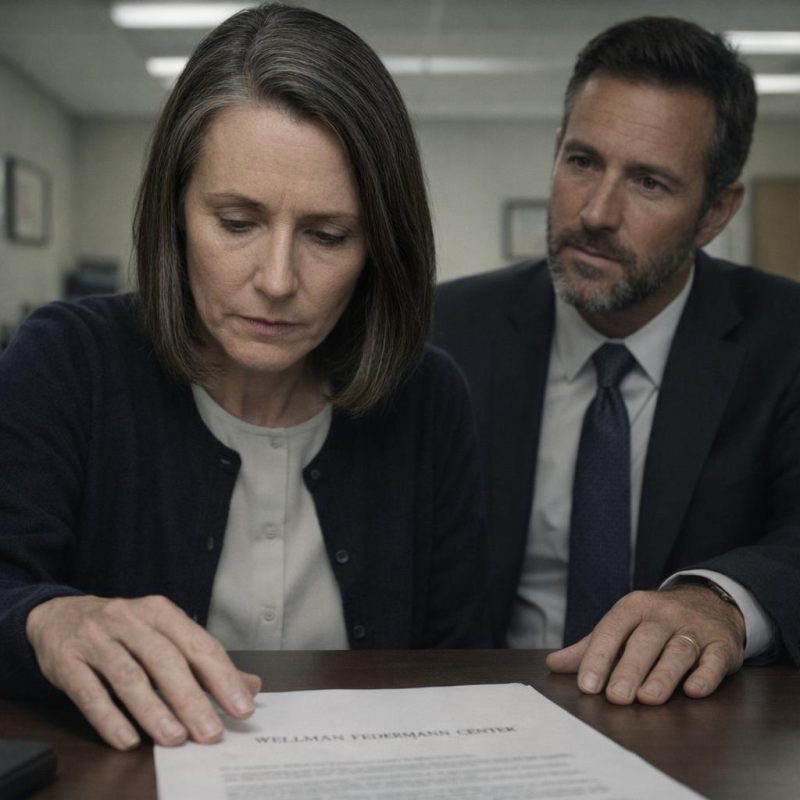 Image by RM AI
Remembering His Concerns
I drove home from Robert's office and sat in the kitchen for a long time without turning on any lights. The late afternoon came in through the window and I just let it go dim around me. I kept thinking about my husband in the months before he died — the way he'd started staying in his study past ten o'clock, which wasn't like him. He'd always been good about keeping work at work, or at least keeping it contained to reasonable hours. But that last stretch, maybe six months or so before his heart attack, something had shifted. I remembered asking him once if everything was all right, and he'd said yes, just some numbers he needed to sort through, nothing I needed to worry about. I'd believed him. He wasn't a man who dramatized things. I remembered another evening when I brought him tea and he was on the phone, voice low, and he held up one finger to let me know he'd be a minute. I set the tea down and left. I never asked who he'd been talking to. He'd mentioned at some point that he needed to sit down with someone about the partnership, that there were some records he wanted to go over. I'd assumed it was routine. He never told me it was anything more than that. He never got the chance to have that meeting. I sat there in the kitchen thinking about how he'd carried whatever it was quietly, the way he carried most things, and I hadn't thought to press him. The worry I remembered in his voice that last year settled over me like something I should have paid more attention to.
 Image by RM AI
The Storage Unit
Robert picked me up Saturday morning and we drove out to the storage facility on the east side of town. I hadn't been there in almost two years. The unit was one of the mid-sized ones, climate controlled, and when I rolled up the door the smell of old paper and cardboard hit me immediately — that particular dusty stillness that belongs to things that haven't been touched in a long time. My husband had been organized about his business files. The boxes were labeled in his handwriting, stacked along the left wall, each one marked with a year range or a property name. Robert and I loaded the most relevant ones into his car — anything labeled with the partnership name or dated within the last three years of my husband's life. Back at his office we spread them across the conference table and started sorting. Most of it was what you'd expect: lease agreements, property assessments, correspondence with tenants. I worked through one box while Robert worked through another. Near the bottom of the third box I pulled out a manila folder that wasn't labeled like the others. Inside were several loose pages covered in my husband's handwriting — not typed documents, not forms, just his own notes, the kind he made when he was working something out for himself. I set the folder on the table and read the first page. He'd circled dates. He'd written amounts next to them. Next to several entries he'd written the words 'need to verify' in the careful, deliberate print he used when something mattered to him. Robert came around the table, looked over my shoulder, and said quietly that he wanted to photograph every page.
 Image by RM AI
The Commercial Properties
Robert spent the better part of that afternoon going through the formal partnership agreements we'd pulled from storage. I made coffee in the small break room off the hallway and brought two cups back, and by the time I sat down he had several documents laid out side by side. He walked me through what he'd found. The partnership had been formed about fifteen years ago — my husband and one other person, equal shares, structured around commercial real estate. Office buildings, a couple of retail spaces, properties I'd heard mentioned by name over the years without ever knowing the specifics. I'd known the partnership existed. My husband had mentioned it the way you mention something that's simply part of the background of your life. He handled all of it — the decisions, the finances, the day-to-day management. I signed things occasionally when my signature was required, but I couldn't have told you the details of any particular property or transaction. Robert noted that the partnership had continued operating right up until my husband's death, and that after he passed, some of the business matters had been settled with the help of the other partner. I confirmed that, yes, there had been someone who helped with the transition — I remembered being grateful for it at the time, not having to manage the business side on top of everything else. Robert said he was going to need to examine the partnership's financial records in detail. He turned the agreement toward me so I could see the signature page — both men's names printed beneath their signatures, the partnership made official in ink, fifteen years ago.
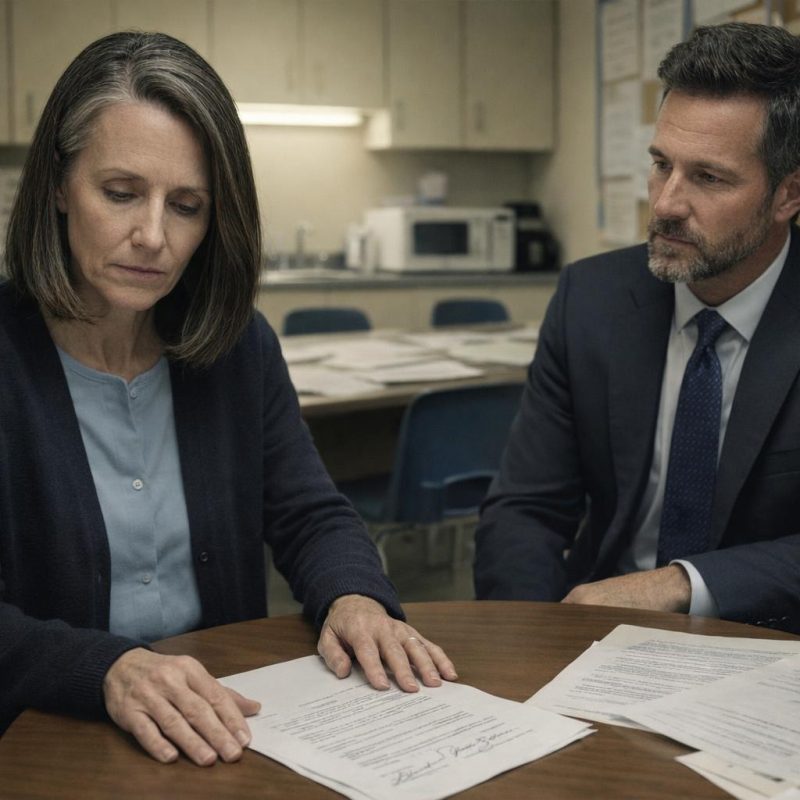 Image by RM AI
Questions in the Margins
We kept working through the boxes into the early evening. Robert ordered sandwiches at some point and we ate at the conference table without really stopping. I found more of my husband's handwritten notes tucked inside financial statements, folded in thirds the way he used to fold things he wanted to come back to. These were more detailed than the first set. He'd highlighted specific line items in the statements — transfers between accounts, amounts that didn't seem to correspond to anything labeled on the surrounding pages. Next to one highlighted entry he'd written a question about where the funds had originated. Next to another he'd written a date and drawn an arrow to a different page, as if he was trying to trace something across documents. There was a loose sheet near the back of one folder that looked like he'd started building a timeline — dates down the left margin, amounts in the middle column, and a question mark or a short note in the right column for each one. Some of the notes just said 'no documentation' or 'verify source.' Robert examined the timeline sheet for a long time without saying anything. Then he said it looked like my husband had been conducting something close to an internal audit on his own, working through the records methodically. I asked him what he thought my husband had been looking for. Robert said he couldn't say yet, not without the actual account records to compare against. I looked back down at the timeline sheet, at my husband's careful handwriting, and at the last line he'd written at the bottom of the page — three words, underlined twice: *where did it go?*
 Image by RM AI
The Unfinished Investigation
Robert spread the timeline sheet and the highlighted statements across the table and walked me through what the notes suggested, taken together. He was careful about how he said it — he kept using words like 'appears' and 'suggests' — but the picture he was drawing was clear enough. My husband had started questioning certain transactions about six months before he died. The questions had gotten more specific over time, not less. He'd been pulling documents, cross-referencing dates, building something. Robert said it looked like a systematic review, the kind a person does when they're not satisfied with the answers they've already been given. He asked if my husband had ever mentioned a confrontation with anyone, an argument about the business, anything like that. I thought about it honestly. I told him my husband had seemed stressed in that period, more than usual, but he hadn't explained why. He'd said once that he needed to get some things straightened out, and I'd assumed he meant paperwork, the ordinary kind. He hadn't told me it was anything more serious than that. Robert nodded and made a note. Then he said, quietly, that the review appeared to have stopped when my husband died — that there was no indication he'd ever reached a conclusion or confronted anyone with what he'd found. I sat with that for a moment. My husband had spent months working through something that worried him enough to document carefully, and he'd died before he could finish it. Whatever he'd been trying to understand, he'd carried it alone, and he'd taken it with him.
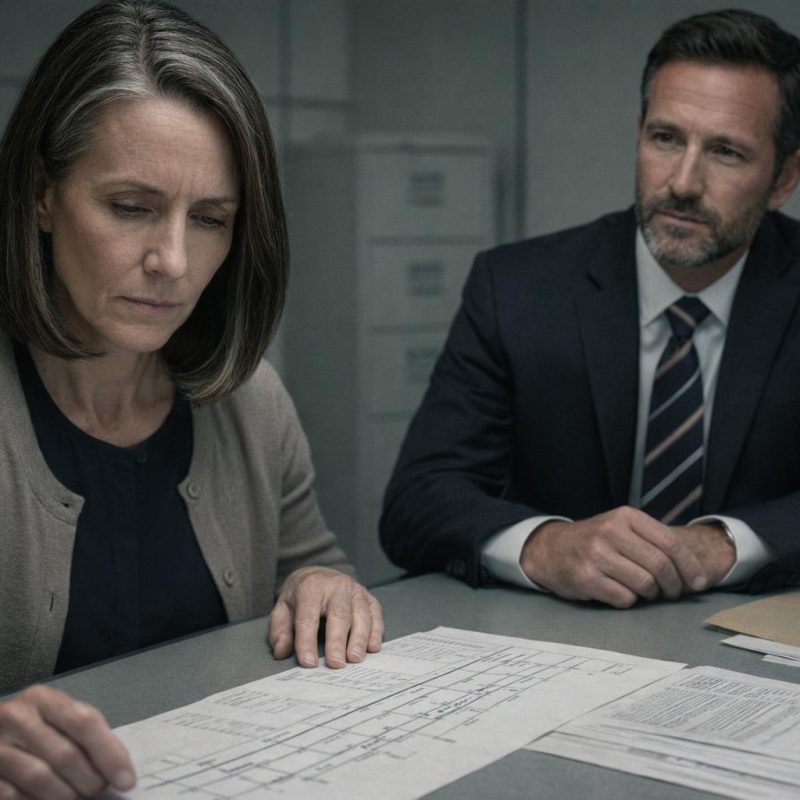 Image by RM AI
Requesting Partnership Records
The following week Robert contacted the accounting firm that had managed the partnership's books. He handled it professionally, the way he handled everything — a formal written request, framed around estate purposes, asking for complete financial records going back to the partnership's formation. He told me afterward that the accountant had been cooperative, no pushback, said he'd compile everything that was on file. The scope of what Robert had requested was substantial: bank statements, transfer records, tax filings, capital account summaries — fifteen years of a two-person commercial real estate partnership. Robert warned me it would take several days for the firm to pull it all together, and that once it arrived, the review would be time-consuming. He said we shouldn't expect quick answers. I told him I wasn't in a hurry for quick answers anymore; I was in a hurry for the right ones. We spent part of that afternoon organizing what we already had — my husband's notes, the documents from storage, the bank records from the forgery investigation — so that when the partnership files arrived, we'd be ready to work through them systematically. Robert said he'd call me as soon as the records came in. I drove home and tried to settle into the waiting, which I'd gotten somewhat better at over the past weeks, though not much. I thought about fifteen years of transactions sitting in boxes at an accounting firm, and what my husband might have found if he'd had more time, and what we might find now that he hadn't.
 Image by RM AI
The Timeline Emerges
The boxes arrived at Robert's office on a Wednesday, four of them, delivered from the accounting firm. He called me that afternoon and I came in the next morning. The conference table was already covered by the time I got there — Robert had started the night before, pulling statements and organizing them by year. He'd printed out a clean copy of my husband's handwritten timeline and set it at the center of the table as a reference point. We worked through the records methodically, Robert on one end of the table and me on the other, passing documents back and forth when something needed a second set of eyes. He'd built a spreadsheet on his laptop, columns for date, amount, account origin, account destination, and a notes field. About two hours in, Robert stopped and looked at the timeline sheet, then back at the statement in his hand. He asked me to come around to his side of the table. He set the statement next to the timeline and pointed to a line item — a fund transfer, a specific date, a specific amount. Then he pointed to the corresponding entry in my husband's notes, the one with 'need to verify' written beside it. The date matched exactly. The amount matched exactly. My husband had flagged this transfer months before he died, and here it was in the official records, exactly where he said it would be.
 Image by RM AI
The Pattern of Transfers
We worked through the rest of that morning without much conversation. Robert had pulled statements going back nearly eight years, and he was moving through them in order, making notes in his spreadsheet as he went. Around midday he stopped and asked me to look at something. He'd flagged a series of transfers — not large ones, nothing that would have jumped out on its own. Three hundred here, eight hundred there, sometimes a couple thousand. But they kept appearing, every few months, sometimes more often in certain years. He turned his laptop toward me and showed me the running total he'd calculated. I had to look at it twice. Individually, each transfer was easy to overlook. Together, over eight years, they added up to just over two hundred and forty thousand dollars. Robert said the documentation attached to each one was minimal — a line or two, sometimes nothing at all beyond the transaction itself. He also noted that the frequency had increased in the last two years before my husband passed. I asked where the money had gone, and Robert said that was the next thing he needed to trace. He closed the laptop partway and leaned back in his chair. I sat with the folder in my hands and looked at the table, at all those years of statements spread out in front of me, and thought about how much could be hidden inside numbers that looked ordinary at a glance.
 Image by RM AI
The Estate Review Threat
Robert poured us both a cup of coffee from the small machine on the credenza and sat back down. He said he wanted to walk me through something about the estate process, because he thought it mattered for understanding the timeline. When a partner dies, he explained, the surviving partners and the estate have to do a full accounting of all partnership assets. Every account, every investment, every transfer — it all gets reviewed as part of settling what the estate is owed. He said it was thorough by design, not optional, and that any irregularities in the records would surface during that process. I asked him what kind of irregularities. He said the kind we'd been looking at all morning. He pulled out a separate sheet — a timeline he'd made of the estate settlement steps — and set it next to the list of flagged transfers. The forged document had appeared early in the settlement process, right around the time the partnership records would have come under scrutiny. He didn't say it as an accusation. He said it carefully, like he was reading from a map and wanted to make sure I was following. I asked if he thought the forgery and the transfers were connected. He said he thought it was worth finding out. I sat there looking at both timelines side by side, and the weight of what the estate review might have uncovered — and what it hadn't — settled over me quietly.
 Image by RM AI
Gerald's Name in the Records
Robert had been quiet for a while, working through a stack of transfer authorization pages he'd separated from the main files. I was going through bank statements on my end of the table when he said my name. Not urgently — just evenly, the way he said most things. He told me to come look. He'd laid out six pages side by side, each one a transfer authorization form from different points across several years. He pointed to the signature line on the first one. I recognized the handwriting immediately. I'd seen it on birthday cards, on checks at charity dinners, on the back of photographs from family trips going back decades. Robert pointed to the second page. Same signature. Then the third. He said Gerald had held signatory authority on the partnership accounts, which wasn't unusual for a managing partner. What was unusual, Robert said, was that these particular transfers — the ones my husband had flagged, the ones with almost no supporting documentation — had Gerald's signature on nearly all of them. He said he wasn't drawing conclusions yet, that there could be explanations, and that they'd need to trace where the funds actually went before anything meant what it appeared to mean. I nodded. I heard everything he said. But I was still standing there looking at those six pages lined up across the table, and Gerald's signature was on every single one of them.
 Image by RM AI
The Weight of Loyalty
Robert gave me a few minutes before he said anything else. When he did, he was careful about it. He said Gerald had been my husband's partner for over twenty years, that he'd been a presence in our family for longer than that, and that signatures on transfer forms weren't proof of anything on their own. He said the right thing to do was trace where the money actually went — follow it through the accounts, find out who received it, and build a complete picture before anyone said anything to anyone. He recommended bringing in a forensic accountant, someone who specialized in exactly this kind of financial trail. I sat with that for a moment. I thought about Gerald at my husband's funeral, standing at the back of the church with his hat in his hands. I thought about the casseroles he'd sent in the weeks after, the phone calls to check on me, the way he'd always asked about the kids by name. Robert said he understood this was difficult, and that moving carefully wasn't the same as moving slowly — it just meant making sure what we found would hold up. I told him I agreed. I asked him not to contact Gerald yet, not until we knew more. Robert said he wouldn't. He wrote something in his notes, and I looked at the signature pages still spread across the table, and I asked myself whether I was ready to find out what came next.
 Image by RM AI
The Quiet Expansion
Robert made the call that same afternoon, while I was still sitting in his office. He stepped out briefly and came back maybe ten minutes later. He said he'd reached a firm he'd worked with before — people who handled financial investigations discreetly, who knew how to trace funds through layered accounts without alerting anyone in the process. He said he'd given them the partnership records and the list of flagged transfers, and that they'd start by trying to identify where the money had landed. He told me the investigation could take several weeks, possibly longer depending on how many accounts were involved. I asked what I was supposed to do in the meantime. He said the most important thing was to behave as I normally would — return calls, respond to messages, keep up whatever contact I usually had with people connected to the partnership. He said any sudden change in my behavior could raise questions we weren't ready to answer yet. I understood what he meant without him having to say it plainly. I authorized the expense and signed the engagement letter he slid across the table. Robert said he'd keep me updated as the investigators reported back. I gathered my coat and my bag and stood there for a moment before I left. Then his phone buzzed on the desk, and he glanced at it and told me the firm had confirmed — they would begin first thing in the morning.
 Image by RM AI
Bringing in the Expert
Robert scheduled the meeting for the following Tuesday. When I arrived, the forensic accountant was already there, seated at the conference table with two folders open in front of her and a legal pad covered in notes. Robert introduced us and she stood to shake my hand — firm grip, direct eye contact, the kind of person who doesn't waste time on pleasantries but isn't unkind about it. She said she'd reviewed the materials Robert had sent over and had some initial questions about the partnership structure before she began the deeper analysis. She asked about the account hierarchy, who had authority over which funds, and whether there had been any changes to the signatory arrangements over the years. I answered what I could and told her honestly when I didn't know. She wrote everything down without reacting to any of it. Then she explained her process: she would map the transaction patterns across all the accounts, identify relationships between transfers, and trace the movement of funds as far as the documentation allowed. She said she'd seen similar record structures before and knew what to look for. She estimated two to three weeks for a thorough analysis, possibly longer if she needed to request additional bank documentation, which she said she likely would. I watched her flip back through her notes with the focused efficiency of someone who had done this many times. Whatever she found, I had the feeling she would find all of it.
 Image by RM AI
The Emerging Pattern
The forensic accountant called us back in about two and a half weeks later. She had printed charts this time — flow diagrams showing money moving out of the partnership accounts in small amounts, collecting in what she called intermediary entities, then moving again. She walked us through it methodically, pointing to each node on the diagram with a pen. The shell accounts, she said, appeared to have been created specifically to receive these transfers — they had no other apparent business activity. She traced the funds through three and sometimes four layers before the trail thinned out. The pattern, she said, spanned most of the years the partnership had been active. She noted that the transfers were timed in ways that kept individual amounts below thresholds that typically trigger closer review, and that the intervals between them varied enough to avoid a simple recurring pattern. Robert asked whether she could identify who had controlled the shell accounts. She said she was still working on that piece — the documentation existed, but it was layered, and she wanted to be certain before she said anything definitive. I looked at the charts spread across the table, at all those lines and arrows moving money through accounts that had no real purpose except to hold it and pass it along, and I sat with the quiet, heavy understanding that whatever this was, it had been going on for a very long time.
 Image by RM AI
Gerald's Question
Gerald called on a Thursday evening, just after seven. I was in the kitchen when my phone lit up with his name, and I stood there for a second before I answered. His voice was warm the way it always was — unhurried, familiar. He asked how I was holding up and whether there had been any progress on the forgery investigation. I told him we were still in the middle of gathering information, that these things moved slowly. He said he understood, that legal processes had their own pace, and that I shouldn't let it wear me down. He asked if they'd had any luck tracing the account the forged document had referenced. I said the attorneys were still working through it. He told me he'd been thinking about my husband lately — said the anniversary of a hard year had a way of bringing things back. He said my husband would have wanted the family protected from all of this, that he would have hated seeing me go through it alone. I thanked him and said I needed to get dinner off the stove. After I hung up, I set the phone down on the counter and stood very still. My hands weren't shaking, but they wanted to. I thought about the charts, all those lines moving through accounts that shouldn't have existed, and I took one slow breath and then another, and I held my voice in my memory from that call, checking whether it had stayed steady the whole way through.
 Image by RM AI
Following the Money
Dr. Hammond spread the charts across Robert's conference table on a Tuesday morning, and I sat down slowly and tried to prepare myself for what I was about to see. She had been working through the financial records for weeks, and the trail she'd mapped out was unlike anything I'd imagined. Six shell accounts, she said, each one created to receive money and pass it along to the next. She pointed to the first node on the chart — a company name I didn't recognize, incorporated in a state none of us had any connection to. From there, the funds moved to a second entity, then a third, each one with a different registered address, a different name, no apparent business activity. Robert leaned forward and asked her to walk through the timing of each transfer. She did, methodically, her finger tracing the lines from one box to the next. Some of the transfers happened within days of each other. Others were spaced out over months, as if someone had been careful not to move too much at once. She said she was close — that she had followed the trail nearly to its end, but needed a few more days to complete the documentation on the final accounts. I nodded and said that was fine. I looked at the chart for a long moment after she finished speaking. All those lines, all those names that meant nothing on their own, and somewhere at the end of them, an answer I wasn't sure I was ready to hold.
 Image by RM AI
The Evidence Links
Dr. Hammond called the meeting for Thursday afternoon, and when I walked into Robert's office she already had the folders open on the table. She didn't waste time. She said she had found the documentation she needed, and she wanted us to see it together. The first set of papers were incorporation records — three shell entities, each one registered in a different state. She slid them across the table one at a time. On each document, in the field for registered agent, was the same name. I looked at it for a moment without speaking. She then showed us the account opening paperwork for two of the entities — signature lines, contact information, a personal address I recognized. Robert put on his reading glasses and went through each page carefully, asking her to confirm the chain of custody on the documents and whether the signatures had been verified against known samples. She said yes to both. The bank records came next — transfers in, transfers out, and in the account holder information, the same personal details appearing again and again. Robert set down the last page and said the documentation looked solid. He said he would need to review everything in full before they moved forward, but that what she had assembled was thorough. I didn't say anything. I sat with my hands folded on the table and looked at the folder in front of Dr. Hammond, thick with pages, each one a piece of something I had spent months trying not to fully imagine.
 Image by RM AI
The Scope of Betrayal
Dr. Hammond said she wanted to present the complete picture before we discussed next steps. She opened the final section of her report and began walking us through the timeline. The first irregular transfer she had identified dated back twelve years. It was small — a few thousand dollars routed through one of the shell entities, easy to miss against the volume of legitimate partnership activity. But it happened again the following year, and the year after that, each time a little larger. She showed us a graph of the amounts over time, and the line climbed steadily, then sharply in the final two years. She had also found evidence of falsified documentation — fabricated expense records, investment losses that didn't correspond to any actual positions, entries that looked routine until you compared them against the underlying source records. Robert asked her to confirm the methodology she'd used to separate the legitimate transactions from the fraudulent ones. She walked him through it carefully. He nodded and made notes. I sat and listened and tried to keep my breathing even. Dr. Hammond said the forgery we had originally brought to her appeared to fit within the same pattern — that it had surfaced during a period when the partnership records would have come under scrutiny. She closed the report and looked at me. Then she said the total amount she had documented came to just over two million dollars.
 Image by RM AI
The Impersonation Connection
Robert set his pen down and was quiet for a moment before he spoke. He said he wanted to lay out the timeline as he understood it, and he asked Dr. Hammond to correct him if anything was off. She nodded. He started at the beginning — the partnership's structure, the way the accounts had been set up years ago, the access points that existed within it. Then he moved to the estate settlement. When my husband died, the settlement process required a review of the partnership records. Robert said that review created a window — a point at which irregularities in the accounts could have surfaced. He pulled out a separate sheet and showed me two dates side by side. The first forged transfer had appeared within weeks of that review window opening. He said the family conflict that followed had the effect of shifting attention away from the financial records and toward the question of what I had or hadn't given to my children. I sat very still. He said the account used in the forged transfer showed the same structural irregularities Dr. Hammond had flagged in her analysis. He said the account had been closed shortly after the conflict in the family reached its peak. He looked at me and said he couldn't say with certainty whether these events were independent of each other, but that the evidence pointed toward something more extensive than a single forged document. He slid the two-column timeline across the table, and I looked at the dates lined up in parallel, each one sitting exactly where it would need to sit if nothing about any of this had been accidental.
 Image by RM AI
The Full Truth Revealed
Robert said he wanted to be direct with me, and I told him to go ahead. He said the evidence, taken together, told a clear story. Gerald had been taking money from the partnership for over a decade. My husband had noticed something in the accounts in the months before he died — Robert had found notes in the estate files, questions my husband had written down and apparently intended to pursue. He had been gathering information quietly. Gerald would have known that the estate settlement was coming, that it would bring outside eyes to the records, and that my husband's notes might surface. Robert said the forgery wasn't random. It was timed. It was designed to fracture the family's trust and redirect everyone's attention — mine, my children's, the attorneys' — away from the financial records and toward each other. The impersonation had been carefully executed, using account information Gerald had access to through the partnership. The conflict it created had bought him time. Dr. Hammond said the documentation supported that sequence of events at every point she had checked. I sat with that for a moment. My husband had known something was wrong. He had been carrying it, quietly, in those last months when I thought he was just tired and worried about his health. He hadn't told me, and I didn't know whether that was to protect me or because he hadn't yet found what he was looking for. Robert folded his hands on the table and said that by the time my husband died, he had been closing in on the truth.
 Image by RM AI
Processing the Betrayal
I drove home from Robert's office and sat in my car in the parking garage for a while before I went upstairs. I didn't trust myself to walk through the lobby and make small talk with anyone I might pass. Inside the apartment, I put my bag down and stood at the kitchen window and let myself think about Gerald. After my husband died, Gerald had come to the house within the first week. He brought food. He sat with me at the kitchen table and let me talk, and he said all the right things about what a good man my husband had been, how much he would be missed, how I shouldn't worry about the practical matters because he would help me sort through them. He had helped me. He came to the first family gathering after the funeral and made sure everyone had what they needed. He called to check in. He asked about the children. Every time the investigation came up in conversation, he was calm and sympathetic and told me not to let it wear me down. I had been grateful. I had told him things — about the attorneys, about the timeline, about how the family was holding up. I stood at the window and thought about all of it, and the gratitude curdled into something I didn't have a clean word for. My husband had spent his final months carrying the weight of what he suspected, alone, and Gerald had stood at his graveside and wept, and then come to my kitchen and poured me tea, and I thought about every single one of those visits.
 Image by RM AI
Telling the Children
I called all three of them on Friday evening and asked them to come Sunday afternoon. I didn't tell them why over the phone — just that I had information I needed to share in person, and that it was important. They all came. Tyler arrived first, then Melissa, then Brian, and I had them sit down at the dining room table the way we used to when the children were young and something needed to be addressed as a family. I told them everything. I started with Dr. Hammond's findings and worked through it in order — the shell accounts, the timeline, the falsified records, the total amount. I told them about the forgery and how it fit into the larger pattern. I told them what Robert had found in their father's estate files, the notes he had written, the questions he had been quietly trying to answer. Melissa went very still when I explained how the forged transfer had been structured to point at her. Brian put his face in his hands at one point and said he was sorry — to me, and then he turned to Melissa and said it again, and she reached across the table and put her hand over his. Tyler asked how Gerald could have done this, and I said I didn't have an answer for that. I told them their father had known something was wrong, that he had been trying to find the proof, and that he hadn't made it far enough. When I finished, no one spoke for a long moment, and the quiet that settled over the table felt like something we were all holding together.
 Image by RM AI
Planning the Response
Robert had cleared his schedule for Monday morning, and all four of us went together. He had printed copies of the key documents for each of us, and he walked us through the options methodically. He said Dr. Hammond's analysis was thorough enough to support both a civil recovery action and a referral for criminal prosecution. The civil suit could pursue the full amount of the diverted funds, plus interest and legal costs. The criminal referral would go to the district attorney's office, and from there it would be out of our hands, but Robert said the documentation was strong. He also told us to expect a fight. Gerald would likely argue that the partnership structure gave him authority over the transfers, that the accounting reflected legitimate business decisions. Robert said that argument would not hold up against Dr. Hammond's analysis, but we should be prepared for it to be made. Melissa asked whether we should reach out to Gerald before anything was filed. Robert said no — that any contact before the legal filings were in place could compromise the process and give Gerald time to move assets. Brian asked how long it would take. Robert said months, possibly longer, and that we should pace ourselves. I looked around the table at my three children — Tyler with his notepad, Melissa with her jaw set, Brian leaning forward with his hands flat on the table — and I thought about my husband, and about what he had started, and about what we were going to finish. The room felt steady in a way I hadn't expected, and I let myself sit inside that for a moment.
 Image by RM AI
Gerald's Lawsuit
Robert called me on a Tuesday afternoon and asked me to come to his office. His voice was measured, the way it gets when he's already processed something and is waiting to walk someone else through it. When I arrived, he had a document laid out on the desk — not one of ours. He slid it toward me and let me read the header before he said anything. Gerald had filed a lawsuit against the estate. I read the words twice before they settled. He was claiming that my husband had owed him five hundred thousand dollars — a business debt from the partnership, he said, unpaid at the time of death. Robert watched me read and didn't rush me. The filing referenced the forged inheritance document. It framed the forgery not as evidence of Gerald's crimes but as evidence of mine — that I was a woman who manipulated financial records, whose word couldn't be trusted, whose family couldn't be believed. I set the papers down and looked at Robert. He said Gerald had filed first because he thought it would put us on the defensive. He said it was a desperate move, and that desperate moves leave openings. I picked the filing back up and read the claim again — five hundred thousand dollars my husband supposedly owed the man who had been stealing from us for twelve years.
 Image by RM AI
The Trap Springs
Robert pulled his chair around to my side of the desk and walked me through what Gerald had just handed us. A lawsuit requires discovery. Both sides have to produce records — financial statements, partnership documents, account histories, correspondence. Gerald had filed expecting us to scramble, expecting the forgery to have already done its damage. He didn't know about Dr. Hammond. He didn't know we had twelve years of forensic analysis sitting in a folder with his name on it. Robert said it plainly: Gerald had just given us a courtroom. He had given us a judge, a formal record, and a legal mechanism to compel him to produce every document he had spent years hiding. Robert said that in his experience, people who overestimate their position make the biggest mistakes, and Gerald had overestimated badly. I thought about the version of this Gerald had imagined — me, rattled and discredited, scrambling to defend myself against a debt claim while he walked away clean. Instead, he had opened a door we couldn't have opened as cleanly on our own. Robert was already drafting the counter-filing. Dr. Hammond was scheduled. The evidence package was ready. I sat back and felt something settle in my chest — not quite satisfaction, but close. Gerald had filed his lawsuit thinking it was a weapon. Robert set his pen down and said, "He gave us exactly what we needed."
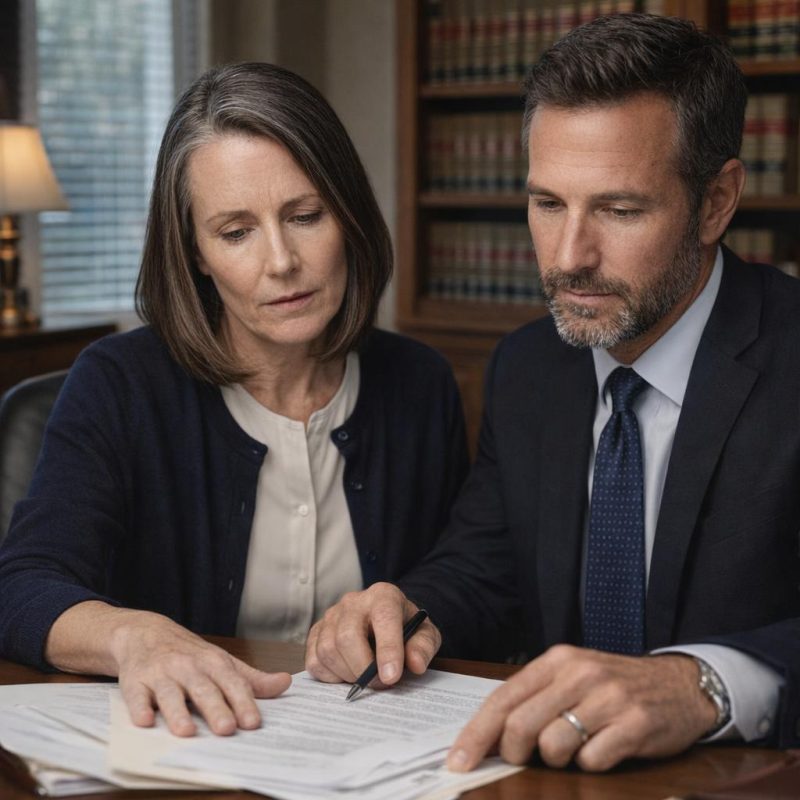 Image by RM AI
Preparing for Court
The two weeks before the first hearing moved fast. Robert's team worked through the documentation in layers — the original partnership agreements, the account statements, the shell entity incorporation records, the forensic timeline Dr. Hammond had built. I came into the office three times that week and sat at the conference table while they organized everything into a sequence a judge could follow. Dr. Hammond was there for two of those sessions. She had prepared visual aids — charts showing the fund transfers, a timeline spanning twelve years, a diagram connecting the shell accounts back to Gerald. She walked me through her testimony outline, and I was struck again by how precise she was, how every claim was anchored to a document, a date, a number. Robert reviewed what my own testimony would cover — my husband's concerns in the months before he died, the conversations I remembered, the moment I first saw my signature on a document I hadn't signed. He told me to speak plainly and stay with what I knew directly. He said the evidence would carry the weight; I just needed to tell the truth. Brian, Tyler, and Melissa all said they would be there. I told them they didn't have to, and they looked at me like I'd said something foolish. The night before the first hearing, I sat at the kitchen table with the folder Robert had prepared for me, and the house was quiet around me, and I thought about my husband, and I felt the full weight of what we were about to do.
 Image by RM AI
The Courtroom
The courtroom was smaller than I'd expected, wood-paneled and fluorescent-lit, with that particular stillness that settles over a room when everyone in it knows something important is about to happen. I came in with Robert on one side and my three children behind me. Tyler had his notepad. Melissa wore the same composed expression she uses when she's holding herself very carefully together. Brian sat close, shoulders squared, jaw set. Gerald was already at the other table with two attorneys I didn't recognize. He was dressed well — dark jacket, silver tie — and he sat with the easy posture of a man who believed he was in control of the room. When I took my seat, he glanced over. I met his eyes for a moment and then looked away, back toward Robert, back toward the judge's bench. The judge entered and the room came to order. Gerald's attorney presented their case first — the claimed debt, the partnership history, the suggestion that the estate's records were unreliable. He referenced the forged document with a confidence that told me he didn't yet understand what was coming. Robert sat beside me taking notes, unhurried, his pen moving steadily across the page. I felt Tyler's hand briefly on my shoulder from the row behind. The judge ordered both sides to present their financial records. Robert opened his first folder. The quiet in that room had a particular quality to it — settled, expectant — and I sat inside it without moving.
 Image by RM AI
The Records Speak
Robert presented our records first — the original partnership agreements, the account statements going back to the beginning, the incorporation documents for the shell entities. He laid them out in sequence, methodical and unhurried, and then he placed Gerald's version of the same records beside them and let the discrepancies speak. The judge leaned forward. She asked for clarification on three specific transactions — large transfers in the middle years, amounts that appeared in one set of records and not the other. Gerald's attorney answered carefully, but the answers didn't hold. Robert introduced Dr. Hammond as an expert witness, and she was sworn in with the same calm efficiency she brought to everything. Gerald shifted in his seat. His lead attorney leaned over and said something to him in a low voice. Then the attorney stood and requested a recess. The judge looked at him over her glasses and denied it. Dr. Hammond began. She explained her methodology first — how she had approached the records, what she had looked for, how she had verified her findings. Her voice was even and clear, and the courtroom was very quiet. I watched the judge's face as Dr. Hammond spoke, the way her attention sharpened with each new document introduced into evidence. Across the room, Gerald sat with his hands folded on the table, and I watched the stillness in his posture begin, slowly, to cost him something.
 Image by RM AI
Dr. Hammond's Testimony
Dr. Hammond had been on the stand for nearly two hours when she reached the shell accounts. She put the incorporation documents on the screen — Gerald's signature, his address, his name listed as the sole authorized party on accounts that had received transfers from the partnership for over a decade. She showed the timeline as a chart: twelve years, forty-one transfers, a total exceeding two million dollars. She explained how the documentation had been altered — which fields, which dates, which figures — and how she had identified the alterations through layered forensic analysis. She was precise and she was thorough and she did not editorialize. She didn't need to. The numbers did it. Gerald's attorney cross-examined her for forty minutes and didn't land a single meaningful challenge. She answered every question with the same even clarity, returning each time to the documents, the dates, the figures. I sat between Robert and Tyler and kept my hands still in my lap. At some point I stopped watching Dr. Hammond and started watching Gerald. His posture had changed. The ease was gone. He was very still in the way that people get when they are working hard not to show something, and his attorney had stopped writing notes and was staring at the table. Dr. Hammond concluded her testimony and the courtroom held its silence for a long moment. Then Gerald turned his head, and his eyes found mine across the room.
 Image by RM AI
The Impersonation Evidence
Robert stood and introduced the next phase of evidence without pausing to let the room recover from Dr. Hammond's testimony. He presented the forged inheritance document first — the one with my signature, the one I had never signed. He showed the court the surveillance footage from the bank, the woman who had walked in presenting identification in my name. Then Patricia was called to the stand. She had driven in from the branch office, and she sat very straight in the witness chair, her reading glasses on, her hands folded. She described the woman who had come into her office — the appointment, the documents, the transaction. She said the woman had known details about the account that weren't publicly available. Robert then presented my travel records — the hotel receipts, the flight confirmation, the timestamped documentation placing me out of state on the day of that visit. He walked the court through the timing: the forgery had appeared during the period when the estate review would have exposed the partnership discrepancies. He showed how the document had been positioned to fracture the family's trust in each other, to redirect attention, to create enough conflict that no one would look closely at the partnership records. Gerald's attorney rose twice to object. The judge overruled both times. When Robert finished, he placed the final exhibit on the screen — a side-by-side comparison of the forged document and the shell account transfer records, the dates aligned in a single column.
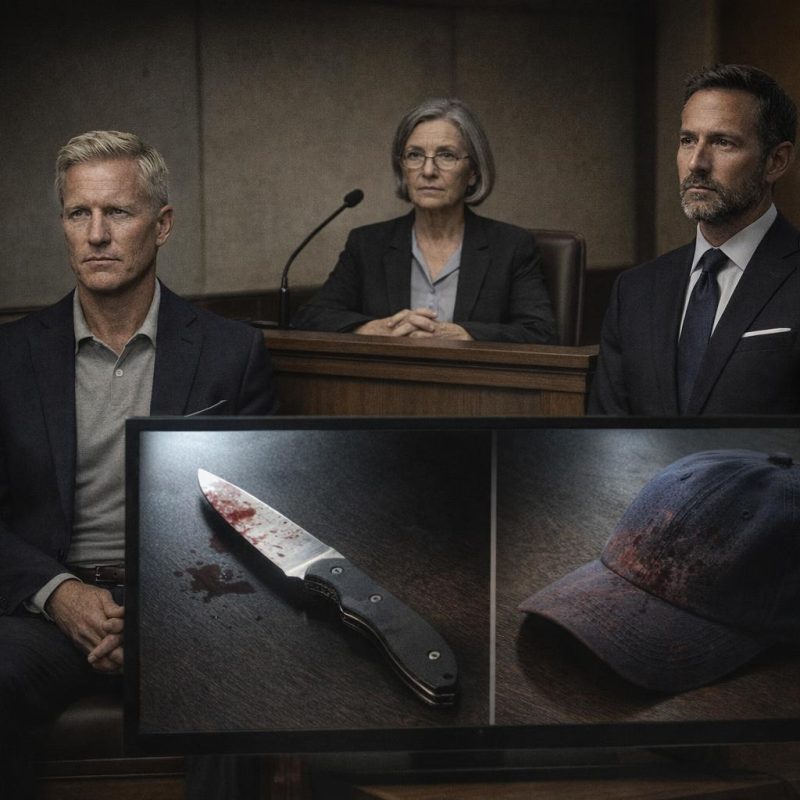 Image by RM AI
The Case Collapses
Gerald's attorney made his closing arguments, and I could hear the effort in it — the way a case sounds when the person making it knows it isn't working. He challenged Dr. Hammond's methodology. Robert addressed each point in turn, calmly, with the relevant document already flagged. The judge had been taking notes throughout, and now she reviewed them without speaking for what felt like a long time. She asked Gerald's attorney two questions about the shell accounts. He gave answers that didn't answer anything. She asked about the timing of the forged document. He said the connection was speculative. She looked at him for a moment and then looked down at her notes again. When she spoke, she was direct. She said Gerald's lawsuit had no merit and was dismissed with prejudice. She said the financial records presented by our side documented a pattern of systematic diversion that the court could not ignore. She ordered Gerald to provide a full accounting of all funds transferred through the shell entities. And then she said she was referring the matter to the district attorney's office for criminal investigation. Gerald sat without moving. Tyler put his arm around me. Melissa reached for my hand. Brian was very still beside me, and I could feel him exhale. Robert leaned over and said we would talk through next steps in the morning. I looked across the room at Gerald, still seated, his attorneys gathering papers around him, and I heard the judge's gavel come down.
 Image by RM AI
The Larger Cover-Up Exposed
The ruling hit the news cycle faster than I expected. By the time Robert drove us back to his office to go over next steps, my phone had already started ringing — people I hadn't heard from in years, some of them business contacts of my husband's, a few of them former clients of Gerald's. One man left a voicemail saying he'd had doubts about Gerald for a long time but never had anything concrete. A woman who had worked with Gerald on a property deal in the early 2000s said she'd always felt something was off about the way the accounts were structured. Robert spread the financial timeline across the conference table and walked us through what the prosecutors would be looking at — shell entities going back nearly eleven years, transfers that had been routed through three different holding companies, fees that had been inflated and redirected. Tyler sat across from me, quiet, turning his pen over in his hands. Brian leaned forward with his elbows on the table, jaw tight, reading the summary Robert had prepared. Melissa sat beside me and didn't say much, but she reached over once and squeezed my hand. I thought about my husband — about the notes he'd kept, the questions he'd started asking in those last months, the way he'd grown quieter and more careful. He had been pulling at the same thread. Robert set down his pen and said the asset seizure orders had already been filed. Gerald's accounts, his properties, the shell entities — all of it was now part of the public record.
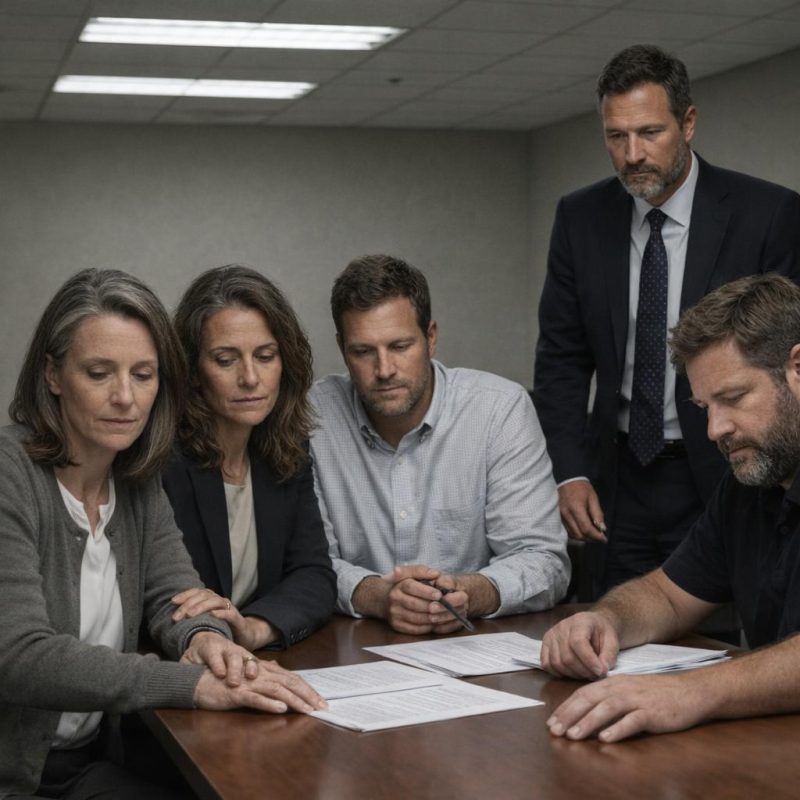 Image by RM AI
Recovery and Reconciliation
The asset liquidation took several months, but Robert kept us informed at every step. Gerald's properties sold at court-ordered auction. The shell accounts were unwound one by one. When Robert called to give us the final recovery figure, I was sitting at my kitchen table with a cup of tea that had gone cold. He said the total recovered exceeded one point eight million dollars. I sat with that number for a moment before I said anything back. Robert handled the distribution according to the original partnership agreement — my husband's share came to us, and the estate was finally, properly settled. The criminal charges against Gerald were proceeding on a separate track, and Robert said that process would take time, but that the evidence Dr. Hammond had compiled was thorough enough that the prosecutors felt confident. We met as a family at my apartment one evening — Tyler, Melissa, Brian, and I — and talked about what to do with part of the recovered funds. It was Tyler who first said we should do something in their father's name. Brian nodded before Tyler finished the sentence. Melissa said she thought a scholarship made sense, something for students studying finance or accounting, something that pointed toward honesty in the field their father had loved. We agreed on it that same night, without any argument. Robert sent a formal letter of congratulations the following week, which I folded and put in the drawer where I keep things that matter. The weight I had been carrying for more than a year had shifted into something I could finally set down.
 Image by RM AI
Family Restored
We had dinner at my apartment on a Saturday in early spring — all three of my children, the first time we'd sat around that table without any legal matter hanging over us. I made the pot roast their father had always requested for occasions that deserved marking. Brian brought wine. Melissa brought flowers, yellow ones, and put them in the blue vase on the sideboard without being asked. Tyler arrived last and hugged me longer than usual at the door. We talked for a long time after the dishes were cleared. Melissa said she was grateful the truth had come out, that there had been moments when she wasn't sure it would. Brian set down his glass and looked at her and said he was sorry — not for the first time, but this time it landed differently, quieter, like something that had finally finished settling. Tyler said he kept thinking about how close it had come — how one more month of silence, one more document left unexamined, might have ended things between us permanently. I told them about their father, things I hadn't said out loud before — the way he used to sit at his desk late at night going over numbers, the careful way he kept his files, the instinct he had for when something wasn't adding up. I told them I believed he would have found it eventually. Brian said he thought so too. We talked about the scholarship, about the first recipient, about what their father would have said about all of it. The candles burned low, and the apartment held us, and I was grateful for every person still sitting at that table.
 Image by RM AI
The Strength That Emerged
After they left, I sat in the quiet for a long time. The dishes were done, the candles were out, and the apartment had that particular stillness it gets when it's just been full of people. I thought about the phone call from Tyler that had started all of this — the accusation, the confusion, the way my hands had shaken when I first saw my own signature on documents I had never signed. I thought about the months that followed: Robert's careful questions, Dr. Hammond's meticulous work, the courtroom, the gavel. I thought about Gerald — the dinners, the holidays, the decades of trust I had extended without question. I thought about what it costs to be wrong about a person for that long, and what it means to finally stop being wrong. But mostly I thought about my husband. He had known something was off. He had kept his notes, asked his careful questions, and then he was gone before he could finish asking them. What he started, we finished. The money was recovered. The truth was public. Gerald's name was attached to what he had actually done. And my children — who had come so close to fracturing beyond repair — had sat around my table tonight and laughed and argued about the wine and talked about their father with love instead of grief. I reached over and turned off the lamp beside my chair. The room went dark except for the light coming in from the window, and I sat with the knowledge that what mattered most had come through intact.
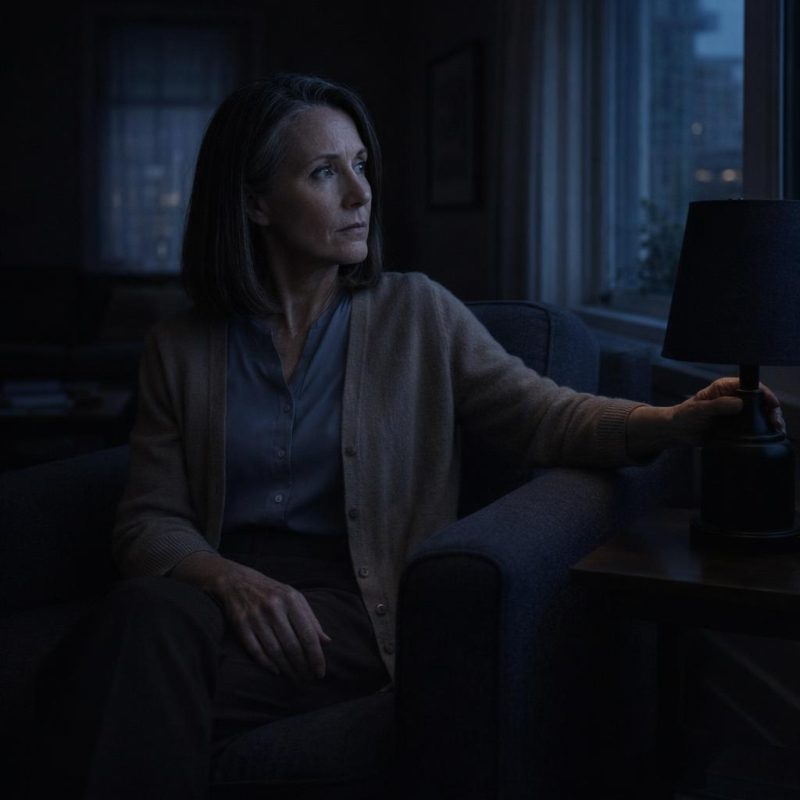 Image by RM AI