The Classroom Conspiracy: How One Mom Uncovered the Truth Behind Her Daughter's Failing Grades
The Classroom Conspiracy: How One Mom Uncovered the Truth Behind Her Daughter's Failing Grades
The Shrinking Child
My name is Marissa, I'm 33, and I'm the kind of mom who labels the lunch containers, remembers picture day, and genuinely believes a warm snack and a pep talk can fix almost anything. You know the type—color-coded calendars on the fridge, emergency granola bars in every purse pocket. That's why when my nine-year-old daughter Ava started third grade and came home looking smaller somehow, I felt that mom-radar ping hard. She was quiet, jumpy, chewing her pencil until it splintered—not my confident little chatterbox who used to burst through the door with stories about recess adventures. At first, I told myself it was just the back-to-school adjustment. New teacher, new classroom, new expectations. We all need time to find our footing, right? I'd make her favorite mac and cheese (the kind with the bread crumb topping she loves), we'd review her homework together, and I'd tuck her in with extra hugs. This was just a phase. We'd settle into our rhythm like always. But as the days passed, that smaller version of Ava didn't bounce back. Her shoulders stayed hunched, her eyes kept darting away when I asked about school. She'd mumble "fine" when I asked how her day was, but nothing about this felt fine. Not the way she'd stare at her untouched dinner, not the way she'd suddenly "forget" her favorite stuffed bunny was mandatory for bedtime. Something was happening to my daughter, and my warm snacks and pep talks weren't fixing it. Not even close.
 Image by RM AI
The First Red Flag
Ava had always been my steady little trooper in school. Not the kid whose artwork gets displayed at the district office, but the one who brings home solid B's with the occasional A that makes her whole face light up. Her second-grade teacher, Ms. Jensen, used to send these little notes home that I'd secretly save in a memory box: "Ava is a joy to have in class" or "She helped a classmate with scissors today." Simple things that told me my girl was doing just fine in the world. So when that first failing quiz came home—a 52% scrawled in harsh red ink across her spelling test—I literally turned it over to check if it was actually hers. Ava stood there, twisting the hem of her shirt between her fingers, watching my face for a reaction. "It's okay, honey," I said, smoothing her hair while my stomach did a little flip. "Everyone has off days." She nodded but didn't look convinced. The second failing quiz felt like a warning bell, a distant siren getting closer. By the third week, I was staring at a pattern I couldn't ignore, a collection of red marks and disappointed teacher comments that made no sense for my daughter. Something was happening in that classroom, and the way Ava's eyes would dart away when I asked about Ms. Carter made me wonder what exactly I wasn't seeing.
 Image by RM AI
The Second Warning
That night, after tucking Ava in with an extra-long hug that she seemed to need more than usual, I spread her schoolwork across our kitchen table like evidence at a crime scene. Last year's cheerful worksheets with Ms. Jensen's encouraging stickers next to this year's papers bleeding with red ink. The contrast was jarring. Last year: "Great thinking, Ava!" This year: "See me after class." Last year: neat handwriting that stayed between the lines. This year: letters that trembled and smudged, like they'd been written by someone afraid to make a mark. I ran my fingers over a math sheet where she'd erased so hard there was a hole in the paper. This wasn't just an academic slide—this was my daughter disappearing. My phone buzzed with another voicemail from Ms. Carter, her third this week. I pressed play and winced at the clipped tone: "Marissa, I need you to understand," she said, voice tight as a drum, "Ava's... suitability for this class is becoming an issue. She's unprepared. She's not meeting expectations. I'm not sure this environment is the right fit." I replayed it twice, that word "suitability" making my stomach drop each time. Ava wasn't a bad kid. She wasn't disruptive. She wasn't mean. She was a little dreamy sometimes, slow to raise her hand, but she'd never been "unsuitable" for anything in her life. What exactly was happening in that classroom that could transform my confident child into this anxious shadow in just three weeks?
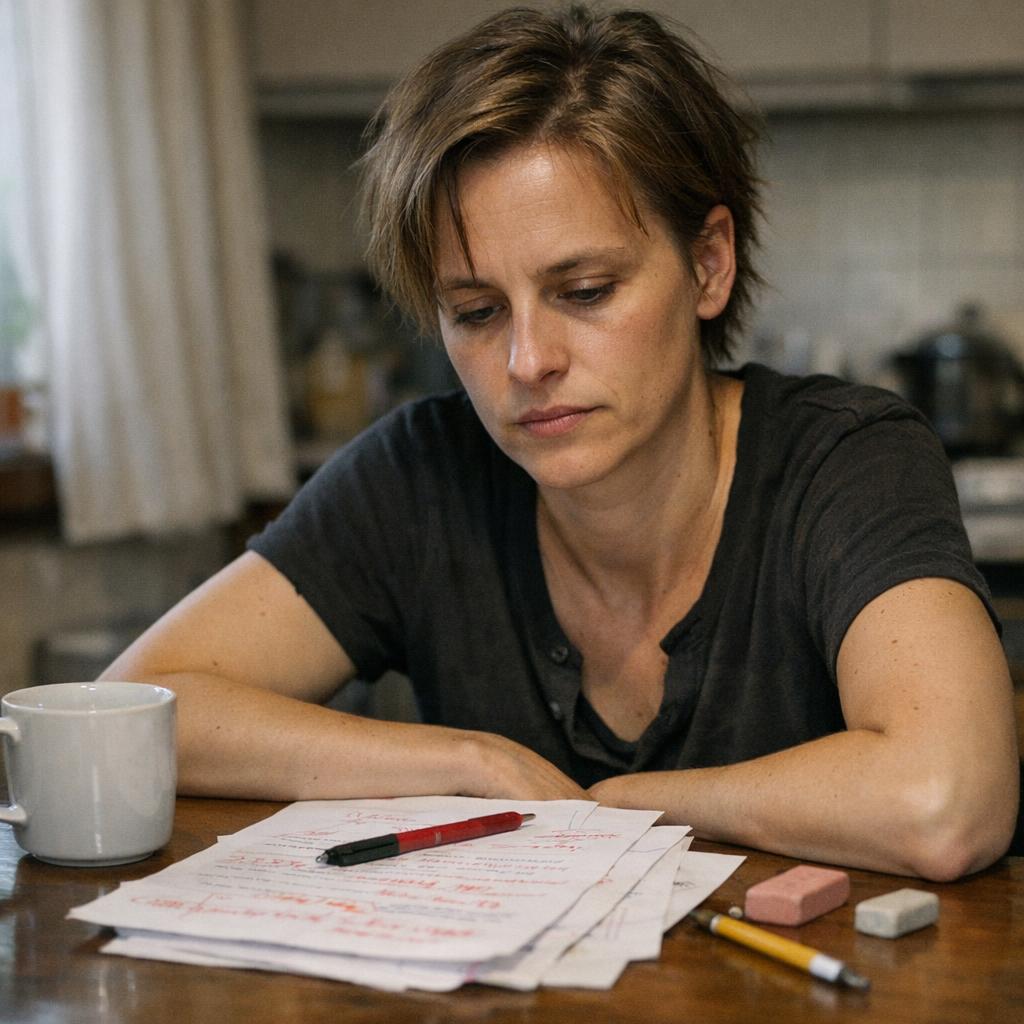 Image by RM AI
The Voice on the Machine
I stared at my phone as Ms. Carter's third voicemail of the week finished playing, her voice ringing in my ears like an accusation. Each message was worse than the last, evolving from 'concerned teacher' to something that felt almost... personal. 'Marissa, I need you to understand,' she'd said, her voice clipped like she was biting off each word, 'Ava's... suitability for this class is becoming an issue.' The pause before 'suitability' made my skin crawl. Who talks about a nine-year-old that way? 'She's unprepared. She's not meeting expectations. I'm not sure this environment is the right fit.' I played it again, trying to decode what was happening between the lines. This wasn't the voice of someone trying to help my child. This was the voice of someone who'd already decided my daughter didn't belong. I called back immediately, then again an hour later. I sent an email marked 'urgent' that evening. By morning, I'd left my own voicemail and sent a follow-up email requesting a face-to-face meeting. The silence from Ms. Carter's end was deafening, and with each passing hour, I felt that mama-bear instinct growing stronger. Something wasn't right here. The Ava I knew wasn't 'unsuitable' for anything—she was kind, she tried hard, she helped other kids. What exactly was happening in that classroom that could make a teacher speak about my child like she was a problem to be solved rather than a student to be taught? When Ms. Carter finally responded with a terse 'I can meet Thursday at 3:15,' I had no idea I was about to walk into a conversation that would change everything I thought I understood about my daughter's education.
 Image by RM AI
The Unsuitable Child
That night, I watched Ava at dinner, pushing pasta around her plate like she was solving some invisible puzzle only she could see. The word 'unsuitable' kept echoing in my head like a bad song you can't shake. Unsuitable? My Ava? The same kid who made get-well cards for the class hamster when it had a cold? The girl who once gave her favorite hair clip to a crying kindergartner on the bus? I mean, sure, she daydreamed sometimes. She'd stare out windows during lessons or take an extra minute to process directions. But that made her thoughtful, not broken. I pulled out my phone and scrolled through photos from just three months ago – Ava beaming with her second-grade completion certificate, arms thrown around Ms. Jensen, not a worry in the world. What could possibly have changed so dramatically in such a short time? As a mom who color-codes the family calendar and triple-checks permission slips, I couldn't ignore when equations didn't balance. And this situation? The numbers weren't adding up. My daughter wasn't the problem student Ms. Carter was describing. Either my child had undergone some personality transplant over summer break, or something else was happening in that classroom – something that made my stomach twist with every new red mark on her papers. I watched Ava carefully fold her napkin into smaller and smaller squares, her shoulders hunched forward like she was trying to disappear, and I knew with absolute certainty: this wasn't about my daughter's abilities. This was about something else entirely, and I was going to find out what Ms. Carter wasn't telling me, even if I had to camp outside that classroom door to do it.
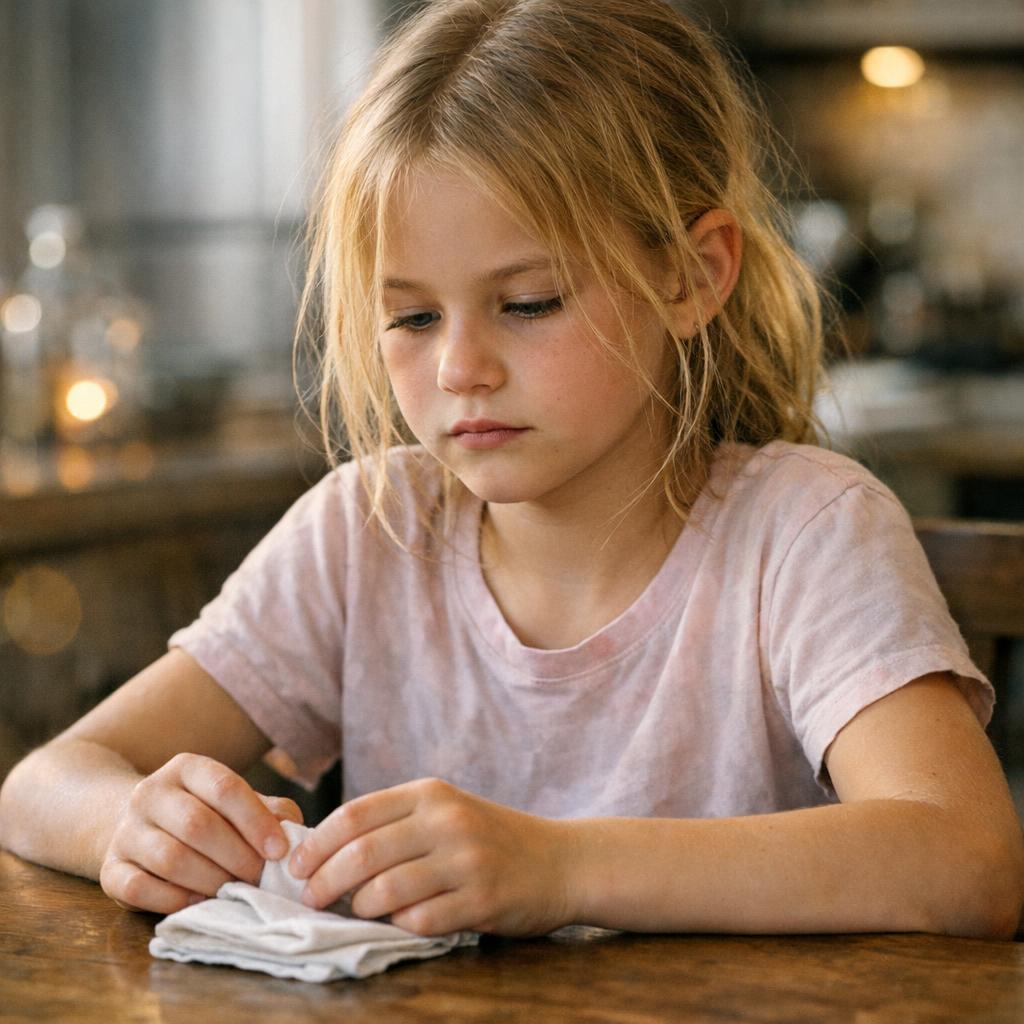 Image by RM AI
The Unanswered Calls
I spent the next three days in a frustrating game of phone tag with Ms. Carter. I called the school office twice, left detailed voicemails explaining my concerns, and sent three separate emails—each one more urgent than the last. My inbox remained stubbornly empty except for an automated 'out of office' reply that felt like a digital door slam. By Wednesday, I was refreshing my email every fifteen minutes like a teenager waiting for a crush to text back. Nothing. Meanwhile, Ava came home with another failed quiz, this one with a note scrawled in the margin: 'See me about this.' The irony wasn't lost on me—how exactly was I supposed to 'see' someone who wouldn't respond? When Ms. Carter finally deigned to reply on Thursday afternoon, her email was a masterclass in professional deflection: 'I understand your concerns and would be happy to meet when our schedules permit. How about next Tuesday at 3:15?' I wanted to scream. Next Tuesday? My daughter was dissolving before my eyes, and this woman was suggesting we wait another five days? I marked the date in my calendar and circled it twice in angry red pen, the same shade as the marks decimating Ava's schoolwork. That night, as I tucked Ava in, she whispered, 'Mom, Ms. Carter says I might have to go to the slow class if I don't do better.' Her voice was so small I almost missed it, but those words hit me like a physical blow. Slow class? Who tells a nine-year-old something like that? I kissed her forehead and promised everything would be okay, but inside, my patience had officially run out. Tuesday's meeting couldn't come fast enough, and when it did, Ms. Carter was going to discover that this labeled-lunch-container mom was about to become her biggest problem.
 Image by RM AI
The Tiny Chair
When Tuesday finally arrived, I walked into Room 23 with my shoulders back and my notes clutched in my hand like a shield. Ms. Carter's classroom hit me immediately with its almost clinical perfection—student work displayed in eerily identical formats, desks arranged in perfect rows, not a crayon or paper clip out of place. It reminded me of those Instagram organization accounts that make you feel inadequate about your junk drawer at home. Ms. Carter gestured to a tiny blue plastic chair across from her adult-sized desk, and I folded myself into it, my knees practically touching my chin. Nothing makes you feel more powerless than sitting in furniture meant for nine-year-olds while trying to advocate for your child. "Thank you for making time," she said with a smile that never quite reached her eyes. It was the kind of smile retail workers give difficult customers—professional but empty. I noticed how her desk was arranged with military precision: pens lined up by color, papers in perfect stacks, even her coffee mug positioned at exactly the same distance from her computer as her stapler. I glanced around at the student work on the walls—all formatted identically, all with similar praise written in the same red pen. "Excellent structure!" "Perfect format!" Not a single "Creative thinking!" or "Unique approach!" in sight. My heart sank as I realized there was no room for my dreamy, sometimes-messy Ava in this sterile environment. Ms. Carter folded her hands on her desk and said, "So, let's discuss Ava's... challenges," and the way she paused before that last word made my mama bear instincts roar to life.
 Image by RM AI
The Cold Diagnosis
Ms. Carter leaned forward in her adult-sized chair, her posture perfect as she delivered what felt like a medical diagnosis for a terminal condition. 'Ava lacks focus,' she said, ticking off each point on her manicured fingers. 'She doesn't retain instruction. She's consistently unprepared.' Each phrase landed like a stone in my stomach. This wasn't constructive feedback—this was a demolition. 'And frankly,' she continued, her voice softening in that way adults do when they're about to say something particularly cruel, 'she might be better served elsewhere if this continues.' My throat tightened. 'Elsewhere?' I repeated, hearing my voice crack slightly. 'What exactly does that mean?' Ms. Carter's smile was thin and practiced. 'Let's not jump ahead,' she said lightly, waving her hand as if dismissing a pesky fly. But the dismissal in her eyes told me everything—she'd already jumped ahead in her mind. She'd already decided my daughter's fate in this classroom. She just didn't want to say it out loud. I nodded and gathered my things, thanking her for her time with words that tasted like ash in my mouth. In the parking lot, I sat in my car and noticed my hands were shaking so badly I couldn't get the key in the ignition. What was happening? How had my bright, kind-hearted daughter become 'unsuitable' in just three weeks? And why did I have the sinking feeling that Ms. Carter had made up her mind about Ava long before she'd ever met her?
 Image by RM AI
The Homework Corner
That night, I transformed our dining nook into what I hoped would be Ava's sanctuary. I called it her 'homework corner,' complete with her favorite fuzzy pillows from the couch, a desk lamp with the perfect warm glow, and a little plant I let her name (she chose 'Leafy,' because nine-year-olds are nothing if not literal). I bought those color-coded folders—you know, the ones that cost way too much at Target but make you feel like you're solving problems just by purchasing them. Red for math, blue for reading, yellow for science. I hung a whiteboard calendar where we could track assignments together, using different colored markers for tests and projects. I even found these little motivational stickers that said things like 'You Got This!' and 'Brain Power!' because I'm that mom who still believes stickers solve problems. When everything was ready, I called Ava in from the living room. She stood in the doorway, eyes wide, taking it all in. Then she looked up at me with such naked hope that I had to physically turn away, pretending to adjust the lamp so she wouldn't see the uncertainty in my eyes. 'Is this all for me?' she whispered, running her fingers along the edge of the desk. 'All for you, baby,' I said, my voice steadier than I felt. That night, she sat in her new space, back straight, pencil gripped tight, looking like she was trying so hard to be the student Ms. Carter wanted. I watched her from the kitchen, wondering if any of this—the folders, the calendar, the stupid expensive stickers—would actually help if the problem wasn't really Ava at all.
 Image by RM AI
The Flashcard Game
I tried everything gentle first. You know that desperate mom energy—where you're convinced if you just find the right approach, you can fix whatever's broken? I turned our living room into a multiplication table treasure hunt, hiding flashcards behind couch cushions and under lamps, making Ava giggle when she'd find a '7×8' tucked inside her sneaker. 'Fifty-six!' she'd shout, and I'd cheer like she'd just won Olympic gold. We celebrated even the tiniest victories with impromptu dance parties in the kitchen—me doing my embarrassing mom moves to whatever pop song was stuck in my head that day, Ava laughing despite herself. Quiz days became special occasions where she got to pick dinner (always, ALWAYS mac and cheese with the shaped noodles, because apparently the regular kind is 'boring pasta'). But beneath all this manufactured fun, I kept gently probing: 'Baby, what's going on at school? Did something happen? Are you worried about something?' Each time, Ava would shrug those small shoulders and mumble, 'Nothing,' but her eyes would slide away from mine like marbles rolling across a tilted floor. It was the look of a child protecting a secret she didn't know how to name—or worse, a secret she thought she deserved to carry alone. One night, after she'd correctly answered fifteen flashcards in a row, I caught her staring at her reward sticker with such confusion, like she couldn't reconcile the success in our living room with whatever was happening in that classroom. That's when I realized all my colorful folders and dance parties were just Band-Aids on something much deeper—and the wound underneath was still bleeding.
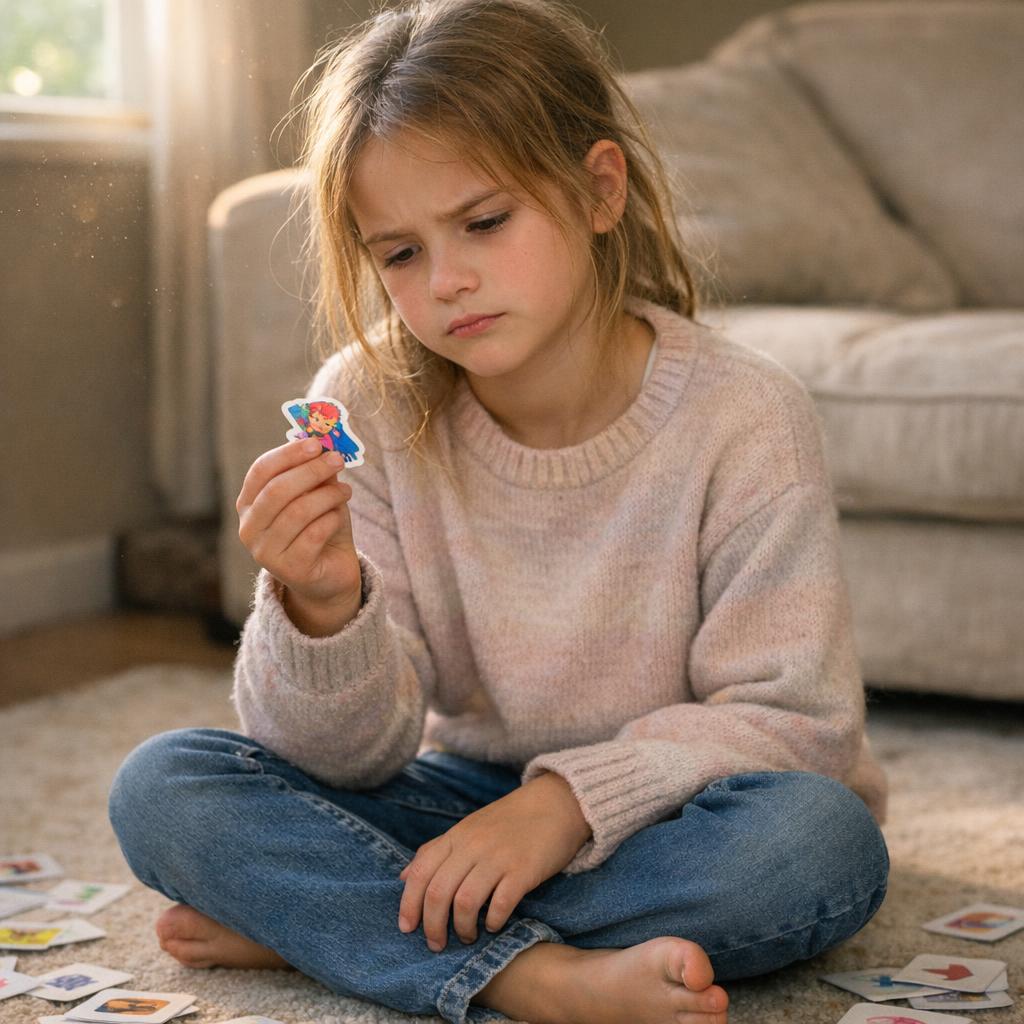 Image by RM AI
The Missing Planner
As the weeks went on, Ava's backpack became a black hole where school assignments mysteriously vanished. 'I forgot my planner,' she'd say, eyes downcast, fingers twisting the hem of her shirt. 'I think I lost the worksheet,' she'd whisper the next day. But this wasn't typical kid forgetfulness—you know, the kind where they genuinely don't care if their math homework feeds the family dog. No, Ava was meticulous about checking her desk before leaving school. She'd triple-check her folders. She'd even started this nervous habit of patting her backpack pockets before we left the house each morning. One evening, after another missing assignment, I sat beside her on her bed. 'Baby, what's really going on?' I asked, keeping my voice gentle. Her lower lip trembled as she looked up at me with those big brown eyes swimming with tears. 'I'm trying, Mom,' she whispered, her voice cracking. 'I'm really trying.' The way she said it—like she needed me to believe her before I gave up too—broke something inside me. This wasn't a child avoiding work; this was a child drowning in it, a child who cared so much she couldn't bear to fail anymore. So instead of showing me the evidence of her struggles, she was hiding it, protecting herself from whatever was happening in that classroom that made her feel so small. What terrified me most wasn't the missing assignments—it was wondering what else my daughter felt she needed to hide from me, and why.
 Image by RM AI
The Whispered Promise
That night, after Ava finally fell asleep, I sat at our kitchen table surrounded by her schoolwork, feeling completely helpless. The math sheet in front of me had eraser marks so deep they'd torn through the paper in spots. I traced my finger over where she'd written and rewritten the same problem, trying so hard to get it right. Earlier, she'd sat in this exact spot, hunched over that same worksheet, her voice barely audible when she whispered, 'I'm trying, Mom.' Those four simple words gutted me more than any failing grade ever could. The desperation in her eyes, like she was begging me not to give up on her—as if I ever could. When I tucked her in that night, I sat on the edge of her bed longer than usual, watching her clutch her stuffed rabbit the way she used to when she was much younger. 'Ava,' I said, taking her small hand in mine, 'I will always believe you're trying. Always.' Her eyes filled with tears, and she nodded, like she'd been holding her breath waiting for someone—anyone—to just believe in her. I kissed her forehead and turned off the light, lingering in her doorway. In the soft glow of her nightlight, I made a silent vow that whatever was happening in Ms. Carter's classroom, whatever was making my bright, beautiful girl shrink into herself, I would fix it. But as I closed her door, a nagging voice in my head wondered: what if trying wasn't enough? What if Ms. Carter had already decided my daughter's fate, regardless of how hard she worked?
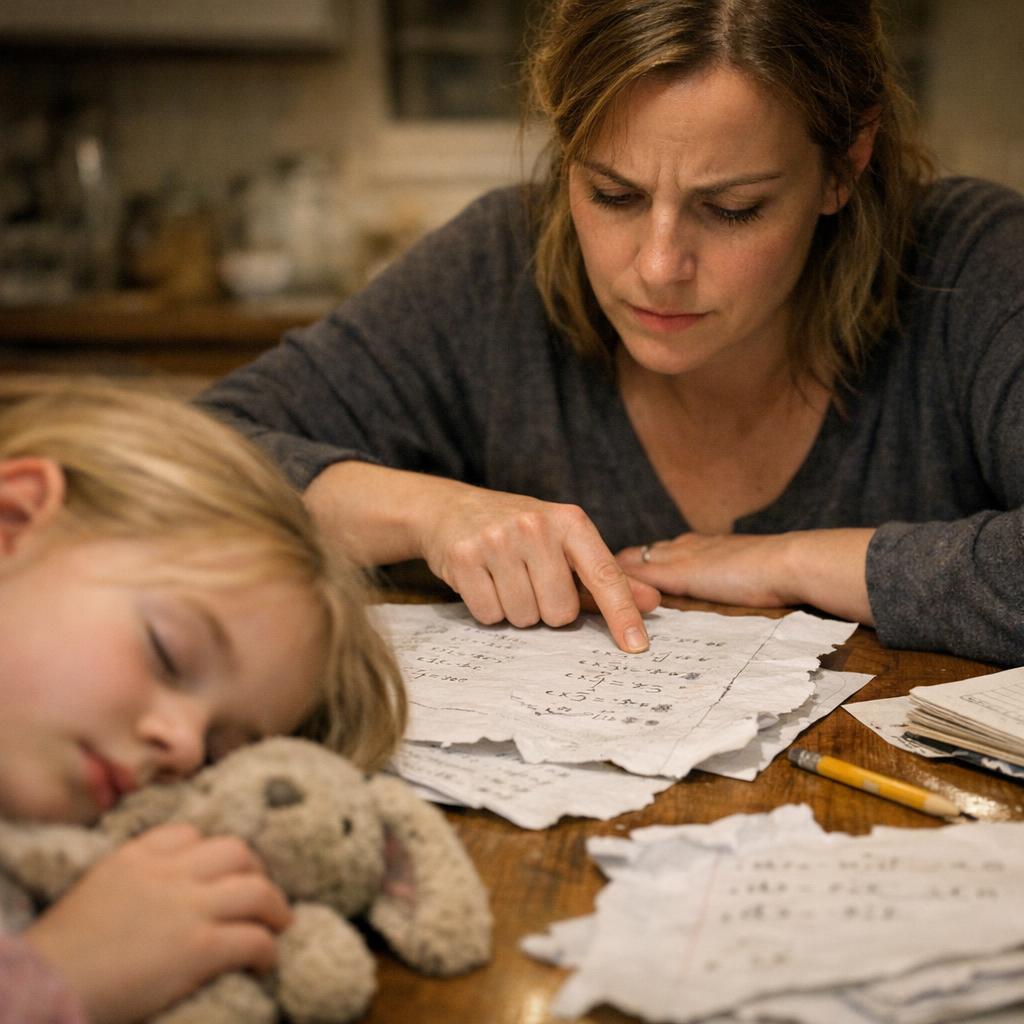 Image by RM AI
The Thursday Night Routine
Thursday nights were sacred in our house—my weekly reset ritual where I'd restore order to our little universe. While Ava soaked in a bubble bath (her one guaranteed quiet moment these days), I'd tackle the mountain of school debris that accumulated in her backpack. It was always the same: half-eaten granola bars fossilized in their wrappers, crumpled art projects I'd secretly save in my memory box, and at least one permission slip I'd already signed that somehow boomeranged back to me. I dumped everything onto the kitchen counter, sorting through the archaeological layers of my third-grader's week. That's when my fingers brushed against something different—a stiff folded paper tucked into the side pocket behind her library book. Not her usual chaotic worksheet or a note from the school nurse. This was crisp, intentionally hidden. I hesitated, my hand hovering over it. As a mom, you develop this sixth sense about discoveries in backpacks—the birthday party invitations that make your kid bounce with excitement versus the crumpled test papers they never want you to see. This paper felt like neither. It felt... official. Important. Secret. I glanced toward the bathroom where I could hear Ava humming to herself, blissfully unaware, and slowly pulled the paper from its hiding place. What I found inside would change everything I thought I understood about my daughter's struggles.
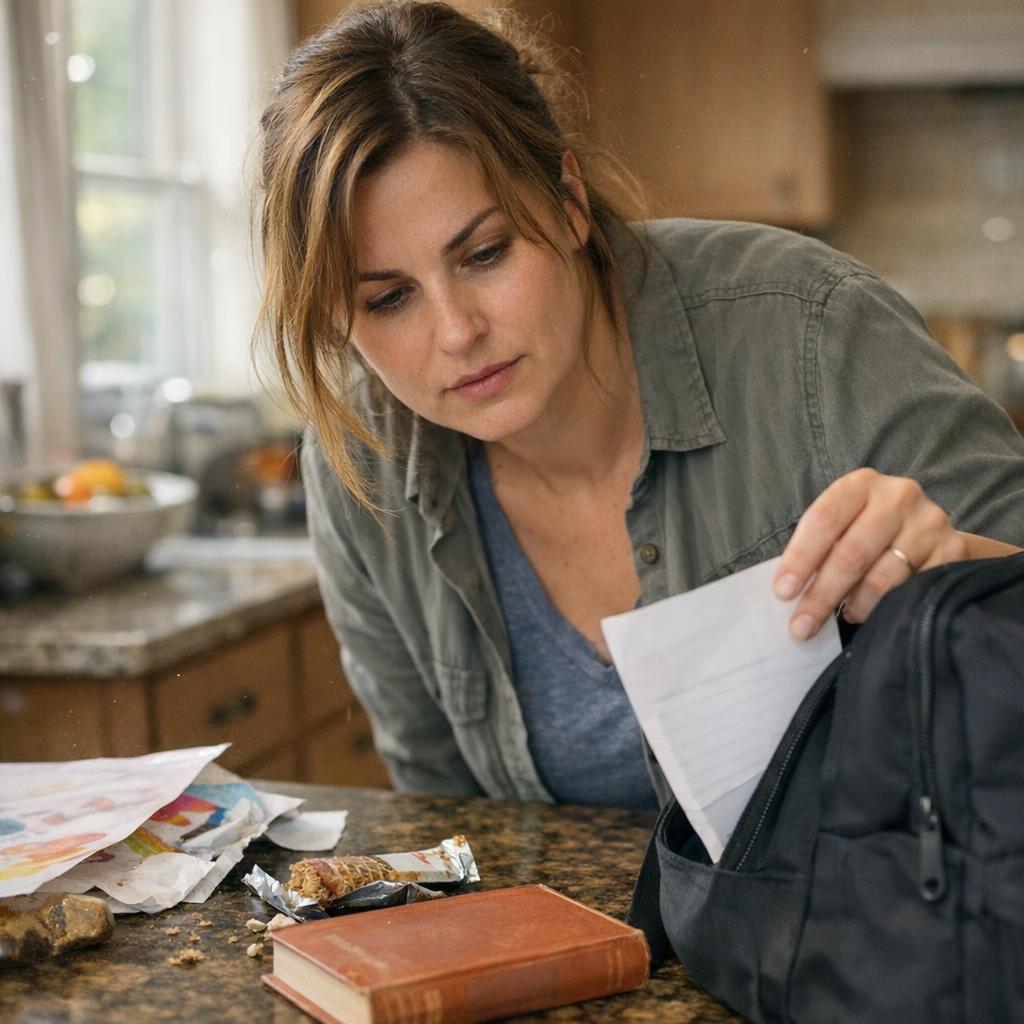 Image by RM AI
The Confidential Document
I unfolded the paper with the casual curiosity of a mom who's seen it all—permission slips for field trips I'd already paid for, lunch menus I'd already memorized. But this wasn't any of those things. My fingers froze as I registered what I was holding: 'Confidential: Student Support Notes' blazed across the top in bold, official font, with Ms. Carter's name in the header like it had been printed directly from the school's system. This wasn't meant for parent eyes. This wasn't meant for my eyes. I glanced toward the bathroom where Ava was still singing to her bubble mountains, blissfully unaware of what I'd just discovered. My heart hammered against my ribs as I smoothed the creases, wondering how this ended up tucked in my daughter's backpack—and more importantly, why it was marked confidential. The bathroom pipes groaned as Ava turned off the water, giving me maybe two minutes before she'd pad out in her towel asking for help with her hair. I took a deep breath and forced myself to actually read the document, not just stare at it in shock. What I saw in those neatly typed bullet points made my stomach drop so fast I had to grip the counter to steady myself. This wasn't a teacher's notes about helping my struggling child—this was something far more calculated, far more deliberate. And as my eyes reached the bottom of the page, I realized with sickening clarity that Ms. Carter's issue with my daughter had nothing to do with Ava's abilities at all.
 Image by RM AI
The Bullet Points
My hands trembled as I stared at the bullet points beneath Ava's name. This wasn't a normal teacher log—it was a calculated battle plan. 'Highlight poor performance to establish pattern,' the first point read, followed by 'Use 'not a good fit' language' and 'Recommend evaluation if mother pushes back.' I felt physically ill as I recognized each phrase—the exact words Ms. Carter had used in our meeting, delivered with that practiced smile that never reached her eyes. This wasn't spontaneous teacher feedback; she'd been reading from a script all along. I leaned against the kitchen counter, suddenly needing its support as the room seemed to tilt around me. The document in my hands wasn't just unprofessional—it was predatory. Each bullet point matched a conversation we'd had, each strategy designed to make my daughter seem deficient when she wasn't. The clinical precision of it made my skin crawl. This wasn't a teacher concerned about a struggling student; this was someone methodically building a case against my child. I glanced toward the bathroom where Ava was still humming, blissfully unaware that her teacher had been gaslighting her—gaslighting us both—with calculated precision. But the most chilling part was yet to come, as my eyes drifted to the final bullet point at the bottom of the page, and suddenly everything about Ms. Carter's behavior made perfect, terrible sense.
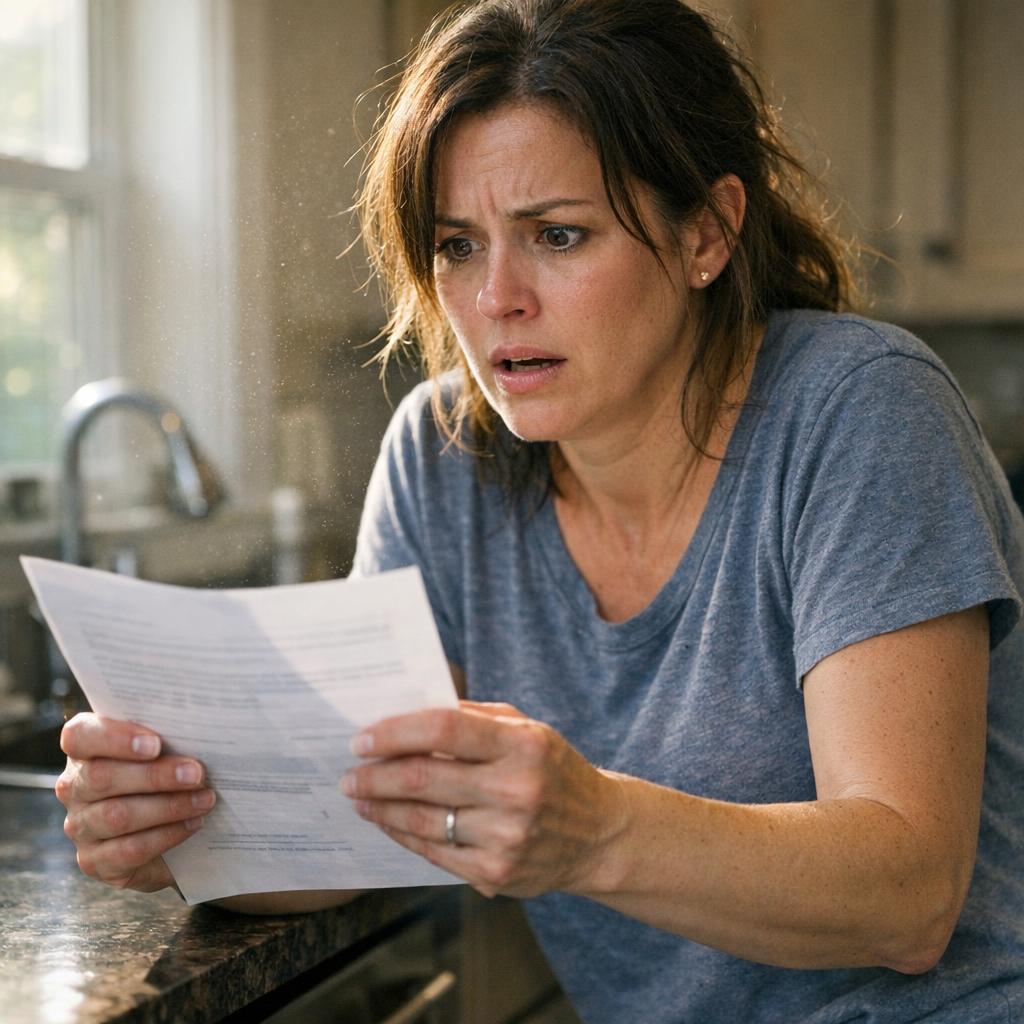 Image by RM AI
The Final Line
And then, there it was—the line that made my hands start shaking so badly I nearly dropped the paper: 'Goal: move Ava out of enrichment track consideration—slot needed.' I read it three times because my brain refused to process what my eyes were seeing. Enrichment track? Slot needed? In my mind, school was school—you did your best, you learned, you moved forward. But this document painted a completely different reality: a cutthroat competition I didn't even know my daughter was part of, with Ms. Carter actively working to eliminate her. I suddenly remembered that note from last spring about a new 'accelerated reading group' for third graders. Limited spots. Teacher recommendations required. Ava had bounced around the kitchen when she got it, saying, 'Ms. Jensen thinks I could do it, Mom!' I'd smiled and hugged her, thinking it was just another school program. Now I understood with sickening clarity—this wasn't about Ava's abilities at all. This was about someone deciding my daughter was taking up space that could be used for... what? Someone more deserving? Someone more connected? The room seemed to tilt as I gripped the counter, trying to steady myself. All those failing quizzes, all those dismissive comments, all those 'concerns' about Ava's suitability—none of it was real. My daughter wasn't failing; she was being failed by the very person who was supposed to help her succeed. And I had a terrible feeling I knew exactly who Ms. Carter thought deserved that 'slot' instead.
 Image by RM AI
The Spring Note
I rummaged through our family bulletin board—that chaotic collection of takeout menus, school calendars, and the occasional birthday card that somehow never makes it to the trash. My fingers pushed past expired coupons and Ava's artwork until I found what I was looking for: that innocent-looking flyer from last spring. 'Accelerated Reading Group: Building Tomorrow's Leaders Today!' it announced in cheerful blue font with little cartoon books dancing across the top. I remembered how Ava had clutched it to her chest, eyes wide with possibility. 'Ms. Jensen thinks I could do it, Mom!' she'd said, practically vibrating with excitement. Her second-grade teacher had even written a little note in the margin: 'Ava would thrive here!' I'd smiled, filed it away mentally as something to revisit in the fall, and then promptly forgotten about it in the summer chaos of popsicles and sprinklers and sunscreen battles. Now, staring at this paper with its limited spots and teacher recommendations required, the pieces clicked together with nauseating clarity. This wasn't just some enrichment opportunity—it was a golden ticket, a pathway that apparently some parents would do anything to secure for their children. Including, it seemed, sabotaging a nine-year-old who stood in their way. I traced my finger over Ms. Jensen's encouraging note, now faded but still visible, and felt something cold settle in my stomach as I realized exactly what Ms. Carter was protecting—and who she was protecting it for.
 Image by RM AI
The First Instinct
My first instinct was to march into that school with the paper held up like a flag and demand answers. I imagined the confrontation in vivid detail: striding through those squeaky hallways, bursting into the principal's office without an appointment, watching Ms. Carter's perfectly composed face crumble as I exposed her scheme. For a moment, I even let myself enjoy the fantasy of justice served immediately, like one of those viral videos where someone catches a scammer in the act. But as I stood in my kitchen, document trembling in my hand, a lifetime of being the reasonable one—the mom who brings extra snacks to soccer games and emails teachers with 'just checking in'—pulled me back from the edge. That, and something more important: Ava's face flashed in my mind, how she'd look if this blew up into a school-wide scandal with her at the center. I took three deep breaths, the way my therapist had taught me during my divorce. This wasn't about my righteous anger; it was about protecting my daughter. And at the bottom of the page, I noticed something else that made me pause: a list of initials next to 'priority families,' and one of them matched Ms. Carter's last name. Carter. That's when I realized I needed to be strategic, not just furious. Because this wasn't just about a teacher being unfair—this was about something much more calculated, and rushing in might destroy the evidence before I could prove what was happening.
 Image by RM AI
The List of Initials
I stared at the list of initials, my heart pounding so hard I could feel it in my fingertips. 'Priority families,' it said, with five sets of initials neatly typed beside it. And there it was—'C.L.'—Carter, Lila. Ms. Carter's daughter. The realization hit me like a physical blow, making me sink onto one of our kitchen stools. I remembered Ms. Carter at open house, her voice dripping with that humble-brag tone all parents recognize: 'Lila's just like me, she loves structure.' I'd smiled politely then, thinking it was just another mom trying to connect. God, how naive I'd been. This wasn't just about a teacher being unfair—this was about a mother using her position to clear the path for her own child. These weren't random initials; they were a ranking system, a predetermined list of who deserved opportunity. And my Ava? She was in the way. I felt sick imagining Ms. Carter sitting at her computer, typing up this hit list against children—CHILDREN—who threatened her daughter's advancement. What kind of person does that? What kind of teacher? What kind of mother? I traced my finger over the initials, wondering about the other kids who'd been deemed worthy while mine had been marked for academic execution. The twist was so unexpected, so petty, that I almost couldn't believe it was real. But the evidence was right there in black and white: Ms. Carter didn't just teach at the school—she was competing inside it, using her position to shape who 'deserved' opportunities, and my daughter was collateral damage in a game she didn't even know she was playing.
 Image by RM AI
The Humble Brag
I sat on my kitchen floor, the document clutched in my trembling hands, as Ms. Carter's words from open house echoed in my head. 'Lila's just like me, she loves structure,' she'd said with that practiced smile, the kind that screams 'my kid is better than yours' without actually saying it. At the time, I'd nodded politely, thinking it was just typical mom-to-mom small talk. You know the kind—where we're all trying to connect while secretly hoping our kids aren't the ones eating glue in the corner. But now? Now I understood with sickening clarity what was really happening. This wasn't just a teacher doing her job. This was a mother waging war from the inside, using her position of power to clear the competition—MY CHILD—from her own daughter's path. The realization hit me like a ton of bricks: Ms. Carter wasn't just Ava's teacher; she was Lila's mother first, and apparently, that meant anyone threatening her daughter's advancement had to be eliminated. I leaned against the cabinet, trying to process this betrayal. How many other children had she pushed aside to make room for her precious Lila? How many other parents were sitting at kitchen tables wondering why their once-confident kids were suddenly falling apart? The thought made me physically ill. But beneath the nausea, something else was building—a slow-burning rage that started in my stomach and worked its way up to my chest. Because if Ms. Carter thought she could sacrifice my daughter's confidence, her love of learning, her FUTURE on the altar of her own ambition, she was about to learn exactly what kind of mother she was dealing with.
 Image by RM AI
The Quiet Strategy
The next morning, I woke up with a clarity I hadn't felt in weeks. Instead of storming into school with righteous mom-fury (which, believe me, was my first instinct), I channeled my inner spy. While Ava ate breakfast, I carefully photographed that damning document from every angle, making sure the school letterhead and Ms. Carter's name were crystal clear. I created a password-protected folder on my laptop called 'Ava's School Records'—innocent enough if anyone glanced at my screen, but inside was the beginning of my case. I even took screenshots of all those voicemails where Ms. Carter's tone shifted from professional to dismissive, transcribing them word for word. You know how they say the best revenge is living well? Well, sometimes the best revenge is documenting everything so thoroughly that no one can gaslight you later. As I drove Ava to school, watching her little shoulders tense as we approached the building, I squeezed her hand and said, "I've got you, baby." She didn't know what I meant yet, but I did. This wasn't just about one bad grade or one mean teacher anymore—this was about a grown woman who'd decided my child was disposable, an inconvenience to be eliminated. And if there's one thing you should never do, it's underestimate a mother who's protecting her child. Ms. Carter thought she was dealing with a pushover parent who'd accept whatever narrative she created. She was about to discover just how wrong she was.
 Image by RM AI
The Red Marks
With my newfound detective mindset, I started digging deeper into Ava's schoolwork. I pulled out every quiz, every worksheet from her folders, spreading them across our dining table like evidence at a crime scene. That's when I spotted something that made my blood run cold – two quizzes with red marks that just didn't add up. One math problem in particular caught my eye; Ava had clearly written the correct answer, but it was marked wrong with an aggressive red X. Even more suspicious was a faint smudge on another problem, like someone had erased her original answer and changed it. 'Ava, honey,' I called softly, 'can you come solve this problem for me?' She sat down, nervously chewing her lip as she worked through the equation. Within seconds, she had the answer – the exact same answer she'd written on her quiz. When I showed her how it had been marked incorrect, her face crumpled. 'But that's the right answer,' she whispered, her voice so small it barely reached across the table. 'I know it is.' I watched as the last shreds of her confidence visibly dissolved before my eyes. This wasn't just a teacher being strict; this was deliberate sabotage. My daughter wasn't failing math – her math was being failed by someone with an agenda. And as I gathered those quizzes with their suspicious markings, I realized Ms. Carter had made a critical mistake: she'd left behind physical evidence of her manipulation.
 Image by RM AI
The Side Table
That evening, after dinner, I sat with Ava on her bed, surrounded by her stuffed animals—her protective circle, as she called them. 'Honey,' I asked, keeping my voice gentle, 'does Ms. Carter ever take your papers before you're finished?' Ava's fingers immediately found her sleeve, twisting the fabric—her nervous tell since kindergarten. The silence stretched between us, heavy with things unsaid. 'Sometimes,' she finally whispered, eyes fixed on her lap. 'She says I'm distracting others and puts me at the side table.' My stomach clenched. I knew exactly which table she meant—that isolated desk in the corner I'd spotted during my classroom visit, positioned to face the wall instead of the class. A modern-day dunce cap without the pointed hat. 'And sometimes,' Ava continued, her voice so small I had to lean closer, 'she takes my test and says she'll bring it back, but then she doesn't.' Tears welled in her eyes. 'When I ask for it later, she says I never gave it to her.' The revelation hit me like a physical blow. This wasn't just about manipulating grades after the fact—Ms. Carter was actively preventing Ava from completing her work in the first place. 'Why didn't you tell me before, baby?' I asked, brushing hair from her forehead. Ava's answer broke my heart into a thousand pieces: 'Because Ms. Carter said if I made problems, you'd get mad and I'd have to change schools.' My daughter had been silenced by the very person who was supposed to be her advocate, and the realization that she'd been carrying this burden alone made me wonder what else Ms. Carter had been saying when no other adults were around.
 Image by RM AI
The Threat of Change
I sat on Ava's bed that night, my heart shattering as her words hung in the air between us. 'Because Ms. Carter said if I made problems, you'd get mad and I'd have to change schools.' Her voice cracked on the last word, and I watched my daughter's shoulders curl inward like she was trying to disappear. This wasn't just about manipulated grades or stolen opportunities anymore—this was psychological warfare waged against a nine-year-old by someone with a teaching license. Ms. Carter had deliberately weaponized my daughter's greatest fear: disappointing me. She'd turned Ava's trust into a prison, convincing her that speaking up would cost her everything familiar. I pulled Ava into my arms, feeling her thin shoulders shake with sobs she'd been holding back for weeks. 'Listen to me,' I whispered fiercely into her hair, 'there is NOTHING—absolutely nothing—you could ever do that would make me send you away.' I tilted her tear-streaked face up to mine. 'You are stuck with me forever, kid. No take-backs, no exchanges, no returns.' That earned me a watery smile. 'Even if I put gum in your hair?' she asked tentatively. 'Even then,' I promised, 'though I might question your artistic choices.' As she finally drifted off to sleep, her stuffed animals forming a protective barrier around her, I sat in the hallway with my back against her door, rage and determination crystallizing into something dangerous. Ms. Carter had no idea what she'd awakened by threatening my child with abandonment—but she was about to find out exactly what happens when you mistake a mother's patience for weakness.
 Image by RM AI
The Weekend Research
That Saturday morning, I became a mom on a mission. I texted two other mothers I trusted from Ava's class—casual messages that seemed innocent enough: 'Hey, how's Tyler adjusting to third grade?' and 'Is Emma enjoying Ms. Carter's class?' When Jenny called back, there was a hesitation in her voice that told me everything before she even spoke. 'Tyler's been having these mysterious stomachaches every reading day,' she confessed. 'The pediatrician can't find anything wrong.' I gripped my phone tighter, scribbling notes while balancing coffee in my other hand. Then Melissa admitted something that made my skin crawl: her daughter Emma had been told she 'wasn't leadership material' after answering too many questions in class. 'She used to love raising her hand,' Melissa said, her voice cracking. 'Now she sits on her hands to stop herself.' As they talked, I documented everything, watching a disturbing pattern emerge on my notepad: children who asked questions, who needed extra time, who didn't fit neatly into Ms. Carter's predetermined boxes—all suddenly labeled as 'problems.' These weren't bad kids. They were just kids who took up space in ways Ms. Carter found inconvenient. By Sunday night, my kitchen table looked like a detective's murder board, covered with sticky notes connecting dots I wished weren't there. The most chilling part wasn't just what Ms. Carter was doing—it was how many children were suffering in silence, thinking they were the problem when the real problem was wearing a teacher's badge.
 Image by RM AI
The Patterns
By Monday morning, I'd transformed our dining room into something between a detective's office and a conspiracy theorist's basement. Three different colored highlighters, sticky notes everywhere, and a spreadsheet that would make my corporate friends proud. I was mapping patterns—which kids were thriving, which were struggling, which parents volunteered at school events. The connections made my skin crawl. Children who received Ms. Carter's praise shared striking similarities: they were quiet, followed directions without question, and—surprise, surprise—many had parents who chaired PTA committees or sat on the school board. Meanwhile, kids like Ava—creative thinkers, question-askers, or those whose parents couldn't chaperone every field trip—were systematically being labeled as 'problems.' It wasn't random struggling; it was calculated elimination. I color-coded each child's situation: green for thriving, yellow for holding steady, red for suddenly struggling. The red column was filled with kids who'd been doing fine until Ms. Carter's class. I noticed something else disturbing—the timing. Ava's decline started the week after she received that summer reading award, the one Ms. Carter's daughter Lila had also been nominated for. I stared at my kitchen wall, covered in evidence of a grown woman's vendetta against children who threatened her daughter's spotlight, and felt something cold settle in my chest. This wasn't just about Ava anymore—it was about every child being sorted and labeled by someone who'd weaponized her authority. And I was beginning to understand that the most dangerous person in a school isn't always the bully on the playground.
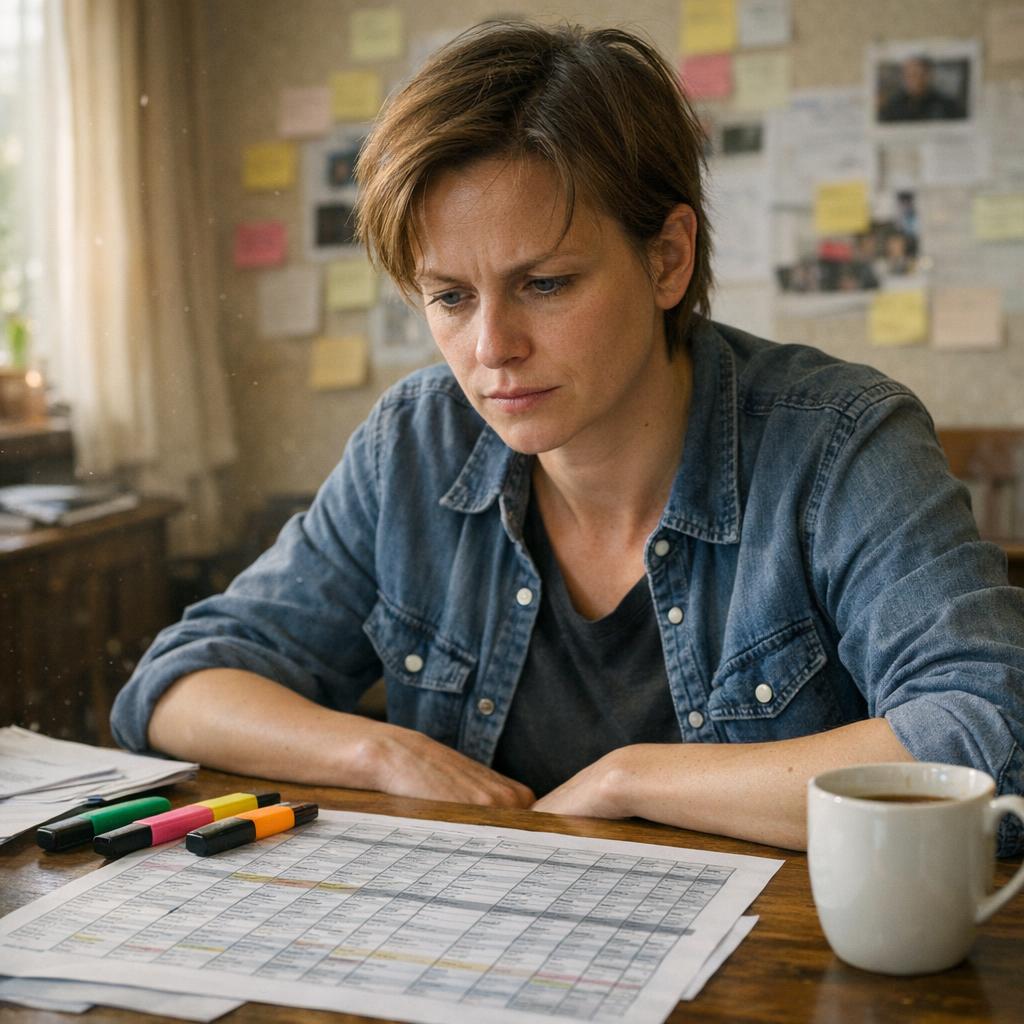 Image by RM AI
The Evidence Folder
Monday morning, I transformed into a different kind of mom—not the one who bakes cookies for class parties, but the one who builds a case. I sat at our kitchen table with a crisp manila folder labeled simply "Ava," methodically organizing what had become undeniable evidence. Inside: printouts of every email exchange with Ms. Carter (highlighting her increasingly dismissive tone), screenshots of voicemails I'd transcribed word for word (including that chilling one about Ava's "suitability"), those suspiciously marked quizzes with their erased answers, and of course, that damning "confidential notes" document that had started it all. The most revealing piece was the timeline I'd created, showing exactly when Ava's grades began to plummet: the week after the summer reading assembly where Ava had received a certificate and Ms. Carter's daughter Lila hadn't. I even added that certificate to my folder—a simple paper with a gold star that apparently had triggered an adult's vendetta against my child. It seemed almost too petty to be real, which is exactly what made it so disturbing. This wasn't some elaborate conspiracy; this was something far more common and insidious—a grown woman with authority using her position to punish a child who had unknowingly stepped into her daughter's spotlight. As I closed that folder, securing it with a binder clip, I realized I wasn't just fighting for Ava anymore. I was fighting for every kid who'd ever been on the wrong side of an adult's wounded ego.
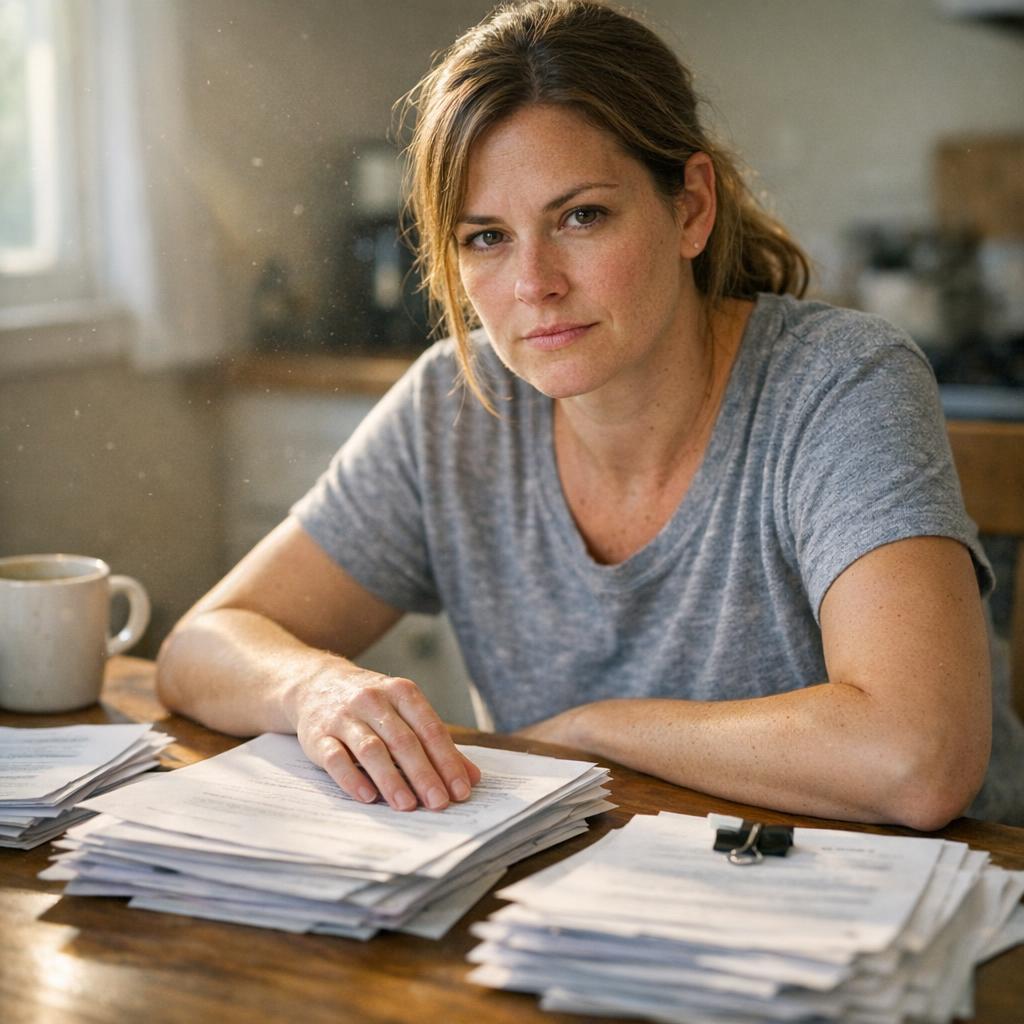 Image by RM AI
The Urgent Request
I called the school first thing Tuesday morning, my voice steady despite the storm brewing inside me. 'I need to meet with Principal Donovan and the counselor,' I told the secretary, who immediately offered me a slot 'sometime next month.' I almost laughed. 'No,' I said, my voice dropping to that dangerous-calm tone my ex-husband used to call my 'final warning voice.' 'This week. My child is being targeted.' I wasn't yelling or making a scene—I was just absolutely certain, and something in my tone made the secretary's eyes widen. She glanced at her computer screen, clicked a few times, and suddenly discovered a miraculous opening for Wednesday morning. Funny how that happens when you refuse to be dismissed. As I turned to leave, the hair on the back of my neck stood up—that primal feeling of being watched. I glanced back to find Ms. Carter standing in her classroom doorway, arms crossed, watching me with an expression I couldn't quite read. Was it concern? Annoyance? Or something closer to fear? Our eyes locked for just a moment before she retreated into her classroom, and I realized something important: she hadn't expected me to fight back. She'd assumed I was just another overwhelmed mom who would accept whatever narrative she created. But I wasn't just any mom—I was Ava's mom. And I was coming with receipts.
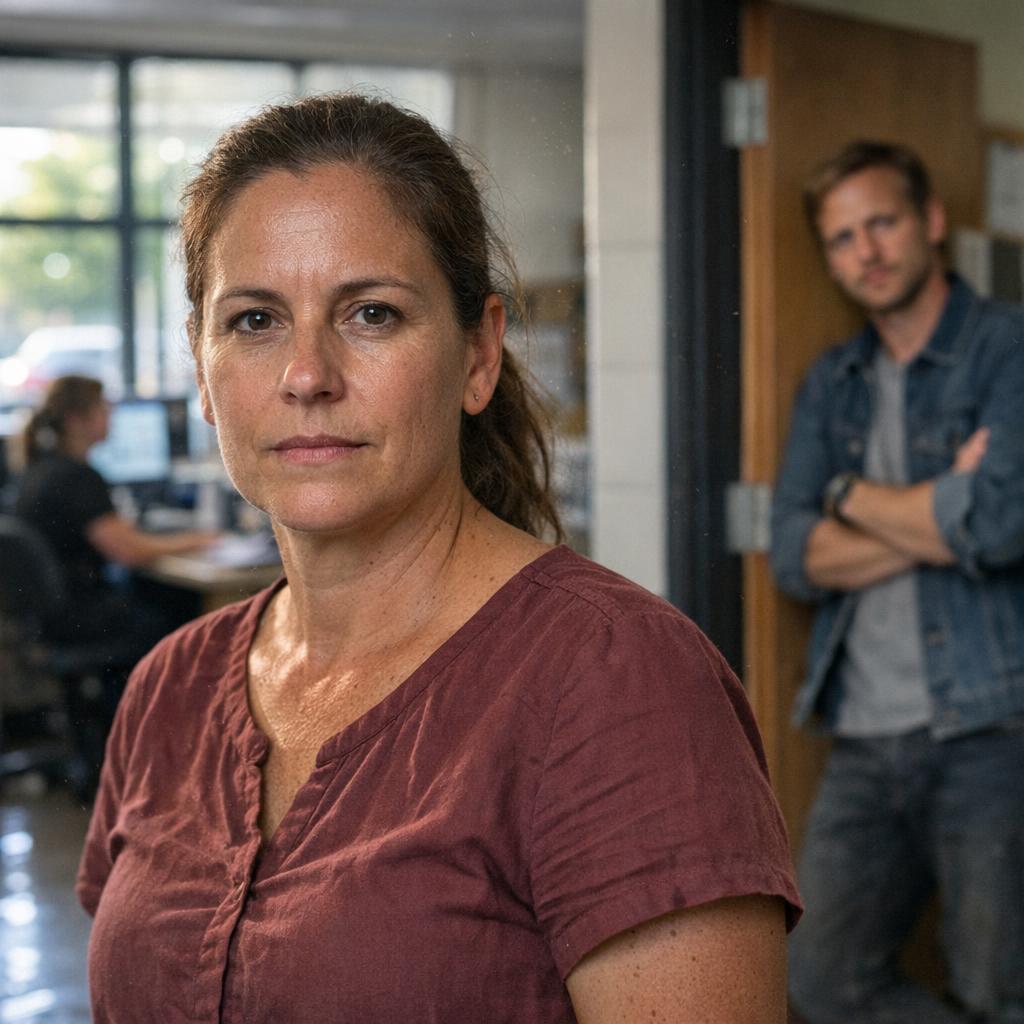 Image by RM AI
The Waiting Game
Those two days before the meeting felt like an eternity. I practiced what I'd say in front of my bathroom mirror, rehearsing how to present evidence without sounding like a conspiracy theorist or an overprotective mom gone wild. 'Stick to the facts, Marissa,' I whispered to my reflection. 'Don't cry, don't yell, don't let them see you break.' At night, after tucking Ava in, I'd spread her homework across our kitchen table, staring at instructions that seemed deliberately designed to confuse a nine-year-old. One math worksheet contradicted everything she'd learned in second grade, with new terminology that wasn't even in her textbook. When Ava struggled through it the next evening, tears of frustration welling in her eyes, I put my hand over hers. 'It's okay to be confused, baby,' I told her softly. 'Sometimes the problem isn't you—it's how something is being taught.' The way she looked at me then—like I'd thrown her a lifeline when she was drowning—broke something inside me. Her little shoulders relaxed for the first time in weeks, and she whispered, 'Really? It's not just me being stupid?' I pulled her into a fierce hug, fighting back tears. 'You have never been stupid a day in your life,' I said into her hair. That night, as I added her confusing homework to my evidence folder, I realized Ms. Carter hadn't just been sabotaging Ava's grades—she'd been systematically dismantling my daughter's belief in herself, one red mark at a time.
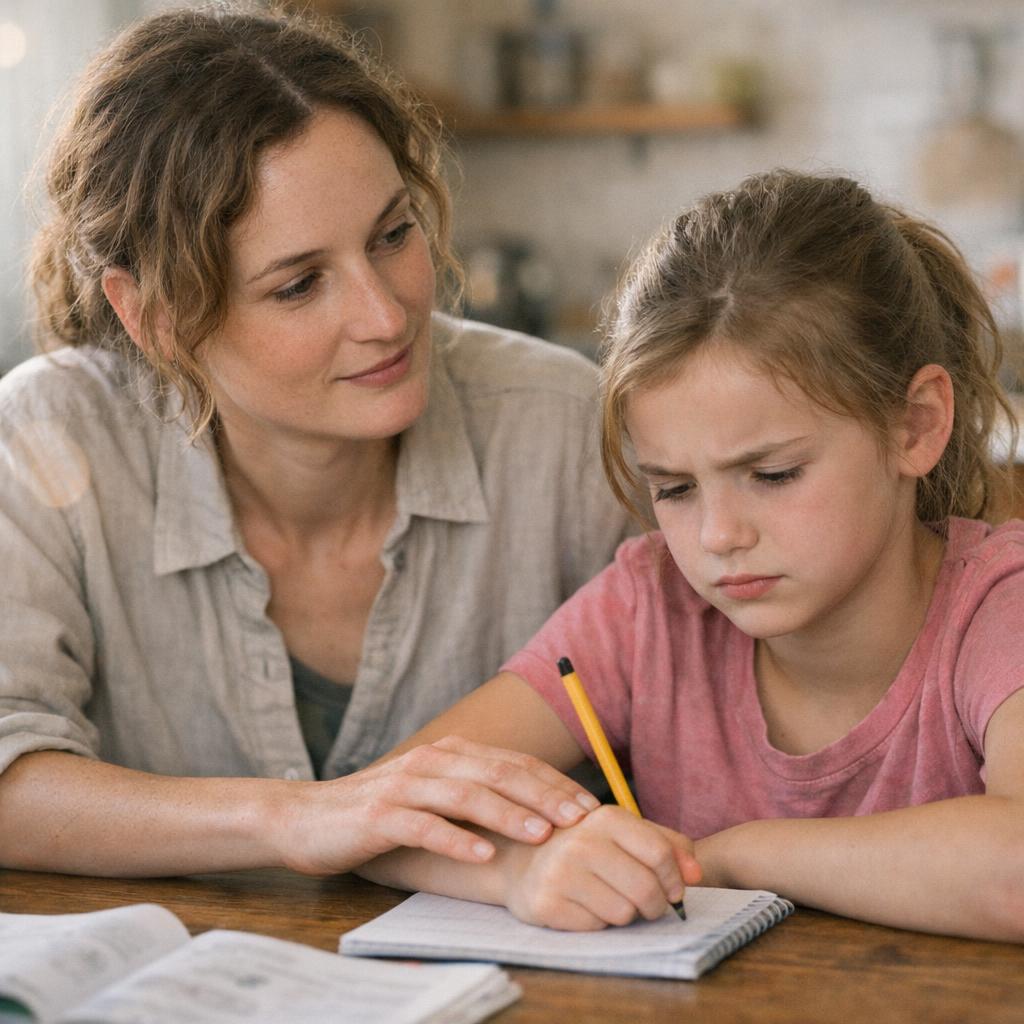 Image by RM AI
The Principal's Office
Wednesday morning arrived with a knot in my stomach that felt like it was made of concrete. I dressed carefully—not too casual, not too formal—wanting to look like a reasonable mom, not a woman on the edge. Walking into that principal's office felt like entering a courtroom where I was both the prosecutor and the defendant. Principal Winters sat behind her desk with the school counselor, Ms. Patel, beside her. Both wore those carefully neutral expressions that professionals perfect when they're preparing to manage a 'difficult parent.' I didn't cry, even though my eyes burned with exhaustion and anger. Instead, I laid my manila folder down on Principal Winters' desk with steady hands and said, 'I don't know what's happening, but I do know this paper was in my daughter's backpack, and it describes a plan to push her out of opportunity. If this is a misunderstanding, I would love an explanation.' My voice didn't waver. Principal Winters opened the folder slowly, like it might contain something dangerous. In a way, it did. I watched her face as she read the first page—that damning 'confidential notes' document with its bullet points of calculated sabotage. Her professional mask slipped for just a second, her eyebrows shooting up before she could control them. She glanced at Ms. Patel, a silent communication passing between them that told me everything: this wasn't the first time they'd heard complaints about Ms. Carter, but it was probably the first time someone had brought receipts. What happened next would change everything—not just for Ava, but for every child who'd been quietly pushed aside to make room for someone else's ambition.
 Image by RM AI
The Changing Faces
I watched as Principal Winters' professional mask cracked in real time. Her eyes widened slightly, then narrowed as she flipped through my meticulously organized evidence. The counselor, Ms. Perez, had gone completely still beside her, that particular kind of frozen that happens when someone realizes they've missed something important. They exchanged a look that made my stomach drop—not just surprise, but something that looked uncomfortably like recognition. Had they heard complaints before? Had other parents tried to speak up without the paper trail I'd assembled? The silence in the room stretched until it felt physical, broken only by the soft sound of pages turning as Principal Winters examined each document. I kept my hands folded in my lap to hide their trembling, determined to appear calm and rational even though inside I was screaming. When Principal Winters finally looked up, her face had transformed from polite skepticism to something much more serious. "Mrs. Jenkins," she said, her voice carefully measured, "where exactly did you find this document?" The way she asked—not dismissing it as fake or misunderstood, but asking for its source—told me she recognized it as legitimate. My heart pounded as I realized we'd crossed some invisible line. This wasn't going to be brushed away with platitudes about "different learning styles" or "adjustment periods." The adults across from me were suddenly seeing what I'd been trying to tell them for weeks: something was very wrong in Ms. Carter's classroom, and it wasn't my daughter.
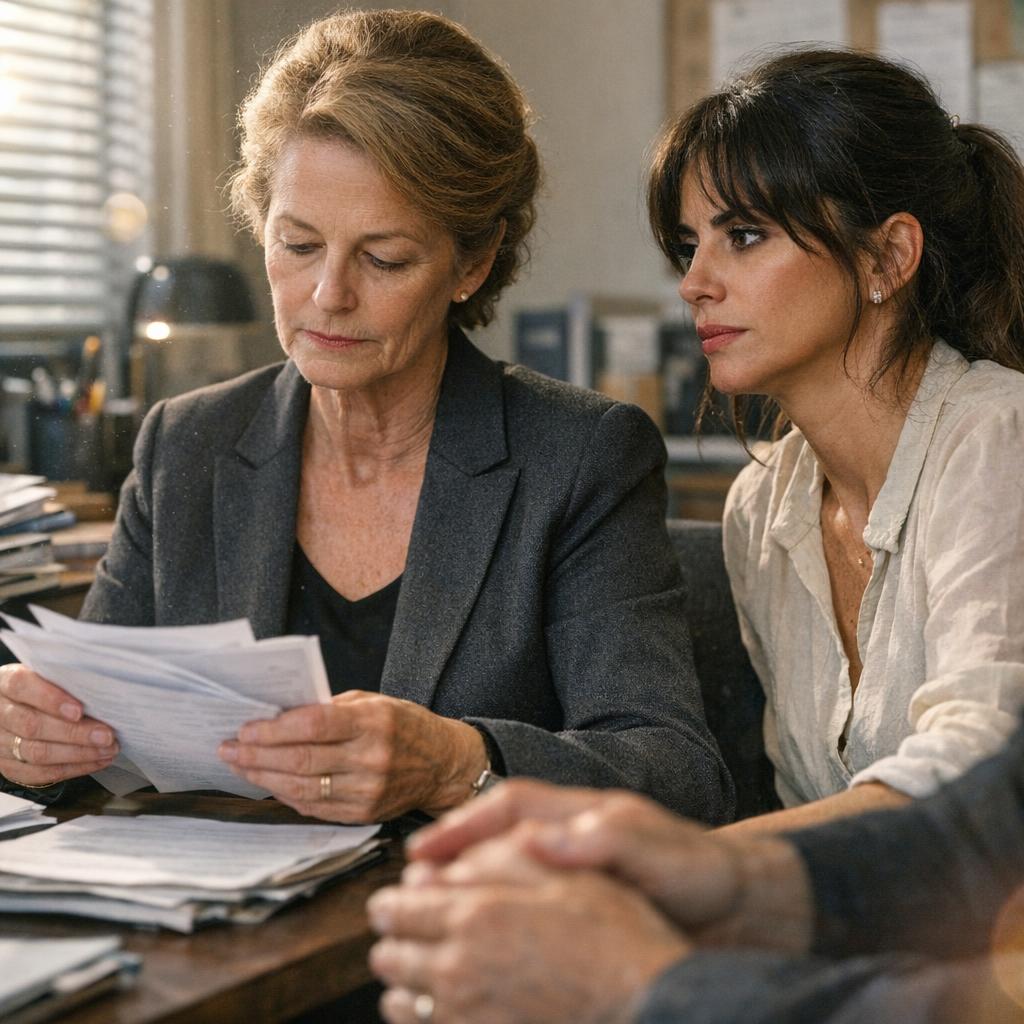 Image by RM AI
The Final Twist
Principal Winters cleared her throat, her fingers tapping nervously on my folder. 'Mrs. Jenkins, there's something you should know.' She glanced at Ms. Perez before continuing. 'Ms. Carter has been... quite vocal about the accelerated reading program.' My confusion must have shown on my face because she continued, her voice dropping lower. 'She's been lobbying for her daughter Lila's placement in the program for weeks, citing what she calls 'continuity needs.'' The principal's eyes met mine directly. 'And she's already informally suggested to the committee that certain students—including Ava, specifically—might not be able to handle the academic rigor.' The words hit me like a physical blow. This wasn't about Ava's performance at all. This was about clearing competition for Ms. Carter's own daughter. My mind flashed to all those red marks, the side table isolation, the 'lost' assignments—they weren't random acts of strictness. They were calculated steps to build a case against my child. I gripped the arms of my chair to steady myself as the full picture finally came into focus. Ms. Carter wasn't just playing favorites; she was systematically eliminating threats to her daughter's advancement. And my bright, creative, kind-hearted Ava was simply collateral damage in another mother's ambition. The realization made me feel simultaneously sick and strangely calm—because now I knew exactly what we were fighting, and it wasn't my daughter's abilities at all.
 Image by RM AI
The Administrative Response
What followed wasn't the dramatic showdown I'd imagined while rehearsing in my bathroom mirror. There were no raised voices, no tearful confessions, no Hollywood moment where Ms. Carter was escorted from the building with her belongings in a cardboard box. Instead, it was all terrifyingly professional—like watching a surgical procedure performed with perfect precision. Principal Winters spoke in careful, measured tones about 'taking this very seriously' and 'immediate action steps.' The counselor took notes in a small leather-bound book, her handwriting tight and controlled. I recognized the language of institutions protecting themselves while also addressing a problem they couldn't ignore. Within hours, I received an email confirming Ava would be transferred to Mrs. Gonzalez's class 'effective immediately.' By the next afternoon, Ms. Carter was placed on 'administrative leave pending investigation'—those bloodless words that mean everything and nothing at once. The school board scheduled an emergency closed session. Parents received a vaguely worded email about 'reviewing grading practices to ensure consistency.' It was all so neat, so contained, so utterly devastating in its quiet efficiency. No one screamed or pointed fingers, but Ms. Carter's carefully constructed world was unraveling thread by thread, all because she'd underestimated a mom with a manila folder and a breaking point. What she never understood was that I wasn't fighting for a spot in some program—I was fighting for my daughter's belief in herself, and there's no battlefield more dangerous than the space between a mother and a child who's been wronged.
 Image by RM AI
The Immediate Transfer
The next morning, I walked Ava to her new classroom, my hand squeezing hers a little too tightly. We both knew what was at stake. When Ms. Novak opened the door, I felt Ava's tiny fingers relax in mine. Unlike Ms. Carter's sterile, competition-driven environment, Ms. Novak's classroom buzzed with the controlled chaos of actual learning. Student artwork covered the walls instead of just the 'perfect' examples. 'We're so happy to have you join us,' Ms. Novak told Ava, her gray-streaked hair pulled back in a loose bun that somehow made her seem more approachable than intimidating. She gestured to an empty desk that wasn't isolated in a corner or by the door—it was right in the middle of the classroom community, surrounded by other kids. I watched Ava's face carefully, catching that flicker of cautious hope as she looked back at me for permission. I nodded encouragement, though my heart cracked a little that my confident girl now needed reassurance to take up space in a classroom. As I turned to leave, Ms. Novak touched my arm gently. 'She'll be okay here,' she whispered, and something in her eyes told me she knew more about the situation than she was saying. 'We believe in letting children bloom at their own pace.' Walking back to my car, I realized I'd been holding my breath for weeks—and now, finally, I could exhale. But the hardest part was still ahead: helping Ava believe in herself again after an adult had systematically convinced her she wasn't enough.
 Image by RM AI
The School Review
Two weeks after our meeting, a thick envelope arrived from the school district. Inside was a formal letter with the school's embossed letterhead, filled with carefully crafted phrases like 'comprehensive evaluation of instructional practices' and 'systemic improvements to ensure equitable assessment.' I sat at my kitchen table, coffee growing cold beside me, reading between the bureaucratic lines. This wasn't just about Ava anymore—the school was in full damage-control mode, trying to simultaneously fix what went wrong while protecting themselves legally. The letter outlined a three-month review process, complete with classroom observations, anonymous parent surveys, and an external educational consultant. What struck me most was what they didn't say: no acknowledgment of how many other children might have been affected, no mention of Ms. Carter by name. I wondered how many other parents had sensed something wrong but couldn't quite name it, or worse, had blamed their own children for failing to thrive. How many kids had internalized the message that they weren't smart enough, good enough, or worthy enough of opportunity? As I filed the letter in my growing folder of documentation, my phone pinged with a text from Jenny, whose son Tyler had been having those mysterious stomachaches: 'Did you get the letter? What does it really mean?' I stared at her message, realizing that what had started as my fight for Ava had somehow transformed into something much bigger—I had accidentally become the spokesperson for parents who'd been silenced by the system that was supposed to nurture their children.
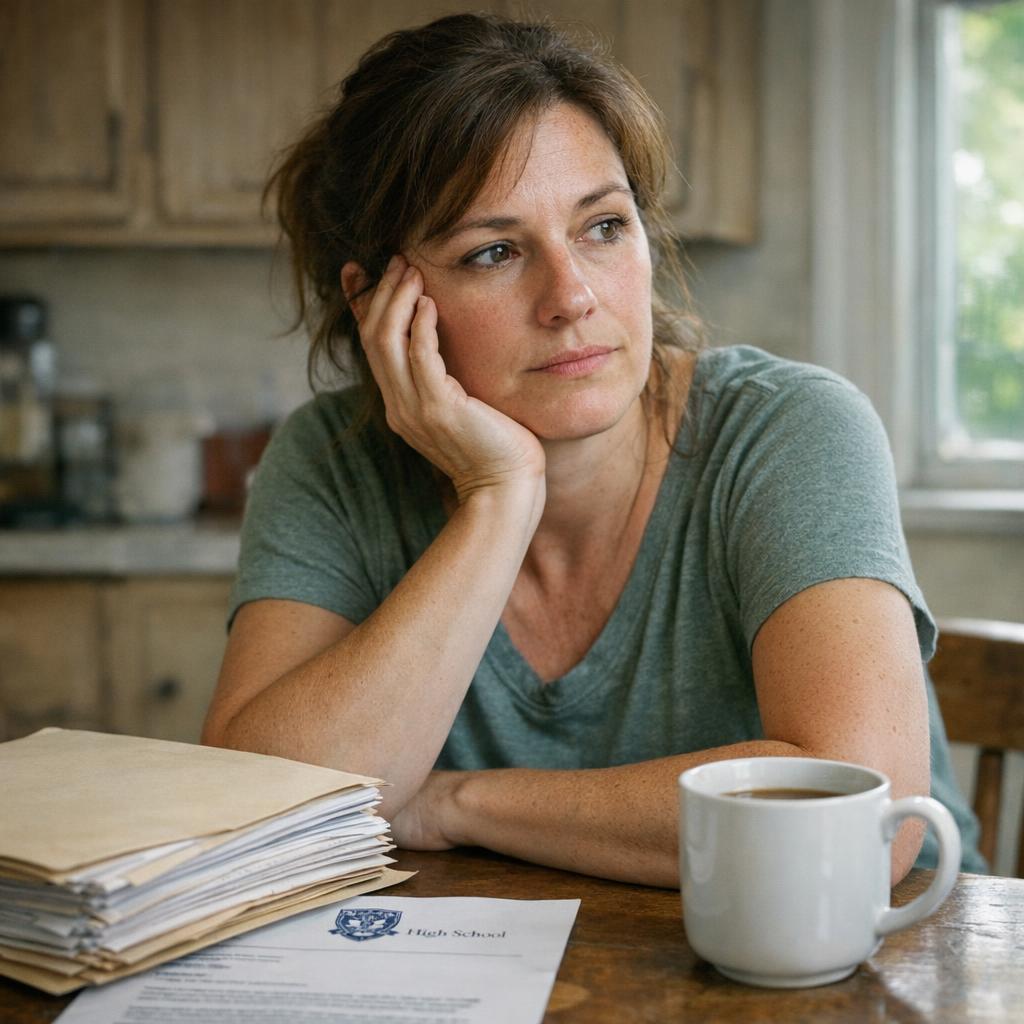 Image by RM AI
The Teacher on Leave
The day after our meeting, I dropped Ava off at school with my heart in my throat. Would there be fallout? Would other teachers look at us differently? But the only thing different was the unfamiliar face greeting students at Ms. Carter's classroom door. The substitute, a gentle-looking woman with salt-and-pepper hair, smiled warmly at Ava, who hesitated only briefly before walking in. The official email arrived in parents' inboxes an hour later: 'Ms. Carter is taking some time away from her classroom duties.' No explanation, no timeline—just administrative speak for 'something's happening we can't legally discuss.' The playground became a hotbed of whispered theories by pickup time. I watched from a distance as Ava stood with a small group of kids, their heads bent together in that conspiratorial way children have when sharing secrets. 'My mom says she did something bad,' I overheard one boy tell her as I approached. My stomach tightened, wondering how Ava would process being at the center of this adult drama she couldn't possibly understand. But my daughter just shrugged, adjusting her backpack straps with a casualness that surprised me. 'I like Ms. Novak better anyway,' she said simply, then spotted me and ran over. That night, as I tucked her in, she asked the question I'd been dreading: 'Mom, did Ms. Carter leave because of me?' I stroked her hair and chose my words carefully. 'No, baby. She left because of her own choices. Adults have to follow rules too, especially when they work with children.' What I didn't say was how those 'rules' existed precisely because people like Ms. Carter sometimes forgot that their classroom wasn't a kingdom where they could pick favorites and punish the rest.
 Image by RM AI
The Child Exhales
The most beautiful transformation wasn't happening in the principal's office or in staff meetings—it was happening at my kitchen table, in the backseat of my car, in the little moments where Ava slowly became herself again. Three weeks after the transfer, I realized I hadn't heard that anxious pencil-chewing sound in days. Her shoulders, which had been perpetually hunched like she was bracing for impact, gradually relaxed back to their natural posture. One morning, I walked into the kitchen to find her so deeply absorbed in a library book that she didn't even notice me standing there, watching her with my coffee mug suspended halfway to my lips. She was just... reading. Not performing reading to please someone, not struggling through it to avoid punishment—just lost in a story because stories are worth getting lost in. Her appetite came back too. Those half-eaten sandwiches I'd been finding in her lunchbox were suddenly coming home as empty containers with crumbs. "Mom," she said one evening while helping me fold laundry, "Ms. Novak says I might be good at the science fair. Do you think I could try?" The hesitant hope in her voice nearly broke me. This was my real daughter emerging from the shell of fear Ms. Carter had built around her—curious, eager, willing to try. It was like watching a flower that had been turning itself into knots suddenly remember which way was up. What Ms. Carter never understood was that she hadn't just been grading papers—she'd been grading a child's sense of possibility.
 Image by RM AI
The Bright Score
Two weeks after Ava's transfer, she burst through the front door clutching a paper to her chest like it contained state secrets. 'Mom! Look!' she exclaimed, thrusting the reading quiz toward me. There at the top was a bright '92%' circled in purple ink, but what made my throat tighten was the note scrawled beneath it: 'Ava, I can see how hard you try.' Such a simple sentence, yet it held the validation my daughter had been starving for. I watched as she carefully placed it on the refrigerator herself, using the strawberry magnet she'd made in first grade. She stood back, admiring it not like a trophy of academic achievement, but like proof of her own worth. 'Ms. Novak says I ask good questions,' she told me, her voice filled with such genuine wonder that I had to turn away to hide my tears. The idea that curiosity could be celebrated rather than punished seemed to be rocking her world. That night, as I was tucking her in, she whispered, 'Mom... I thought I was getting dumb.' The confession hung in the darkness between us, and I gathered her into my arms, feeling how small she still was despite the enormous weight she'd been carrying. 'You have never been dumb,' I told her fiercely. 'Not for one single second.' As she drifted off to sleep, I realized we were witnessing something precious: not just academic recovery, but the slow, delicate process of a child learning to trust herself again after an adult had tried to convince her she wasn't enough.
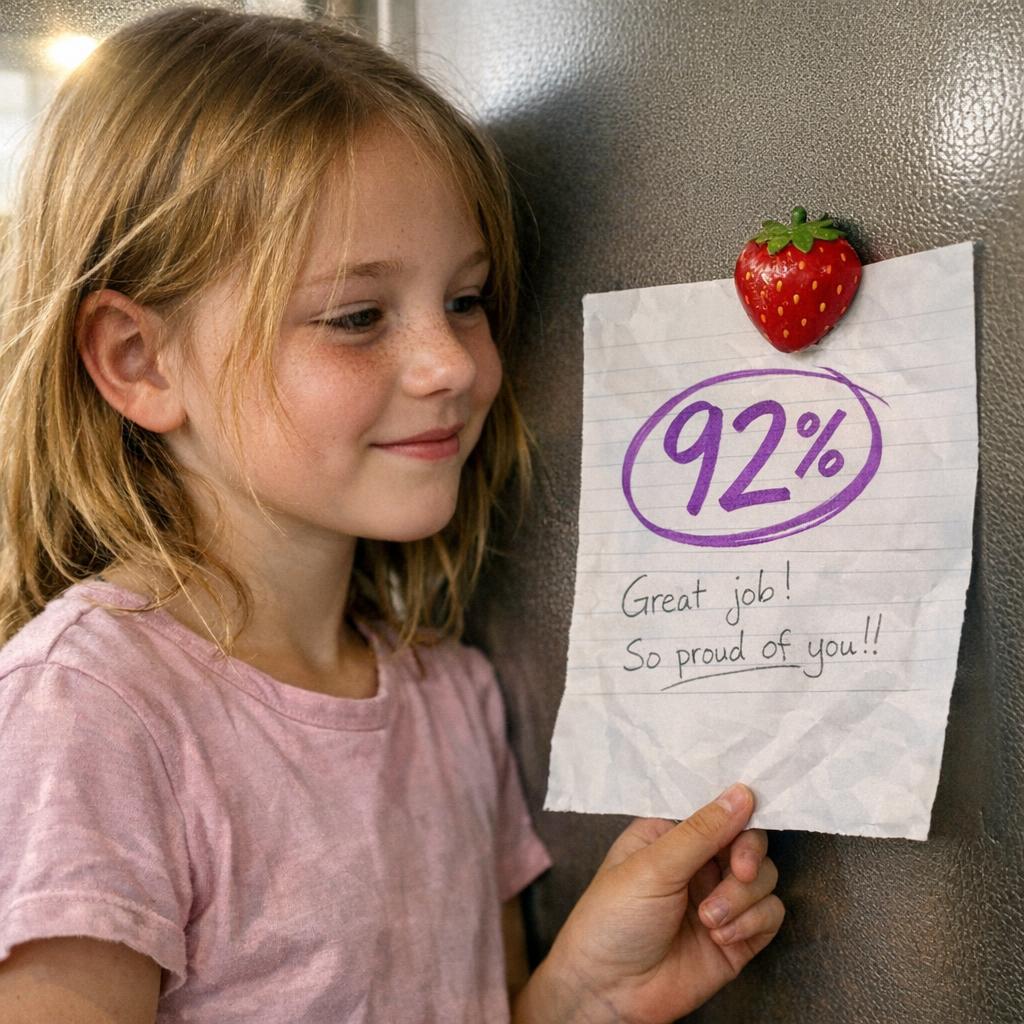 Image by RM AI
The Quiet Confession
That night, after Ava had shown me her quiz with the bright score, we curled up on our worn beige couch—the one with the slight dip in the middle that always pulled us together like gravity. She leaned against me, her small body finally relaxed after weeks of carrying tension no nine-year-old should know. 'Mom,' she whispered, her voice so quiet I almost missed it, 'I thought I was getting dumb.' Five words that shattered my heart into a million pieces. I pulled her closer, feeling her warmth against me, and chose my words carefully. 'Listen to me, Ava. Adults can be wrong. Adults can be unfair. But we don't ever, ever let anyone rewrite who you are.' She nodded against my shoulder, and I felt a dampness that told me she was crying—not the desperate tears from before, but the relieved kind that come when a burden is finally shared. As we sat there in the soft glow of our living room lamp, I couldn't help but wonder how many other children were sitting in classrooms right now, shrinking themselves smaller and smaller, convinced that their struggles were proof of their inadequacy rather than someone else's failure. How many kids went home believing they weren't enough because an adult with an agenda had made them feel that way? The thought made me hold Ava tighter, this fierce, resilient daughter of mine who had weathered a storm she never should have faced. What I didn't tell her—what I couldn't tell her—was that our battle wasn't over yet, not by a long shot.
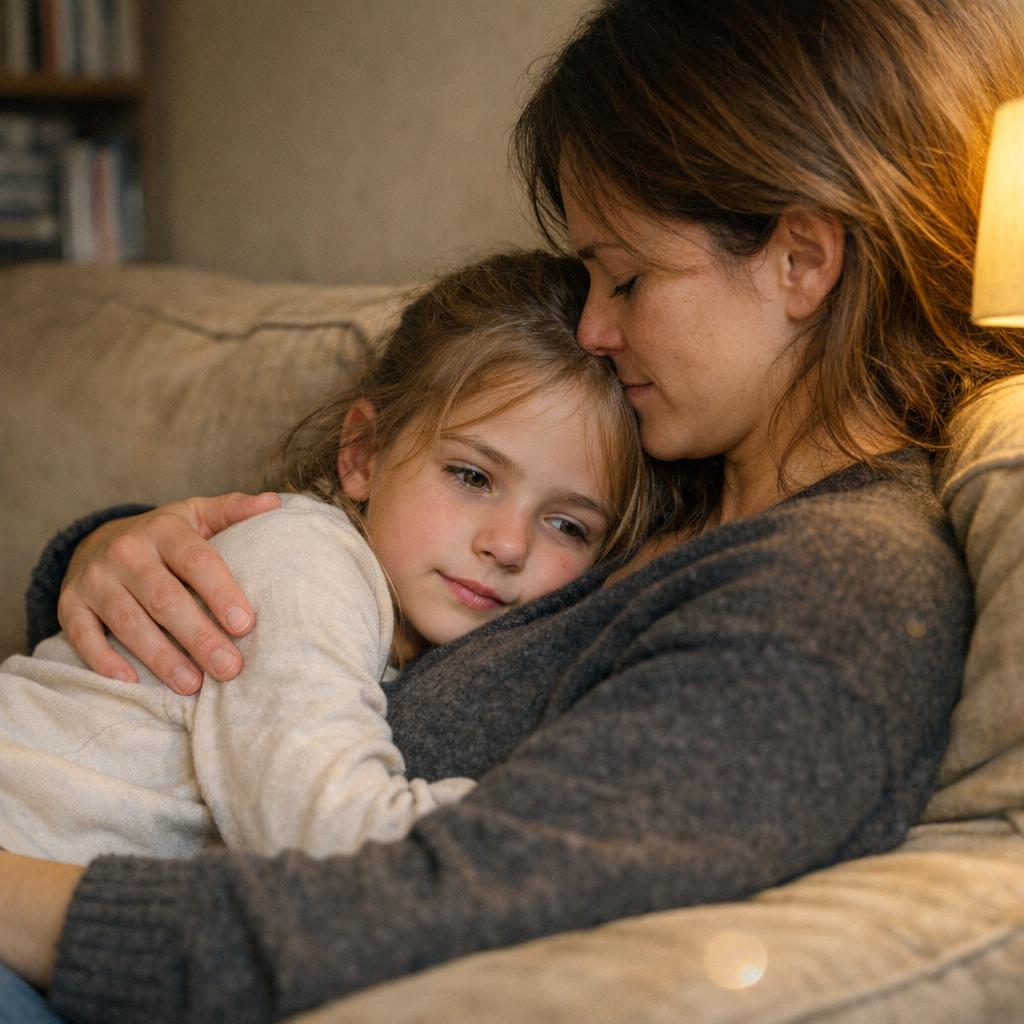 Image by RM AI
The Staff Changes Email
The email arrived on a Tuesday morning, nestled between a PTA fundraiser announcement and a coupon for school photos. 'Dear Oakridge Elementary Families,' it began with that formal tone schools adopt when they're about to say something without really saying it. 'We are writing to inform you of recent staff changes and our renewed commitment to supporting student success.' I almost laughed at the careful wording—how they managed to write three paragraphs about 'fair assessment practices' and 'professional development opportunities' without once mentioning Ms. Carter by name or acknowledging what had actually happened. Between the lines, I read the real message: We fixed the problem you exposed. We're making sure it doesn't happen again. The email mentioned a 'thorough review of classroom placement procedures' and 'enhanced oversight of enrichment program selections'—bureaucratic speak for 'someone was gaming the system and we got caught.' I didn't need them to thank me publicly or acknowledge my role in uncovering what happened. I didn't need my name in lights or a personal apology. What mattered was watching Ava at the kitchen table that evening, humming to herself as she drew a picture of her new classroom, her body relaxed, her smile genuine. I had found that damning paper, I had assembled the evidence, and I had stood my ground when it would have been easier to believe I was just being 'that mom.' Most importantly, I had shown my daughter that she never needed to earn her place by shrinking herself to make room for someone else's ambition. What I didn't realize then was how many other parents were about to reach out to me, their own stories spilling out like water through a broken dam.
 Image by RM AI
The Other Mothers
The ripple effects of what happened with Ms. Carter spread through our parent community like wildfire. My phone started buzzing with text messages and coffee invitations from mothers I'd barely spoken to before. Jenny, whose son Tyler had been having those mysterious stomachaches, called me first. 'He hasn't complained once about going to school this week,' she told me, her voice thick with emotion. 'Not once, Marissa.' Then came Diane, whose daughter Lily had also been transferred to Ms. Novak's class. We met at the little café near the school, and she couldn't even look me in the eye at first. 'I should have said something sooner,' she confessed, stirring her latte absently. 'I thought it was just my kid, you know? I thought maybe she really was too chatty.' I reached across the table and squeezed her hand, because I understood completely—that terrible, nagging self-doubt that makes you question your own instincts, that makes you think the professional must be right and you must be wrong. 'We all did,' I assured her. 'That's how people like Ms. Carter operate—they make you doubt yourself.' One by one, they shared stories that mirrored my own: children who had suddenly 'lost interest' in subjects they once loved, mysterious missing assignments, comments about certain kids not being 'leadership material.' What none of us realized was that we were just seeing the tip of an iceberg that had been growing for years before our children ever set foot in that classroom.
 Image by RM AI
The Playground Encounter
It was a perfect Saturday afternoon when I spotted her—Ms. Carter, standing near the monkey bars at Westside Park, a good twenty minutes from our neighborhood. I'd brought Ava here specifically to avoid school connections, to give her a place where she could just be a kid without history hanging over her. My heart skipped when I saw them: Ms. Carter and her daughter Lila, who looked so much smaller than I'd imagined from all those humble-brags at open house. Our eyes locked across the playground, and for a moment, time seemed to freeze. I instinctively moved closer to Ava, who was thankfully absorbed in the sandbox and hadn't noticed them. Ms. Carter's face did something complicated—a flash of recognition, followed by what might have been shame or defiance, I couldn't tell which. I half-expected her to march over with some rehearsed explanation or accusation. Instead, she quickly gathered Lila's things, whispered something in her ear, and hurried toward the parking lot, her shoulders stiff as boards. As I watched them retreat, I wondered what story she told herself at night—was she the wronged professional in her version? The misunderstood mother just trying to help her child? Or did she ever, even for a moment, recognize the damage she'd done to children who trusted her? What haunted me most wasn't anger anymore, but curiosity about whether people like Ms. Carter ever truly see themselves clearly, or if self-deception is the only way they can live with the choices they've made.
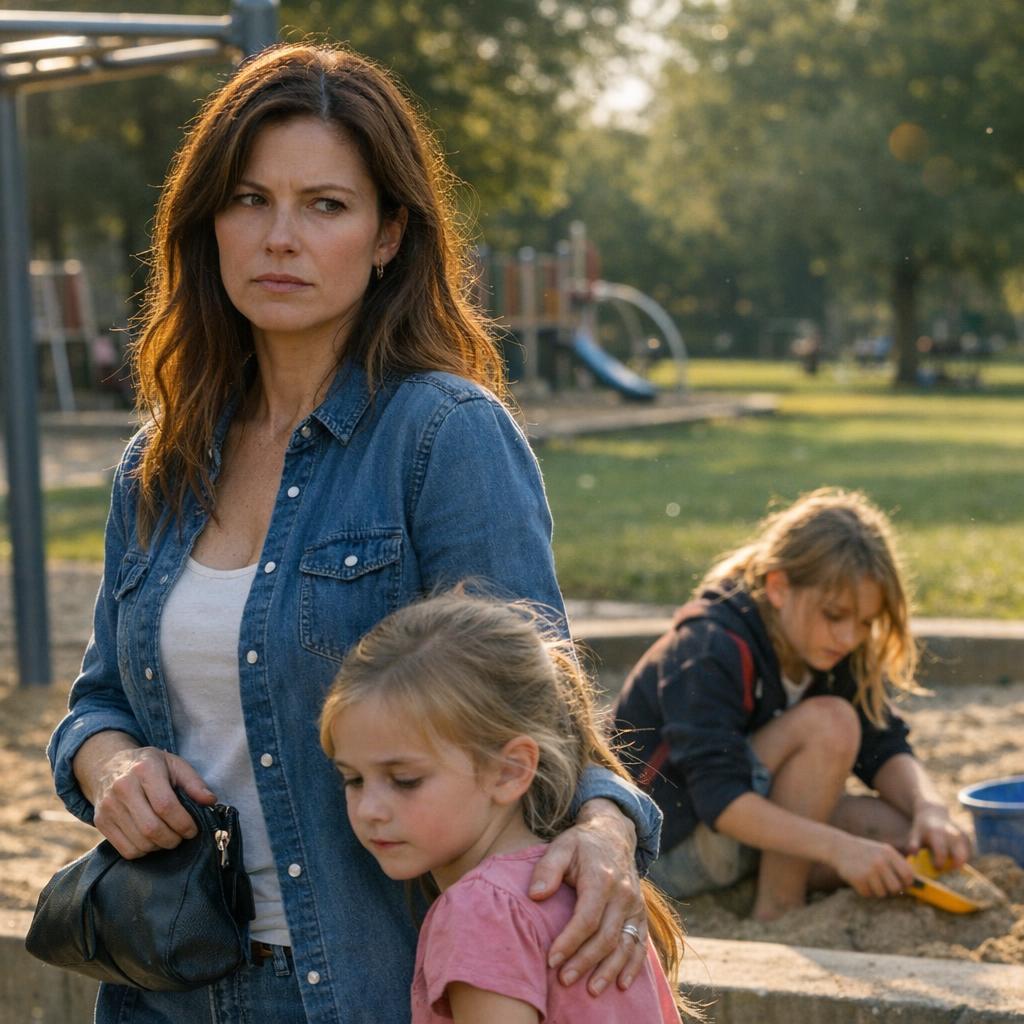 Image by RM AI
The Enrichment Decision
The email arrived on a Tuesday morning, three weeks after the investigation began. 'Accelerated Reading Program Selections' sat bold in the subject line, making my heart skip. I clicked it open, holding my breath as I scrolled to the attached list. There was Ava's name, right between 'Adams, Michael' and 'Benson, Jayden.' But what made me pause was seeing 'Carter, Lila' just a few names down. Both girls had made it. I stared at the screen, processing what this meant. Later that afternoon, my phone rang with an unfamiliar extension—Principal Winters herself. 'Marissa,' she said, her voice carrying that careful blend of professional and personal, 'I wanted to call you directly about the reading program.' She explained the new selection process: blind evaluations, multiple teacher input, and clear rubrics that parents could actually see. 'We want to make sure every child who's ready for a challenge gets the opportunity,' she said. What struck me wasn't what she said, but what she didn't say—no direct acknowledgment of Ms. Carter's manipulation, no apology for what Ava had endured. Just a careful path forward. That evening, I asked Ava how she felt about the reading group. She looked up from her book, eyes bright with something I hadn't seen in months: uncomplicated excitement. 'Ms. Novak says we get to read The Lion, the Witch and the Wardrobe,' she said, bouncing a little on her toes. I smiled, watching my daughter reclaim her joy in learning, even as I wondered what would happen when she eventually had to share a table with Lila Carter.
 Image by RM AI
The First Group Meeting
Tuesday afternoon arrived with a knot in my stomach that rivaled Ava's first day of kindergarten. I sat in my car in the school parking lot, pretending to scroll through emails while actually watching the clock tick toward 3:30. When the time came, I watched my daughter walk into the library for her first accelerated reading group meeting, her paperback copy of 'The Westing Game' clutched against her chest like armor. Her steps were hesitant but determined – the walk of someone who knows they belong somewhere but isn't quite sure of their welcome yet. I couldn't help but wonder if Lila Carter would be there, and what that might mean for Ava. For an hour, I alternated between answering work emails and staring at the school entrance, imagining all the possible scenarios unfolding inside. When Ava finally emerged, I knew immediately that something good had happened. Her face was flushed with the kind of genuine excitement I hadn't seen in months, her eyes bright as she practically bounced into the passenger seat. "Mom! We're reading about kids who solve mysteries! And we get to write our own chapter!" she exclaimed, words tumbling out faster than she could organize them. The irony wasn't lost on me – my little detective, who had been at the center of a mystery herself, now creating stories where children uncover truth. As she chattered about character development and plot twists, I caught a glimpse of something in the rearview mirror: Ms. Carter, standing at the school entrance, watching us drive away with an expression I couldn't quite decipher.
 Image by RM AI
The New Teacher
Ms. Carter never came back to Oakridge Elementary. The official explanation was vague—something about 'pursuing other opportunities'—but the playground whispers told a different story. In her place came Mr. Abadi, a soft-spoken man with salt-and-pepper hair and eyes that crinkled when he smiled. I first met him at the winter open house, where I watched him from across the room, studying how different his teaching style was from Ms. Carter's. Where she had commanded attention, he invited it. Where she had expected perfection, he celebrated progress. Most striking was how he knelt down to meet each child at eye level when they spoke to him, as if their words deserved his complete attention. 'You must be Ava's mom,' he said when we were finally introduced, his handshake warm and firm. 'I've heard wonderful things about her from Ms. Novak. Quite the reader, from what I understand.' The simple acknowledgment of my daughter as a learner with strengths—not a problem to be managed or an obstacle to be removed—felt like cool water after months in the desert. I found myself wondering how different Ava's year might have been if she'd started with someone like Mr. Abadi, someone who saw children as people first and test scores second. As I watched him high-five a student who'd built an impressive volcano model, I couldn't help but notice something else: Lila Carter was thriving in his class, her hand shooting up to answer questions, her smile genuine when he praised her work. It made me wonder if Lila had been as much a victim of her mother's ambition as Ava had been.
 Image by RM AI
The Parent Committee
The email from Principal Winters arrived on a Thursday evening: 'Dear Ms. Thompson, We would like to invite you to join our newly formed Parent Advisory Committee on Educational Equity.' I stared at my phone, wondering if this was the school's way of keeping me close—the squeaky wheel gets the committee invitation. Still, I accepted. The first meeting was held in the school library after hours, eight parents sitting awkwardly around tables meant for children, our adult knees bumping against the undersides. No one mentioned Ms. Carter directly, though her absence hung in the air like a ghost. 'I'm glad we're all here,' Principal Winters began, her professional smile firmly in place. 'Recent events have highlighted areas where we can improve.' Talk about an understatement. As we introduced ourselves, I recognized Jenny and Diane, but there were others I'd never met—a father whose son had ADHD and had been struggling with 'classroom fit' issues, a mother whose daughter was learning English as a second language. Slowly, hesitantly, we began sharing our hopes for our children. Not complaints or accusations, but dreams: fairness, opportunity, teachers who saw potential instead of problems. 'I just want my kid to come home excited about learning again,' the father said, and heads nodded around the table. By our third cup of lukewarm coffee, something had shifted. We weren't just angry parents anymore; we were advocates with a purpose. We drafted a mission statement about transparency in enrichment program selection and classroom placement. We talked about teacher training and parent communication protocols. As I drove home that night, I realized something that sent a chill down my spine: what happened to Ava wasn't just about one teacher with a grudge—it was about a system that had allowed that grudge to weaponize itself against a child.
 Image by RM AI
The Holiday Performance
December arrived with its usual chaos of tinsel and to-do lists, but this year felt different. The winter holiday performance loomed on the calendar, and Ava had been selected for a speaking role—just two lines, but you'd think she was headlining Broadway the way she practiced. Every night before bed, she'd stand in front of her mirror, shoulders back, voice steady: "Even in the darkest winter, we can be the light. Even in the coldest moment, we can bring what's bright." Simple words that took on deeper meaning after everything she'd been through. The night of the performance, I sat wedged between other parents, phone ready to record, heart hammering harder than it should for a third-grade production. When Ava stepped forward from the line of children, I held my breath. She looked so small under those auditorium lights, but her eyes scanned the crowd until she found me. She took a deep breath—the same way I'd taught her when anxiety bubbled up—and delivered her lines without a single stumble, her voice clear and confident. The pride that washed over her face afterward was like sunshine breaking through clouds. As the audience applauded, I caught Ms. Novak's eye across the room. She gave me a thumbs up and mouthed something that looked like "star student." It was such a small thing, this moment of a child succeeding at something that mattered to her, but it felt monumental—like watching a flower that had been trampled somehow stand tall again. What I didn't realize then was that someone else was watching Ava shine that night, someone whose presence would complicate our carefully rebuilt world.
 Image by RM AI
The Unexpected Ally
I was loading the dishwasher when my phone buzzed with a text from a number I hadn't seen in months: 'Marissa, it's Elaine Jensen. Do you have time for a call?' My heart skipped—Ms. Jensen had been Ava's second-grade teacher, the one who'd written those glowing notes about my daughter being 'a joy to have in class.' Twenty minutes later, we were talking, her voice carrying that careful tone teachers use when they're stepping outside professional boundaries. 'I wanted you to know,' she said, lowering her voice like someone might be listening, 'that I recommended Ava for the accelerated program last spring. I was surprised when I heard she was struggling this fall.' She paused, and I could almost see her weighing her next words. 'I'm glad you found out what was really happening.' My hands gripped the phone tighter as the final puzzle piece clicked into place. This wasn't just confirmation—it was vindication from someone who had nothing to gain by speaking up. 'Did you know?' I asked, the question I'd been turning over in my mind for weeks. 'About Ms. Carter's... methods?' Ms. Jensen sighed, the sound of someone who'd carried a burden too long. 'Let's just say this isn't the first time certain students have mysteriously fallen behind in her class.' She didn't elaborate further, but she didn't need to. What I couldn't have known then was that Ms. Jensen's quiet act of solidarity would soon open doors I hadn't even known existed at Oakridge Elementary.
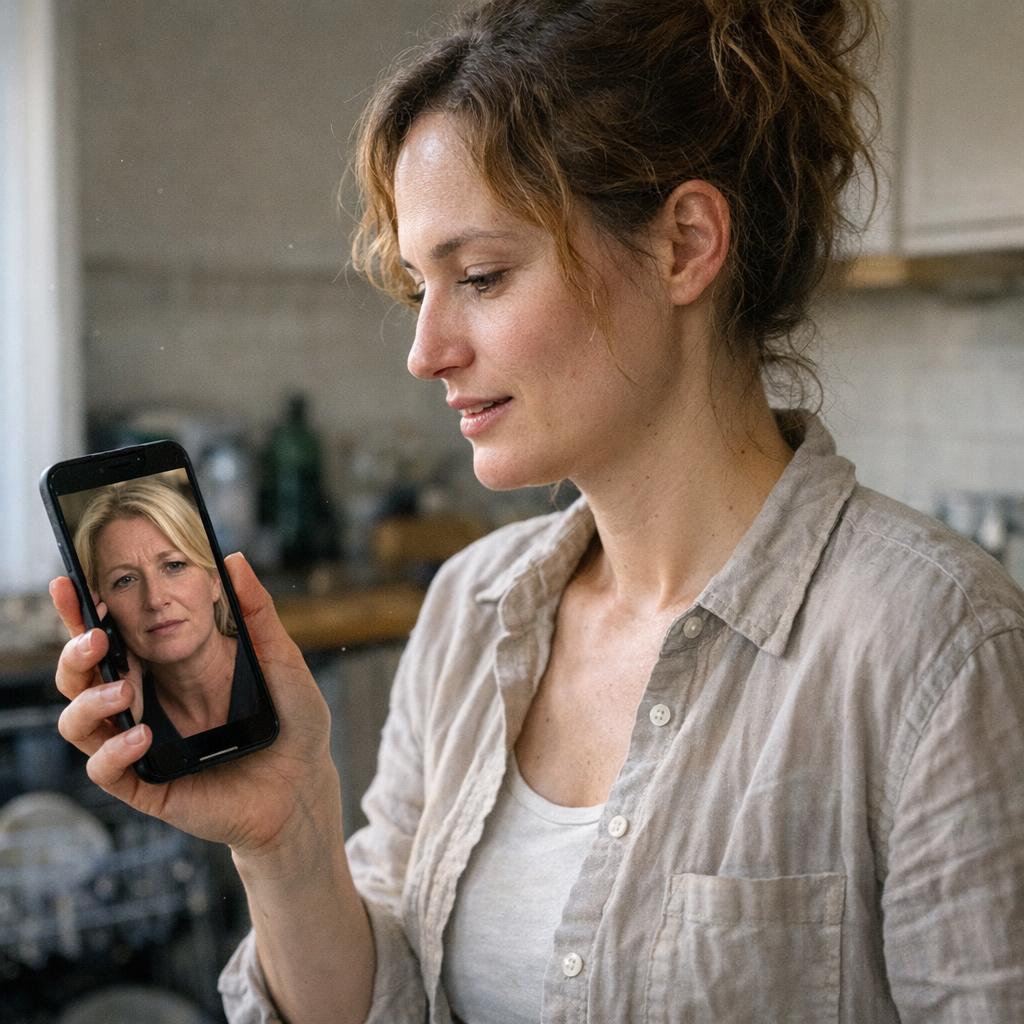 Image by RM AI
The District Response
The manila envelope arrived in my mailbox on a Tuesday, the school district's logo stamped in the corner like an official seal of acknowledgment. Inside was a five-page document titled 'Educational Equity Initiative: Policy Updates for Oakridge School District.' I sat at my kitchen table, coffee growing cold beside me, as I read through what appeared to be standard bureaucratic jargon—until I recognized the real story hidden between the carefully crafted lines. 'Enhanced oversight of student assessment practices,' 'Mandatory peer review of grade modifications,' 'Transparent documentation of enrichment program selection criteria'—each bullet point addressed exactly what had happened to Ava, without ever mentioning her name or mine. There was even a new whistleblower protection clause for parents who reported 'educational concerns.' I ran my finger over that section, remembering how alone I'd felt when I first walked into that principal's office with my folder of evidence. The letter concluded with a parent hotline number and an online portal where we could anonymously report concerns—tools that would have changed everything for us months ago. That night, I showed the letter to my sister over FaceTime. 'They're covering their asses,' she said bluntly. 'Maybe,' I replied, 'but they're also fixing what was broken.' It wasn't justice in the satisfying, movie-ending way I might have once wanted. Ms. Carter wasn't publicly shamed or dramatically fired in front of an assembly. But systems were changing because one teacher had abused her power and one mother had refused to accept it. What I didn't realize then was that this district response was just the beginning—and that the most unexpected part of our story was about to unfold at the upcoming school board meeting.
 Image by RM AI
The Lila Question
I was folding laundry when Ava wandered into the living room, her reading journal clutched against her chest like a shield. 'Mom,' she said, her voice small but steady, 'Lila Carter is in my reading group now. Should I be nice to her?' The question hit me like a sucker punch. Of all the parenting challenges I'd prepared for, navigating the politics of my daughter's relationship with her former teacher's child wasn't on the list. I set down the half-folded t-shirt and patted the couch beside me. 'That's a really good question,' I said, buying myself a moment to find the right words. Ava sat down, legs swinging nervously. I took a deep breath. 'Being kind doesn't mean forgetting what happened. It means remembering that everyone deserves a chance to be more than their mistakes—or their parents' mistakes.' I watched her face as she processed this, her forehead crinkling in that way it does when she's thinking hard. 'So... I don't have to be her best friend?' she asked. I shook my head. 'No, honey. You get to choose your friends. But you don't have to punish Lila for what her mom did.' Ava nodded slowly, then surprised me with her next words: 'She's actually pretty good at finding clues in the stories.' There was a hint of reluctant admiration in her voice that made me wonder if these two girls—both caught in a storm created by adults—might somehow find their way to something like understanding. What I didn't realize then was that Lila Carter would soon become much more than just a classmate in Ava's reading group.
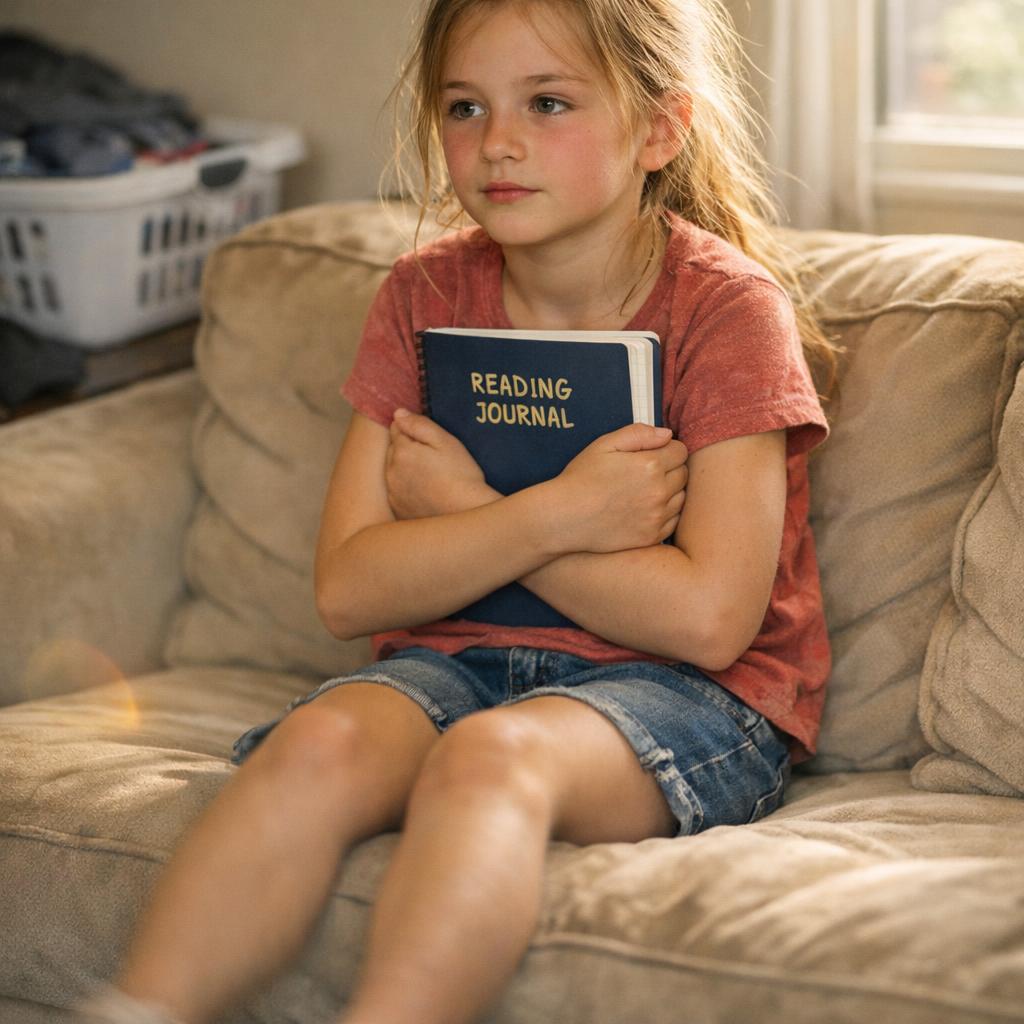 Image by RM AI
The Spring Conference
I sat across from Ms. Novak at the spring parent-teacher conference, my heart in my throat as she carefully arranged Ava's work across her desk. 'I want to show you something remarkable, Marissa,' she said, her eyes warm with genuine pride. She laid out three writing samples side by side – September, December, and March – creating what looked like a timeline of my daughter's spirit returning. 'Look at this progression,' she said, her finger tracing the evolution from hesitant, sparse sentences to rich, confident paragraphs. 'This is a child finding her voice again.' I leaned forward, blinking back unexpected tears as I read Ava's latest story about a girl who discovers a magical library where books whisper their secrets to readers who listen carefully. The metaphor wasn't lost on me – my daughter, learning to trust her own voice again, to believe that what she had to say mattered. 'She's processing what happened,' Ms. Novak said quietly, meeting my eyes with understanding. 'Children often do that through stories.' I nodded, unable to speak past the lump in my throat. This wasn't just academic progress – it was emotional healing captured in pencil marks and eraser smudges. As I gathered the papers to take home, Ms. Novak hesitated before adding, 'There's something else you should know about Ava and Lila – something that happened in reading group last week that I think you'll want to hear.'
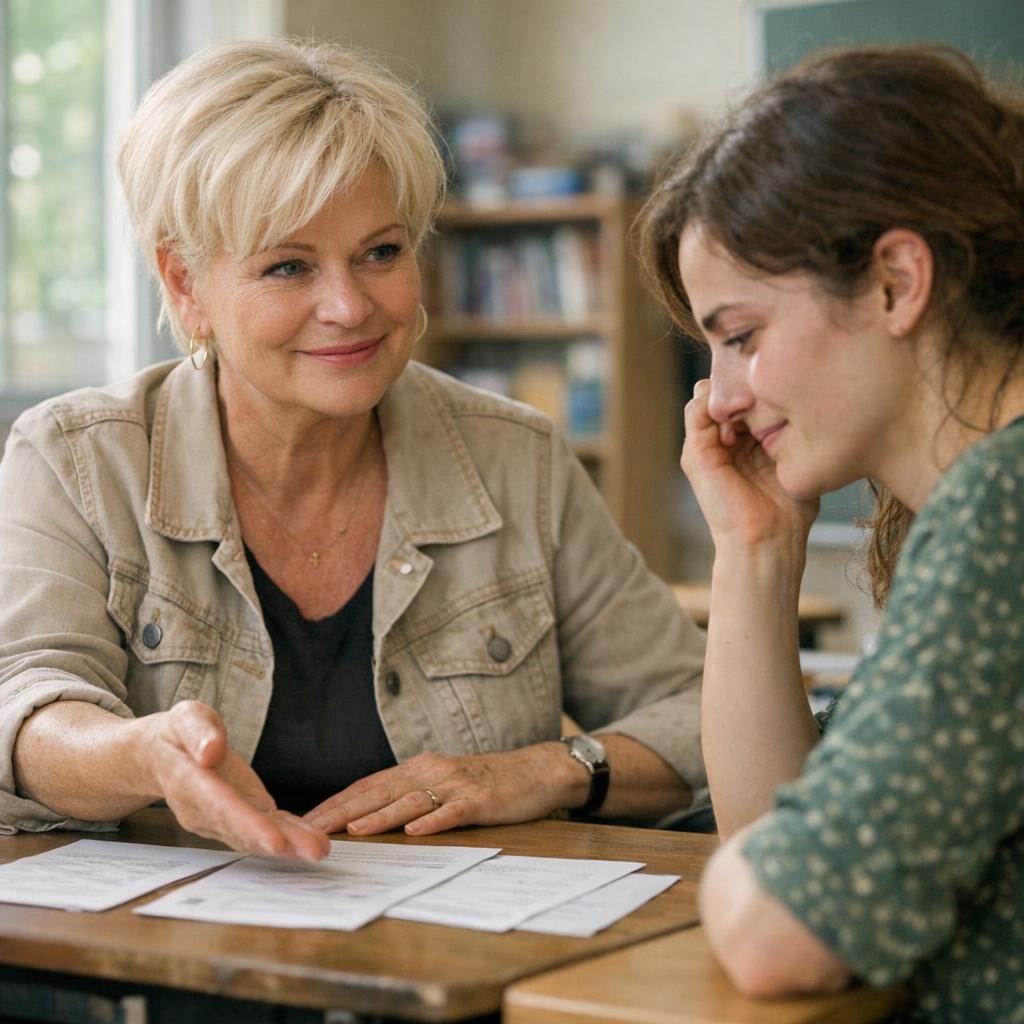 Image by RM AI
The Mothers' Group
What started as a formal committee with agendas and minutes transformed into something far more powerful—a circle of parents who'd found their voices together. Every third Thursday, we'd claim the corner table at Perks Coffee House, laptops and school folders scattered between our lattes and muffins. 'The Advocates,' we jokingly called ourselves, though there was nothing funny about the changes we were making. 'I questioned my son's new teacher three times about a grade last week,' Jenny announced during our April meeting, a hint of pride coloring her voice. 'I never would have done that before.' Diane nodded vigorously, her silver hoop earrings catching the light. 'I used to think advocating meant being difficult. Now I know it means being present.' I watched these parents—once strangers united only by our children's school—become a force that administrators now recognized by name. We shared templates for emails requesting accommodations, practiced difficult conversations with each other before having them with teachers, and celebrated when someone's child finally got the support they needed. The most surprising part wasn't how much we'd changed the school; it was how much we'd changed ourselves. I thought about Ava, who now walked into school with her shoulders back, and realized she'd learned that from watching me stand up for her. What none of us realized that evening, as we clinked our coffee mugs in a mock toast to 'parental persistence,' was that our little group was about to face its biggest test yet—and it would come from the last person any of us expected.
 Image by RM AI
The Science Fair
The science fair announcement came home in Ava's folder on a Thursday, and I watched her face carefully for any sign of anxiety. Six months ago, she would have immediately said she couldn't do it, that she wasn't smart enough. Instead, she studied the paper with thoughtful concentration. "I want to see if plants grow better with different kinds of music," she announced at dinner that night. "Ms. Novak says it's called a controlled experiment." Over the next three weeks, our kitchen windowsill transformed into a miniature laboratory—six identical bean plants, each labeled in Ava's careful handwriting: Classical, Rock, Country, No Music, Talking, and Silence. Every day after school, she'd measure each sprout with a ruler, recording growth in a chart she'd created herself. When two plants wilted unexpectedly, I braced for tears. Instead, Ava frowned, consulted her notebook, and realized she'd been overwatering. "That's okay," she said, surprising me. "Scientists have to fix their mistakes too." The night before the fair, as we arranged her display board on the dining room table, I realized how far she'd come. This wasn't just about bean plants—it was about a little girl who'd learned to trust herself again. When her project won honorable mention, the pride on her face wasn't about the blue ribbon. It was the quiet confidence of someone who knew she'd earned every millimeter of growth, fair and square. What I couldn't have known then was that someone else had been watching Ava's transformation too—someone whose unexpected appearance at the awards ceremony would throw our carefully rebuilt world into chaos once again.
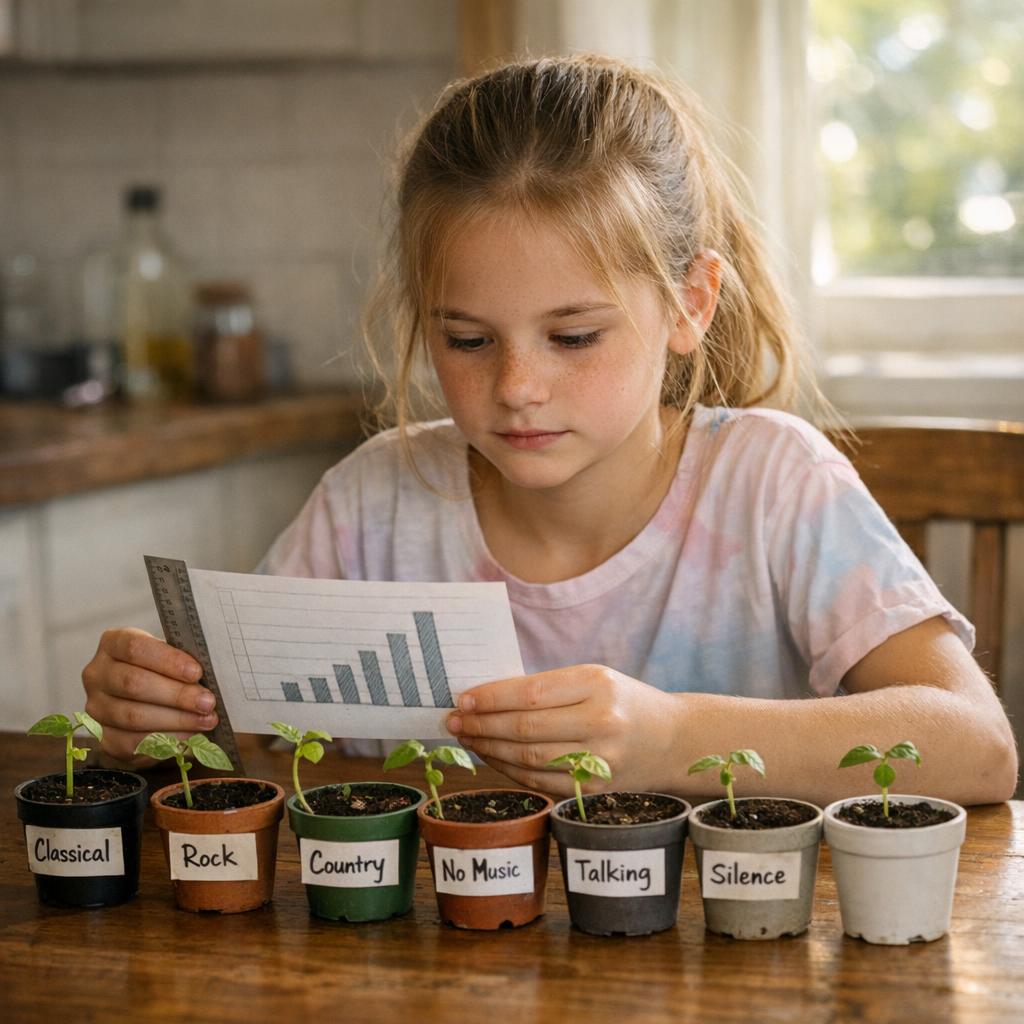 Image by RM AI
The Board Meeting
The school board meeting room was packed tighter than a Black Friday sale, fluorescent lights humming overhead as I waited my turn at the microphone. My hands trembled slightly as I smoothed my notecards—not from fear, but from the weight of what I was about to do. When they called my name, I walked to the podium, feeling the eyes of administrators and parents alike. 'I'm here to talk about transparency,' I began, my voice steadier than I expected. 'About how easily a child's light can be dimmed when adult agendas take priority over student needs.' I didn't mention Ms. Carter or Ava by name—I didn't need to. The slight shift in Principal Winters' posture told me she knew exactly what case had inspired my three-minute speech. I spoke about merit mattering more than connections, about how systems fail when they protect power instead of potential. When my time ended, the room felt different somehow, like the air itself had changed density. Afterward, as parents clustered in small groups, an older gentleman with silver hair and kind eyes approached me. 'Thirty-eight years in the classroom,' he said, extending his hand. 'And I've seen this story play out more times than I care to count.' He smiled, the wrinkles around his eyes deepening. 'It takes one parent willing to rock the boat to make things better for all the children in the water.' His words settled over me like a warm blanket, but as I drove home that night, I couldn't shake the feeling that something else had happened in that meeting room—something I wouldn't understand until the following morning when my phone rang with a call from a number I never expected to see again.
 Image by RM AI
The End-of-Year Party
The end-of-year party buzzed with the chaotic energy of children ready for summer freedom. I leaned against the wall, punch cup in hand, watching Ava move through the classroom with an ease that made my heart swell. This was the same girl who, months ago, had shrunk into herself like a turtle retreating into its shell. Now she laughed with her friends, helped a kindergartner reach the cupcakes, and presented Ms. Novak with a handmade card that had taken three evenings to perfect. "Thank you for seeing me," she'd written inside—simple words that carried the weight of our entire year. As I scanned the room, my eyes landed on Lila Carter standing alone by the snack table, methodically arranging cookies on her plate. No sign of Ms. Carter anywhere. I watched, holding my breath, as Ava noticed her too. There was a moment—brief but unmistakable—when my daughter hesitated, her shoulders tensing slightly. Then, something shifted in her expression. She walked over to Lila and said something that made the other girl's face light up with surprise. Together, they filled their plates with cookies, giggling over some shared joke. It was a moment of grace I'm not sure I could have managed in her place—this child of mine, extending kindness to the daughter of the woman who had tried to dim her light. What Ava couldn't know was that this small act of compassion would set in motion events that would change both families forever.
 Image by RM AI
The Summer Reading List
The summer reading list came home on the last day of school, tucked neatly into Ava's folder alongside a note about the accelerated program continuing in fourth grade. My heart did a little dance as I watched her spread the books across our kitchen table, her fingers tracing the covers with genuine excitement. This wasn't the same girl who'd come home in September with hunched shoulders and fear in her eyes. 'Mom, look! Ms. Novak says I can read ahead if I want to,' she announced, already reaching for the first title – a fantasy novel about a girl who discovers she can talk to books. I remembered those awful days when worksheets would 'disappear' and quizzes would come back with suspicious red marks, when my bright, curious daughter had whispered 'I'm trying, Mom' with tears threatening to spill. Now here she was, practically vibrating with anticipation over summer reading. 'Which one are you starting with?' I asked, sliding into the chair beside her. 'This one,' she said, holding up a book with a tree house on the cover. 'Lila read it last year and said it has a really good twist at the end.' I tried not to react to Lila's name – still strange to hear it spoken with something like friendship after everything that had happened with Ms. Carter. As Ava flipped through the pages, already lost in the possibility of new worlds, I couldn't help wondering if Ms. Carter knew that our daughters had somehow found their way to friendship despite everything she'd done to keep them apart.
 Image by RM AI
The Unexpected Letter
The manila envelope arrived on a sweltering July afternoon, the school district's official seal stamped in the corner like some kind of government decree. I almost tossed it aside with the bills and grocery flyers, assuming it was just more paperwork for next year's registration. But something made me open it right there at the kitchen counter, my iced coffee leaving a ring on the granite as I pulled out a single-page letter on heavy letterhead. My hands started trembling as I read the carefully crafted sentences acknowledging 'unprofessional conduct by a former employee' that had 'negatively impacted' my child. The language was stiff and formal, clearly vetted by an army of attorneys, but between those sanitized lines was something I never thought I'd see: validation. They couldn't dismiss what happened as a mother's overreaction or a simple misunderstanding. The truth had been documented, investigated, and made official. I read it three times, each reading revealing something new in what they weren't saying directly. No names were mentioned—not Ava's, not mine, certainly not Ms. Carter's—but we all knew. I folded the letter carefully and tucked it into my desk drawer, not sure if I would ever show it to Ava but somehow comforted by its existence. It was proof that sometimes the system actually works, that sometimes speaking up changes things. What I couldn't have known then was that this wouldn't be the last official communication I'd receive about Ms. Carter—or that the next one would come from a source I never expected.
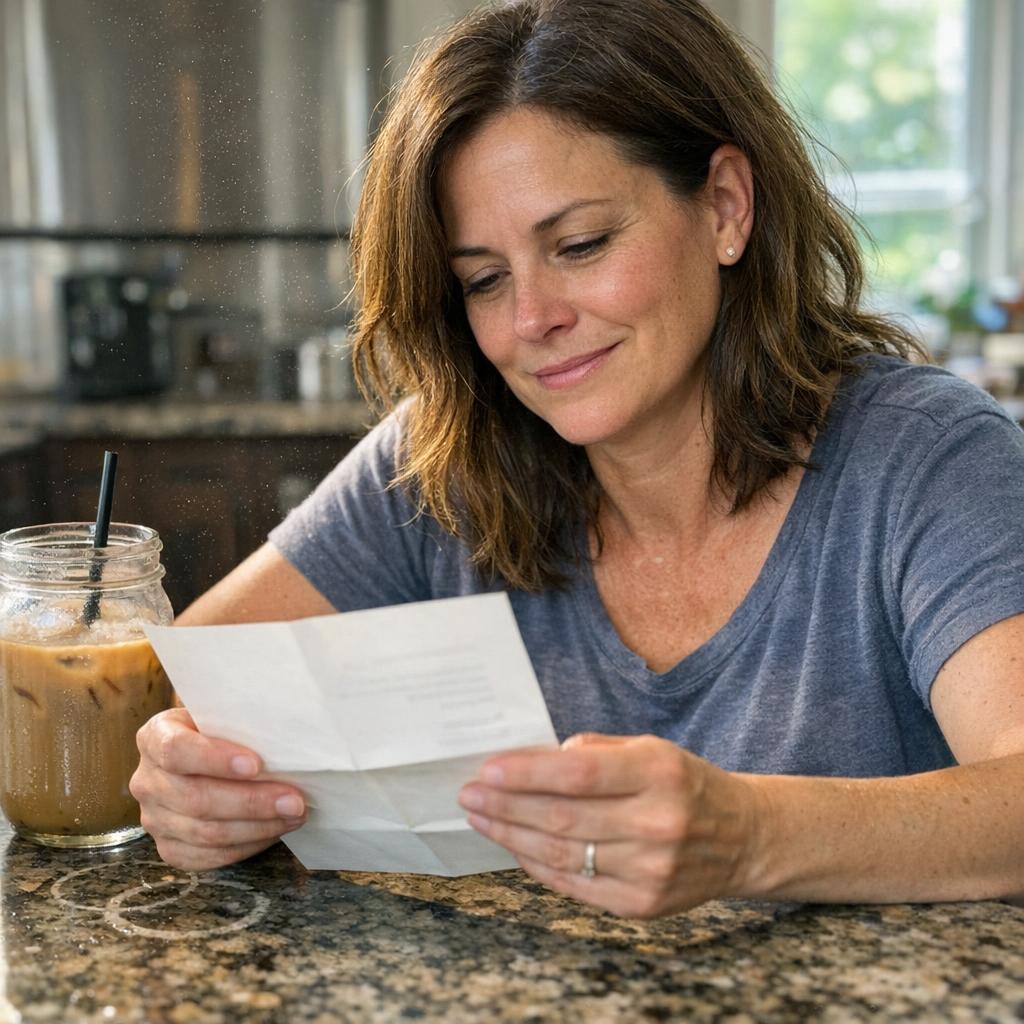 Image by RM AI
The Beach Day
August sunshine beat down on my shoulders as I watched Ava race toward the ocean, her footprints disappearing in the wet sand behind her. 'Watch me, Mom!' she called, her voice carrying over the crash of waves. Without hesitation—that same hesitation that had plagued her all year in Ms. Carter's class—she dove under an incoming wave and popped up on the other side, arms raised in victory. I couldn't help but smile, remembering the girl who once whispered 'I'm trying, Mom' with tears in her eyes. That girl was gone now, replaced by this confident nine-year-old who faced the ocean like she faced life: head-on. As I watched her navigate the water, I thought about all the metaphorical waves she'd survived this past year—the undertow of Ms. Carter's manipulation, the rip current of a system that almost failed her, the crushing pressure of feeling 'unsuitable.' She'd learned to swim through it all, not because she was naturally buoyant, but because someone had noticed she was drowning and reached out a hand. That someone had been me, armed with nothing but maternal instinct and a folder of evidence. 'Mom! Come in!' Ava shouted, waving frantically as another wave approached. I set down my book and walked toward the water's edge, feeling the cool foam tickle my toes. As I waded in to join my daughter, I had no idea that tomorrow morning would bring a text message that would connect our summer idyll to the storm we thought we'd left behind.
 Image by RM AI
The Night Before Fourth Grade
The night before fourth grade, I watched Ava meticulously lay out her clothes with the precision of a tiny fashion stylist. Not the coordinated outfit I would have chosen—striped leggings in purple and teal, a t-shirt with the periodic table splashed across it, and those ridiculous mismatched socks she swore were 'lucky' (one covered in stars, the other in dinosaurs). But this wasn't about my taste; it was about her reclaiming her confidence piece by mismatched piece. As I tucked her in that night, smoothing her hair away from her forehead, she looked up at me with those big eyes that had seen too much disappointment for a nine-year-old. "Do you think my new teacher will like me?" she asked. The question hung between us, carrying echoes of last year's trauma, but something was different—her voice held curiosity rather than dread. I sat on the edge of her bed, choosing my words carefully. "I think Mrs. Henderson will appreciate exactly who you are," I said, squeezing her hand. "And if she doesn't see that right away, we'll make sure she gets the chance to learn." Ava nodded, seeming satisfied with my answer. "I'm going to try really hard this year," she whispered, and my heart cracked a little because she'd never stopped trying, even when the deck was stacked against her. "Just be you," I told her. "That's always enough." What I didn't tell her was that I'd already emailed Mrs. Henderson a carefully worded note—not to poison the well, but to ensure history wouldn't repeat itself. What I couldn't have known then was that Mrs. Henderson had already heard about us, and not from the source I would have expected.
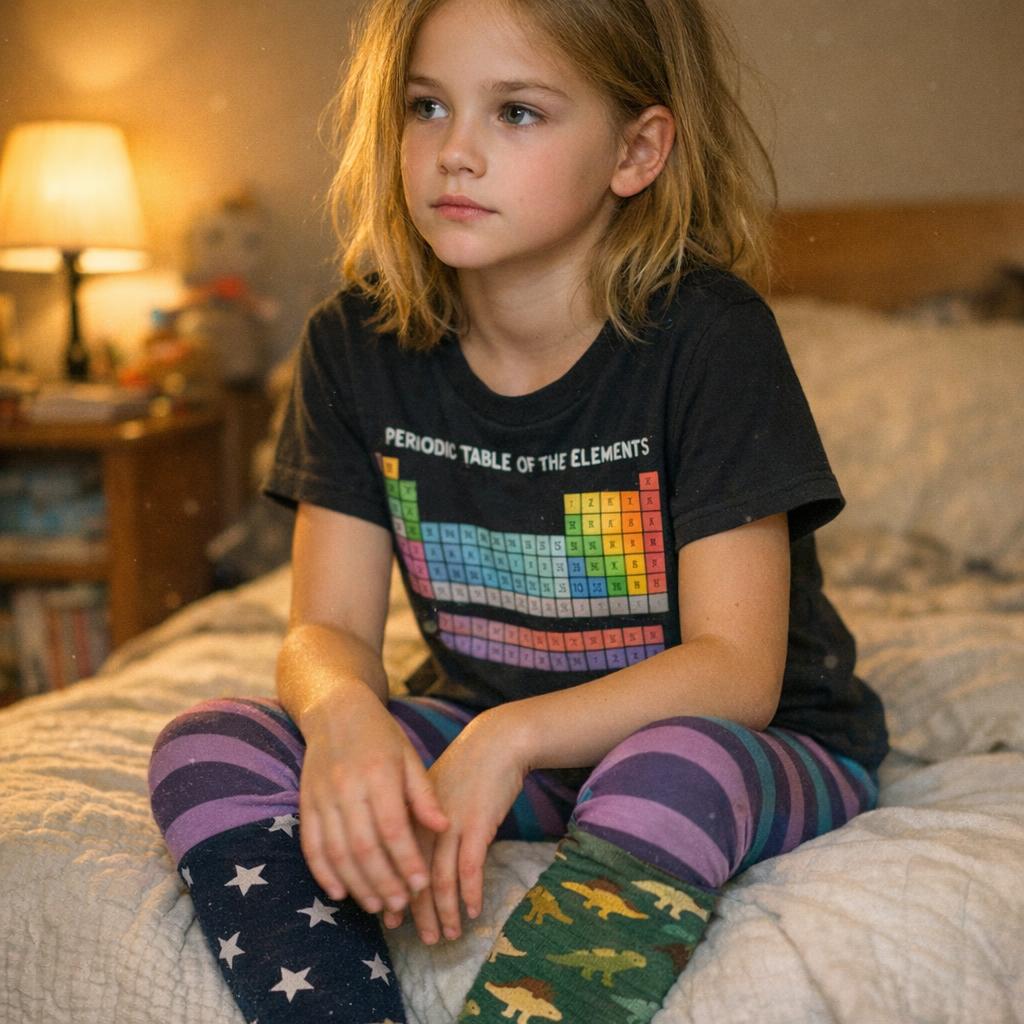 Image by RM AI
The Paper That Changed Everything
Sometimes I find myself staring at that folded paper—the one that changed everything—tucked away in my desk drawer like a battle scar. I run my fingers over the creases and think about how easily it might have stayed hidden in Ava's backpack, buried under apple cores and crumpled worksheets. How different our lives would be if I hadn't opened that pocket that night. I think about all the other children sitting in classrooms right now, their potential being quietly erased by red pens wielded with ulterior motives, their parents believing the problem lies with their child rather than the system. Being a mom isn't just about labeled lunch containers and warm cookies after school—sometimes it's about standing in an office with shaking hands, holding up evidence of injustice and refusing to back down even when your voice cracks. Sometimes it's about teaching your child that they matter by showing them you'll fight for them when they can't fight for themselves. Ava may not remember every painful detail of third grade as she grows older, but watching her confidently pack her backpack for fourth grade, I know she carries something more valuable than perfect grades: the unshakable knowledge that she never, ever has to earn her place by shrinking. What I didn't realize then was that finding that paper wouldn't just change Ava's story—it would change an entire school.
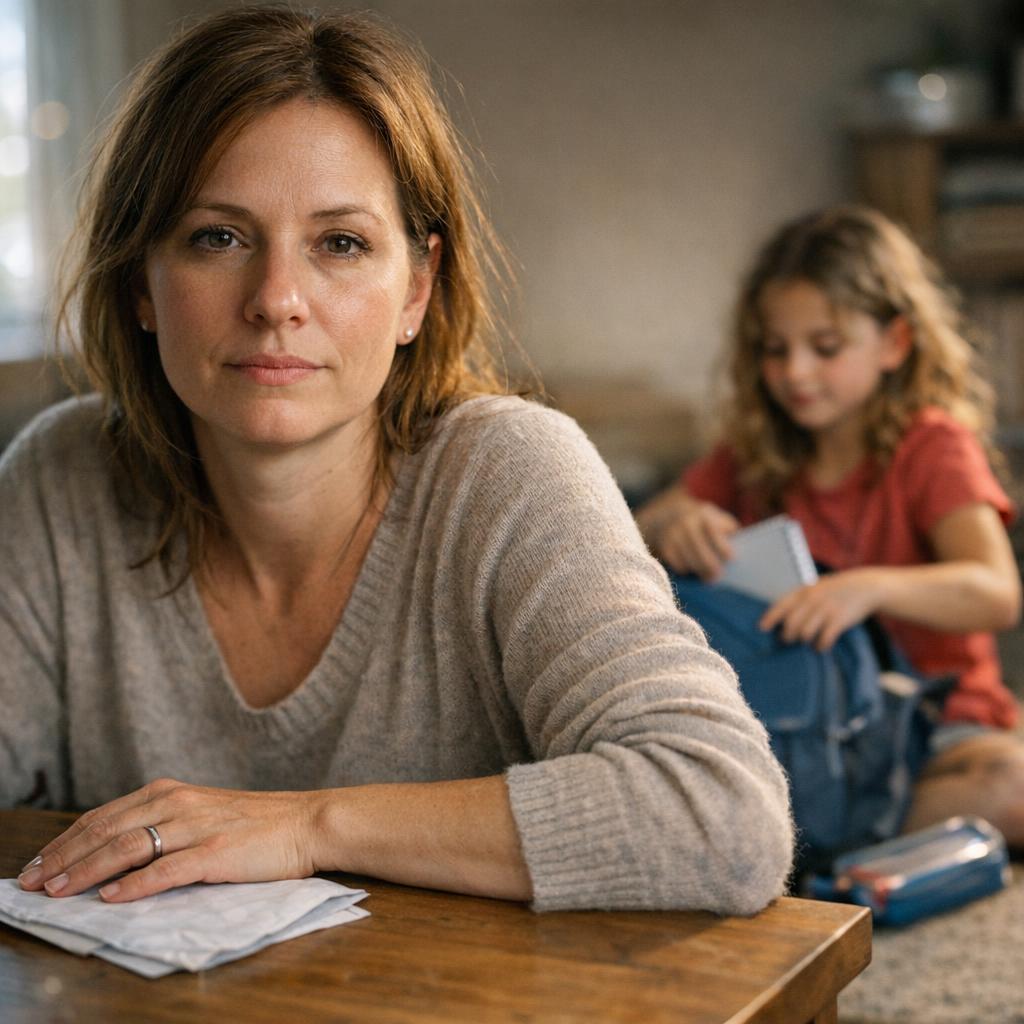 Image by RM AI