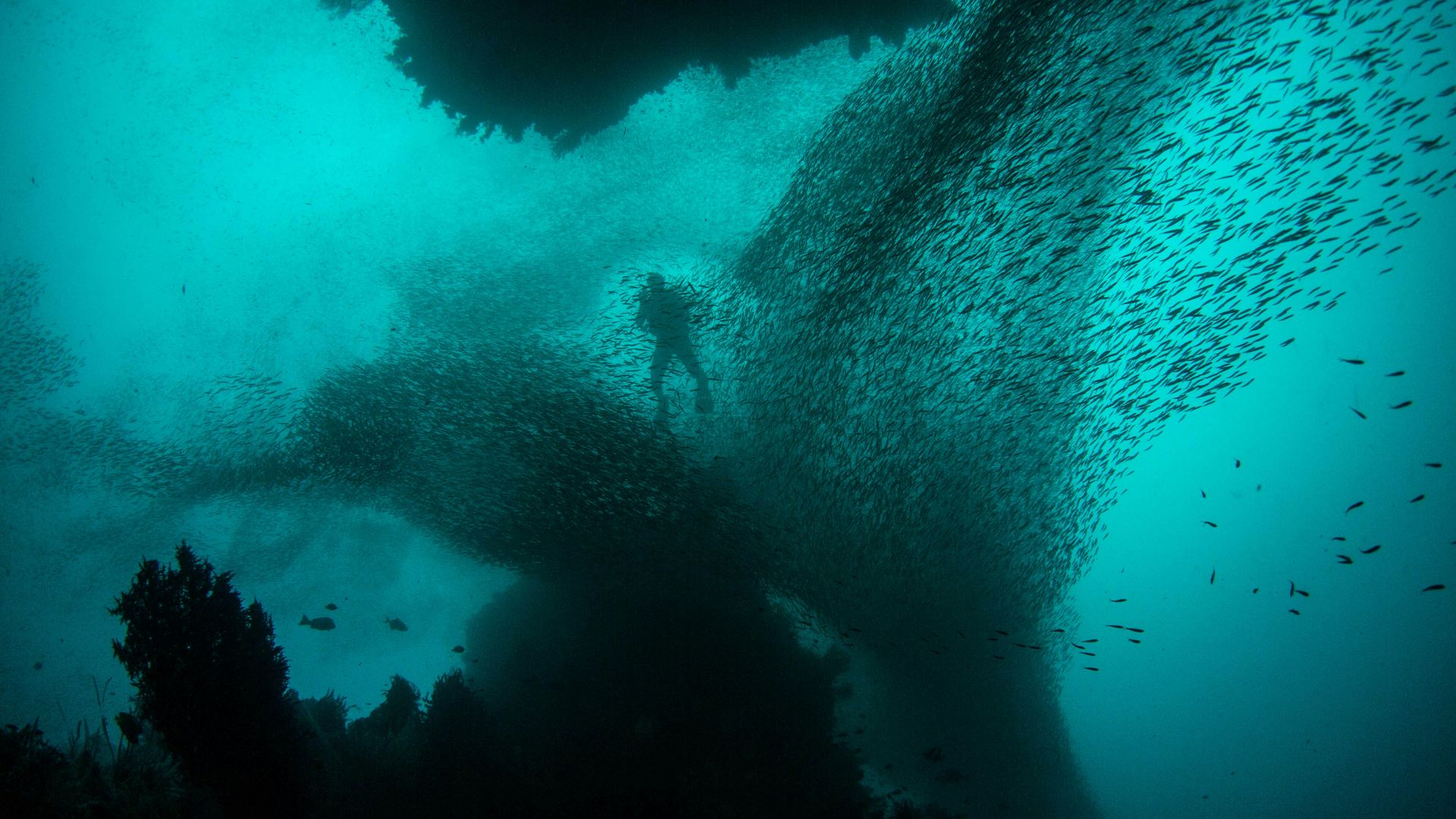
The Pacific Ocean seems endless when you stare out at its blue expanse shimmering in the sunlight. It’s hard to imagine that right beneath your feet there are miles of ocean going down into the Earth’s crust. Oddly enough, most unexplored territory on our planet isn’t outer space: it’s the crescent shaped scar on the Earth known as the Mariana Trench. Stretching over 70,000 feet below sea level, the Mariana Trench is a barely explored alien world just off the coast of Japan. With crushing pressures and complete darkness below, life as we know it is truly tested in the deepest parts of our planet. Join us down in the trenches as we meet some of its bizarre inhabitants.
Descending to the bottom of this canyon isn’t simple. The pressure at the bottom is like having an elephant sitting on your thumb. Few brave souls have made the journey to Challenger Deep, the deepest area of the trench. Along with robotic submarines, only twelve people have ever made it to the bottom and have seen what lies there. You might expect a barren landscape but this is one unexpectedly busy place. Grab your helmet and venture down below to meet these freaky bottom dwellers and underwater monsters.
Survivors of the Crushing Pressure
Lifeforms in the Hadal Zone have developed extreme adaptations just to prevent their bodies from being crushed. Many species are missing swim bladders that fish living in less pressurized environments have, as their swim bladder would be crushed by the pressure. Look! There’s a Mariana snailfish floating right before your very eyes! It’s see-through and fragile-looking, yet it exists miles underwater where most ship’s hulls would give in to pressure. It’s boneless because its skeleton is made out of cartilage instead of calcium.
Lifeforms tend to look translucent and otherworldly down there because there’s no reason for them to produce pigment or have stealth coloring in the eternal darkness of pitch black water. Observe how many of them are blind as well, having evolved to use sensitive hairs and feel for vibrations in the water to sense prey. Food is so rare down there that the predators have giant mouths and expandable stomachs in order to consume anything that falls into their mouths. They’re a walking sponge, living just barely.
You’ll even find their cell membranes contain large amounts of unsaturated fat in order to allow for more pliability under such pressure. If you were to take a fish from the bottom of the sea to surface pressure, their body would swell up from decompression and they would die. Creatures in the hadal zone are bound to the deep, because any place with less pressure would end them instantly. Awesome right? Nature finds a way.
The Weird World of Xenophyophores
Maybe you'd find something else weird and wonderful if you were scuttling along the trench floor. Maybe you'd find a xenophyophore. Xenophyophores resemble crumpled-up sponges or balls of yarn. In reality, they're enormous single-celled amoebas that reach sizes up to four inches in diameter. They capture sediment in the mud and become host to microscopic organisms that live inside them. Unlike other surface animals, these bizarre organisms flourish in ooze rich with minerals.
Xenophylophores are capable of recycling heavy metals such as lead and mercury through their outsized cells. As such, they act like sieves for other minerals, purifying the water around them. They're also organisms that scientists study to learn about the most basic, bare-minimum forms of successful life on Earth. There's no brain. There's no centralized collection of organs keeping the animal alive. Simply, one huge container of protoplasm creeping across the sea floor.
Despite their plain appearance, they're evidence that being big doesn't mean an animal is complicated. Xenophylophores have been on this planet for millions of years, largely unchanged. They sit in silence and watch the world change around them. Think of them every time you gaze out into the trench and don't see anything eating. They're the creatures that really matter.
Geological Wonders and Liquid Carbon Dioxide
Living things aside, there are plenty of geological oddities to be found at the bottom of the trench as well. Remember: this is a subduction zone, where Earth's tectonic plates grind against each other and one slides beneath. You'll find fault lines which heat up rocks and seawater, causing a chemical reaction that results in pools of hot mineral water bursting forth from hydrothermal vents, otherwise known as "black smokers." Oddly enough these vents actually support colonies of sea life surrounding their unusual waterfalls. Again: no sunlight down there. Their ecosystems are supported by an underwater food chain completely separate from the process of photosynthesis.
Elsewhere on the trench floor, cold temperatures combined with extreme water pressure create pools of liquid carbon dioxide that bubble across the ground like oily puddles. This rare geological occurrence is called a "white smoker." Between supporting fictional work on alien planets and the bottom of the Mariana Trench, Earth rarely beats its own geography. Minerals reacting under immense water pressure result in hydrogen and methane which bacteria then convert into usable energy. It's essentially dinosaurs living off the super-heated leftovers of Earth's molten center.